Comparison

Saddleback Clownfish vs Orange Clownfish

Saddleback Clownfish (Amphiprion polymnus) and Orange Clownfish (Amphiprion percula) both belong to the genus Amphiprion (clownfish) and part ways below it. Both are recorded in 10 countries.

Saddleback Clownfish

Saddleback Clownfish

Amphiprion polymnus

Jens Petersen, CC BY-SA 3.0, via Wikimedia Commons

Orange Clownfish

Orange Clownfish

Amphiprion percula

CrisisRose, CC BY-SA 3.0, via Wikimedia Commons

Side by side

Saddleback ClownfishOrange Clownfish
Scientific nameAmphiprion polymnus (Linnaeus, 1758)Amphiprion percula (Lacepède, 1802)
English nameSaddleback ClownfishOrange Clownfish
GroupFishesFishes
ClassTeleostei TeleostTeleostei Teleost
OrderPerciformesPerciformes
FamilyPomacentridae DamselfishesPomacentridae Damselfishes
GenusAmphiprion ClownfishAmphiprion Clownfish
Named in17581802
Red List categoryLeast ConcernLeast Concern
Environmentmarinemarine
Countries on record13 countries13 countries
GBIF occurrence records702 records835 records

Rows where the two agree are shown in grey.

Where each is found

Both recorded in 10 countries

Only Saddleback Clownfish (3)

Only Orange Clownfish (3)

From Catalogue of Life checklists and GBIF occurrence records. A country missing from a list means no record is held, which is not proof of absence.

Checked facts

Saddleback ClownfishOrange Clownfish
Appearance
  • Its body is oval-shaped, laterally compressed, stocky, and has a rounded profile. English Wikipedia
  • Its body coloration varies from dark brown to yellow-orange. English Wikipedia
  • It typically has two or three white bars, including a prominent marking immediately behind the eyes. English Wikipedia
  • A large, slanted white marking crosses the middle of its body and forms a distinctive saddle-like pattern. English Wikipedia
  • In some individuals, the saddle marking extends onto the dorsal fin, with an additional white marking across the caudal peduncle. English Wikipedia
  • The outer edges of its caudal and anal fins have white lines. English Wikipedia
  • Its snout and pectoral fin range in color from orange-yellow to brownish-orange. English Wikipedia
  • Individuals associated with Heteractis crispa tend to have darker coloration than those associated with Stichodactyla haddoni. English Wikipedia
  • Its coloration can become lighter or darker after it adopts a different host anemone, sometimes within hours. English Wikipedia
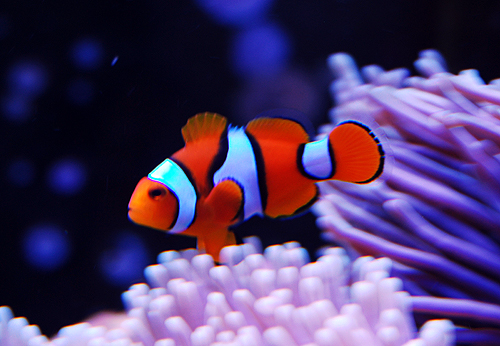
  • The species has a bright orange body marked by three white bands across the head, middle and tail. English Wikipedia
  • The middle white band has a forward-projecting bulge. English Wikipedia
  • Its fins are outlined with black edging of varying thickness. English Wikipedia
  • The species has 10 spines in its first dorsal fin, occasionally having nine. English Wikipedia
  • Its lateral line has 30–38 pored scales without interruptions. floridamuseum.ufl.edu
Size
  • The species can reach a maximum reported length of 13 centimetres. English Wikipedia
  • Females are larger than males, although males of this species are nearly equal in size to females. English Wikipedia
Habitat
  • Adults inhabit silty lagoons and harbour environments. English Wikipedia
  • Adults occur at depths between 2 and 30 metres. English Wikipedia
  • The species uses Stichodactyla haddoni, commonly called the saddle carpet anemone, as a host. English Wikipedia
  • Heteractis crispa, also called the Sebae anemone, is a host species, although the association is rare. English Wikipedia
Diet
  • The species is omnivorous and feeds on zooplankton, small benthic crustaceans, and algae. English Wikipedia
Behaviour
  • The species is active during daylight hours. English Wikipedia
  • It displays aggressive territorial behaviour. English Wikipedia
  • It depends on its host sea anemone for group shelter and nesting. English Wikipedia
  • It can protect its host anemone from reef fishes that feed on anemone tentacles. English Wikipedia
  • When its host anemone buries itself in sand under stressful conditions, the fish becomes vulnerable to predators. English Wikipedia
  • Its nearly equal male and female sizes have been proposed as an adaptation that helps males escape predators through erratic swimming or movement toward shelter in coral rubble. English Wikipedia
  • The species maintains a symbiotic relationship with host sea anemones that provide protection from predators. English Wikipedia
  • The fish helps its host anemone by consuming algae residue and zooplankton. English Wikipedia
  • The species helps protect its host anemone from polyp-consuming fish and other predators. English Wikipedia
  • Individuals generally remain associated with their particular host anemone rather than moving between distant anemones. English Wikipedia
  • The species uses chemical cues released by anemones to identify suitable hosts during its larval stage. English Wikipedia
Reproduction
  • The species is a sequential hermaphrodite with females occupying the largest position in its size-based dominance hierarchy. English Wikipedia
  • The species exhibits protandry, with the breeding male changing into a female if the sole breeding female dies. English Wikipedia
  • When the breeding female dies, the largest non-breeding male becomes the breeding male. English Wikipedia
  • The species exhibits protandrous hermaphroditism, with individuals developing as males before potentially becoming females. English Wikipedia
  • Social groups typically consist of one breeding female, one breeding male and up to four nonbreeding individuals. English Wikipedia
  • The largest individual in a social group is the female and the second largest is the breeding male. floridamuseum.ufl.edu
  • The species can reproduce throughout the year in warm tropical waters. floridamuseum.ufl.edu
  • Females produce approximately 400–1,500 eggs per spawning cycle, depending on their size. English Wikipedia
  • Spawning activity is associated with the lunar cycle. English Wikipedia
  • The male prepares the nesting site by cleaning the substrate before spawning. floridamuseum.ufl.edu
  • The male externally fertilizes eggs as the female deposits them on the nest. floridamuseum.ufl.edu
Distribution
  • The species occurs in the central Indo-Pacific, particularly across the Coral Triangle. English Wikipedia
  • Its recorded distribution also includes northern Australia, Melanesia, and the Ryukyu Islands of southern Japan. English Wikipedia
No checked fact yet
Conservation
  • The species faces potential pressure from collection for the marine aquarium trade. English Wikipedia
  • Collection from the wild has been associated with reduced anemonefish densities in exploited areas. English Wikipedia
  • Bleaching affecting host anemones is identified as an environmental threat to anemonefish. English Wikipedia
  • The species was not assessed in the 2012 release of the IUCN Red List. English Wikipedia
  • Aquaculture production of this species helps reduce harvesting pressure on wild populations for the aquarium trade. floridamuseum.ufl.edu
Uses
Similar species
  • The species was historically grouped in the saddleback complex alongside Amphiprion sebae and Amphiprion latezonatus. English Wikipedia
  • Amphiprion sebae can be distinguished from Amphiprion polymnus by its yellow tail. English Wikipedia
  • Amphiprion percula has thicker black bands separating its orange and white body coloration than Amphiprion ocellaris. floridamuseum.ufl.edu

In brief

Saddleback Clownfish

Amphiprion polymnus occurs in the central Indo-Pacific, particularly across the Coral Triangle, with a recorded distribution that includes northern Australia, Melanesia, and the Ryukyu Islands of southern Japan. It is distinguished by a large, slanted white marking across the middle of its body that forms a saddle-like pattern. Full profile

Orange Clownfish

Amphiprion percula inhabits tropical marine lagoons and seaweed reefs at recorded depths of 1–15 metres. It has a bright orange body with three white bands, a forward-projecting bulge on the middle band and black-edged fins. Full profile

Compare something else

Page built on 29 November 2026 from the data on the two species pages, where every source is listed.

Cite this page

ScientificNames.org. (2026). Saddleback Clownfish vs Orange Clownfish. Retrieved November 29, 2026, from https://scientificnames.org/compare/saddleback-clownfish-vs-orange-clownfish