Species · Fishes
Saddleback Clownfish Amphiprion polymnus
The scientific name of the Saddleback Clownfish is Amphiprion polymnus. It is a species of fish in the family Pomacentridae (damselfishes), order Perciformes. The name dates from 1758.
- Scientific name
- Amphiprion polymnus (Linnaeus, 1758)
- Common name
- Saddleback Clownfish
- Genus
- Amphiprion
- Family
- Pomacentridae (Damselfishes)
- Order
- Perciformes
- Class
- Teleostei
- Red List category
- LC Least Concern
- Environment
- marine
- Recorded in
- 13 countries
- Name status
- accepted in the Catalogue of Life

Overview
Amphiprion polymnus occurs in the central Indo-Pacific, particularly across the Coral Triangle, with a recorded distribution that includes northern Australia, Melanesia, and the Ryukyu Islands of southern Japan. It is distinguished by a large, slanted white marking across the middle of its body that forms a saddle-like pattern.
Written 26 November 2026 from the sources listed below. Each statement was checked against the passage it cites; statements that could not be supported were removed.
Appearance
The Saddleback Clownfish has an oval-shaped, laterally compressed, stocky body with a rounded profile. Its body coloration varies from dark brown to yellow-orange.[1][2]
It typically has two or three white bars, including a prominent marking immediately behind the eyes. A large, slanted white marking crosses the middle of its body and forms a distinctive saddle-like pattern.[3][4]
In some individuals, the saddle marking extends onto the dorsal fin, with an additional white marking across the caudal peduncle. The outer edges of the caudal and anal fins have white lines.[5][6]
Its snout and pectoral fin range in color from orange-yellow to brownish-orange. Individuals associated with Heteractis crispa tend to have darker coloration than those associated with Stichodactyla haddoni.[7][8]
Its coloration can become lighter or darker after it adopts a different host anemone, sometimes within hours.[9]
The species can reach a maximum reported length of 13 centimetres. Females are larger than males, although males are nearly equal in size to females.[10][11]
Habitat
Adults inhabit silty lagoons and harbour environments at depths between 2 and 30 metres.[12][13]
The species uses Stichodactyla haddoni, commonly called the saddle carpet anemone, as a host. Heteractis crispa, also called the Sebae anemone, is a host species, although the association is rare.[14][15]
Diet
The Saddleback Clownfish is omnivorous and feeds on zooplankton, small benthic crustaceans, and algae.[16]
Behaviour
The species is active during daylight hours and displays aggressive territorial behaviour.[17][18]
It depends on its host sea anemone for group shelter and nesting. It can protect its host anemone from reef fishes that feed on anemone tentacles.[19][20]
When its host anemone buries itself in sand under stressful conditions, the fish becomes vulnerable to predators.[21]
Its nearly equal male and female sizes have been proposed as an adaptation that helps males escape predators through erratic swimming or movement toward shelter in coral rubble.[22]
Reproduction and life cycle
The species is a sequential hermaphrodite, with females occupying the largest position in its size-based dominance hierarchy. It exhibits protandry, with the breeding male changing into a female if the sole breeding female dies.[23][24]
When the breeding female dies, the largest non-breeding male becomes the breeding male.[25]
Similar species
The species was historically grouped in the saddleback complex alongside Amphiprion sebae and Amphiprion latezonatus. Amphiprion sebae can be distinguished from Amphiprion polymnus by its yellow tail.[26][27]
Conservation
The species faces potential pressure from collection for the marine aquarium trade. Collection from the wild has been associated with reduced anemonefish densities in exploited areas.[28][29]
Bleaching affecting host anemones is identified as an environmental threat to anemonefish. The species was not assessed in the 2012 release of the IUCN Red List.[30][31]
Uses
The species is collected for the marine aquarium trade and has been bred successfully in captivity.[32][33]
Classification of the Saddleback Clownfish
| Kingdom | Animalia |
|---|---|
| Phylum | Chordata |
| Subphylum | Vertebrata |
| Infraphylum | Gnathostomata |
| Parvphylum | Osteichthyes |
| Gigaclass | Actinopterygii |
| Superclass | Actinopteri |
| Class | Teleostei (Teleost) |
| Order | Perciformes |
| Family | Pomacentridae (Damselfishes) |
| Subfamily | Amphiprioninae |
| Genus | Amphiprion (Clownfish) |
| Species | Amphiprion polymnus (Linnaeus, 1758) |
Where the Saddleback Clownfish is found
Checklists and occurrence records place Amphiprion polymnus in 13 countries. GBIF holds 702 georeferenced records of it.
Countries
- Australia 8
- India 4
- Indonesia 380
- Japan 60
- Malaysia 22
- Papua New Guinea 57
- Philippines 90
- Singapore 3
- Solomon Islands 20
- Taiwan 5
- Thailand 20
- Timor Leste 10
- Vietnam 23
Regions and cities with the most records
- Bitung, Indonesia 106
- Amlapura, Indonesia 75
- Amlapura city, Indonesia 75
- Bedugul, Indonesia 75
- Port Moresby, Papua New Guinea 26
- Bali, Indonesia 24
- Ambon, Indonesia 16
- Klungkung, Indonesia 11
- Dili, Timor Leste 8
- Likisá, Timor Leste 8
- Manado, Indonesia 8
- Bauang, Philippines 6
- Calapan, Philippines 6
- San Fernando, Philippines 6
- Apas, Philippines 5
- Cebu City, Philippines 5
- Consolacion, Philippines 5
- Lapu-Lapu City, Philippines 5
- Liloan, Philippines 5
- Mandaue City, Philippines 5
- Minglanilla, Philippines 5
- Naga, Philippines 5
- Sabah, Malaysia 5
- Talisay, Philippines 5
- Tomohon, Indonesia 5
- Central Province, Solomon Islands 4
- Queensland, Australia 4
- Samal, Philippines 4
- Selong, Indonesia 4
- Bang Pakong, Thailand 3
- Banjar, Indonesia 3
- Chachoengsao, Thailand 3
- Chachoengsao, Thailand 3
- Dili Municipality, Timor Leste 3
- Donggongon, Malaysia 3
- Dumaguete, Philippines 3
1 more country has a few records outside this range
These countries hold a few records of Amphiprion polymnus but lie outside the range the checklists give for it. Such records are often zoo or garden specimens, museum material or vagrants, so the species is not counted as occurring there.
A number beside a place is its count of GBIF occurrence records. A place without a number comes from a checklist alone. Records show where a species has been observed or collected, which can include escapes and vagrants.
Common names
English
- Saddleback Clownfish
- Clown Fish
- Panda Clownfish
- Saddle Back Clown
- Saddleback Anemonefish
- White-tipped Anemonefish
- Yellow-finned Anemone-fish
- Brownsaddle Clownfish
- Yellowfinned Anemonefish
Names in 14 other languages
- Catalan
- Peix pallasso ensellat
- Chinese
- 鞍斑雙鋸魚, 鞍背小丑
- Danish
- Sadelpletklovnfisk
- Finnish
- Satulavuokkokala
- French
- Poisson-clown selle blanche, Poisson-clown à selle de cheval
- German
- Sattelfleck-Anemonenfisch
- Hungarian
- Nyerges bohóchal
- Italian
- Pesce pagliaccio dalla sella meridionale, Pesce pagliaccio sellato meridionale
- Japanese
- トウアカクマノミ
- Malay
- Gombing, Inggu, Rombin
- Portuguese
- Peixe-palhaço-de-sela-branca
- Russian
- Новогвинейский амфиприон
- Spanish
- Pez payaso ensillado
- Thai
- ปลาการ์ตูนอานม้า
Synonyms
15 other scientific names have been used for this species and are now treated as synonyms of Amphiprion polymnus.
- Amphiprion bifasciatus (Bloch, 1792)
- Amphiprion intermedius Schlegel & Müller, 1839
- Amphiprion laticlavius Cuvier, 1830
- Amphiprion polynemus (Linnaeus, 1758)
- Amphiprion trifasciatus Cuvier, 1830
- Anthias bifasciatus Bloch, 1792
- Coracinus seu Meuschen, 1781
- Coracinus seu sciaena unimaculata Meuschen, 1781
- Coracinus unimaculata Meuschen, 1781
- Coracinus vittatus Gronow in Gray, 1854
- Lutjanus jourdin Lacepède, 1802
- Paramphiprion hainanensis Wang, 1941
- Perca polymna Linnaeus, 1758
- Premnas trifasciatus Cuvier in Cuvier & Valenciennes, 1830
- Sciaena unimaculata Meuschen, 1781
Related species
-
 Ocellaris ClownfishAmphiprion ocellaris
-
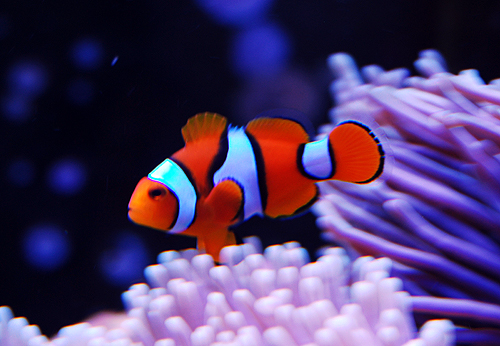 Orange ClownfishAmphiprion percula
-
 Clark's AnemonefishAmphiprion clarkii
-
 Tomato ClownfishAmphiprion frenatus
-
 Pink Skunk ClownfishAmphiprion perideraion
-
 Barrier Reef AnemonefishAmphiprion akindynos
-
 Red Sea ClownfishAmphiprion bicinctus
-
 Wide-band AnemonefishAmphiprion latezonatus
Compare
Questions and answers
What is the scientific name of the Saddleback Clownfish?
The scientific name of the Saddleback Clownfish is Amphiprion polymnus. Written with its author, the full name is Amphiprion polymnus (Linnaeus, 1758).
Which family does the Saddleback Clownfish belong to?
Amphiprion polymnus belongs to the family Pomacentridae, in the order Perciformes and the class Teleostei.
Where is the Saddleback Clownfish found?
Checklists and occurrence records place Amphiprion polymnus in 13 countries, including Indonesia, Philippines, Japan, Papua New Guinea, Vietnam and Malaysia.
What is the conservation status of the Saddleback Clownfish?
The IUCN Red List category recorded for Amphiprion polymnus is Least Concern (LC).
What other names does the Saddleback Clownfish have?
Amphiprion polymnus is also known in English as Clown Fish, Panda Clownfish, Saddle Back Clown, Saddleback Anemonefish, White-tipped Anemonefish and Yellow-finned Anemone-fish.
What type of habitat do clownfish live in?
Adult Saddleback Clownfish inhabit silty lagoons and harbour environments at depths between 2 and 30 metres. They use sea anemones as hosts.[12][13][14][15]
What is the diet of a clownfish?
The Saddleback Clownfish is omnivorous and feeds on zooplankton, small benthic crustaceans, and algae.[16]
Are clownfish carnivores, herbivores, or omnivores?
The Saddleback Clownfish is an omnivore.[16]
Sources
Passages the profile rests on
- Its body is oval-shaped, laterally compressed, stocky, and has a rounded profile. Source passage: “Its body has a stock appearance, oval shape, compressed laterally and with a round profile.” — English Wikipedia
- Its body coloration varies from dark brown to yellow-orange. Source passage: “The body color ranges from dark brown to yellow orange and this species has two or three white bars.” — English Wikipedia
- It typically has two or three white bars, including a prominent marking immediately behind the eyes. Source passage: “The body color ranges from dark brown to yellow orange and this species has two or three white bars. The white head bar is thick and located just behind the eyes.” — English Wikipedia
- A large, slanted white marking crosses the middle of its body and forms a distinctive saddle-like pattern. Source passage: “A large white abbreviated saddle shape or slanted white bar across the middle of the fish's body makes it quite obvious to see how it got the name Saddleback.” — English Wikipedia
- In some individuals, the saddle marking extends onto the dorsal fin, with an additional white marking across the caudal peduncle. Source passage: “In some varieties, typically those specimens initially associated with Heteractis crispa anemone, the saddle shape may extend up onto the fish's Dorsal fin with a third white bar or margin located across the caudal peduncle” — English Wikipedia
- The outer edges of its caudal and anal fins have white lines. Source passage: “The external edge of the caudal and the anal fins are underlined with a white line.” — English Wikipedia
- Its snout and pectoral fin range in color from orange-yellow to brownish-orange. Source passage: “The snout and the pectoral fin are in any case of color variation orange yellow to brownish orange.” — English Wikipedia
- Individuals associated with Heteractis crispa tend to have darker coloration than those associated with Stichodactyla haddoni. Source passage: “Specimens associated with Heteractis crispa tend to be darker than those associated with Stichodactyla haddoni.” — English Wikipedia
- Its coloration can become lighter or darker after it adopts a different host anemone, sometimes within hours. Source passage: “Aquarium specimens have been observed becoming lighter or darker after accepting a new host anemone species, sometimes within a few hours.” — English Wikipedia
- The species can reach a maximum reported length of 13 centimetres. Source passage: “A. polymnus is a small sized fish which grows up to 13 centimetres (5.1 in).” — English Wikipedia
- Females are larger than males, although males of this species are nearly equal in size to females. Source passage: “In any anemonefish group, the female is always larger than the male, but in this species the male is almost equal in size to the female.” — English Wikipedia
- Adults inhabit silty lagoons and harbour environments. Source passage: “Adults inhabit silty lagoons and harbour areas” — English Wikipedia
- Adults occur at depths between 2 and 30 metres. Source passage: “Adults inhabit silty lagoons and harbour areas in depth range from 2 to 30 metres (6.6 to 98.4 ft).” — English Wikipedia
- The species uses Stichodactyla haddoni, commonly called the saddle carpet anemone, as a host. Source passage: “Stichodactyla haddoni (Saddle carpet anemone)” — English Wikipedia
- Heteractis crispa, also called the Sebae anemone, is a host species, although the association is rare. Source passage: “Heteractis crispa Sebae anemone (rarely)” — English Wikipedia
- The species is omnivorous and feeds on zooplankton, small benthic crustaceans, and algae. Source passage: “Like all anemonefish, A. polymnus is omnivorous and its diet is based on zooplankton, small benthic crustaceans and algae.” — English Wikipedia
- The species is active during daylight hours. Source passage: “A. polymnus has a diurnal activity” — English Wikipedia
- It displays aggressive territorial behaviour. Source passage: “is aggressively territorial” — English Wikipedia
- It depends on its host sea anemone for group shelter and nesting. Source passage: “is dependent on its host sea anemone which it uses as a shelter for the group and for the nest.” — English Wikipedia
- It can protect its host anemone from reef fishes that feed on anemone tentacles. Source passage: “The anemonefish can also defend the anemone against some reef fishes which could eat the tentacles such as butterflyfishes.” — English Wikipedia
- When its host anemone buries itself in sand under stressful conditions, the fish becomes vulnerable to predators. Source passage: “Both species of sea anemone, which host A. polymnus, are known to bury themselves in the sand when they are under stress, leaving the fish vulnerable to predation.” — English Wikipedia
- Its nearly equal male and female sizes have been proposed as an adaptation that helps males escape predators through erratic swimming or movement toward shelter in coral rubble. Source passage: “It has been suggested that the almost equal size of the male is an adaptation to allow it to elude predators by erratic swimming in the water column or covering the relatively long distance to shelter in coral rubble.” — English Wikipedia
- The species is a sequential hermaphrodite with females occupying the largest position in its size-based dominance hierarchy. Source passage: “It is a sequential hermaphrodite with a strict sized-based dominance hierarchy: the female is largest, the breeding male is second largest, and the male non-breeders get progressively smaller as the hierarchy descends.” — English Wikipedia
- The species exhibits protandry, with the breeding male changing into a female if the sole breeding female dies. Source passage: “They exhibit protandry, meaning the breeding male will change to female if the sole breeding female dies” — English Wikipedia
- When the breeding female dies, the largest non-breeding male becomes the breeding male. Source passage: “with the largest non-breeder becomes the breeding male.” — English Wikipedia
- The species was historically grouped in the saddleback complex alongside Amphiprion sebae and Amphiprion latezonatus. Source passage: “A. polymnus is part of the saddleback complex with A. sebae and A. latezonatus.” — English Wikipedia
- Amphiprion sebae can be distinguished from Amphiprion polymnus by its yellow tail. Source passage: “The yellow tail of A. sebae distinguishes that species from A. polymnus.” — English Wikipedia
- The species faces potential pressure from collection for the marine aquarium trade. Source passage: “The other threat to anemonefish is collection for the marine aquarium trade” — English Wikipedia
- Collection from the wild has been associated with reduced anemonefish densities in exploited areas. Source passage: “the majority are captured from the wild, accounting for decreased densities in exploited areas.” — English Wikipedia
- Bleaching affecting host anemones is identified as an environmental threat to anemonefish. Source passage: “While bleaching is a significant threat to anemonefish and their host anemones” — English Wikipedia
- The species was not assessed in the 2012 release of the IUCN Red List. Source passage: “This species was not evaluated in the 2012 release of the IUCN Red List.” — English Wikipedia
- The species is collected for the marine aquarium trade. Source passage: “The other threat to anemonefish is collection for the marine aquarium trade” — English Wikipedia
- The species has been bred successfully in captivity. Source passage: “A. polymnus has been bred in captivity.” — English Wikipedia
Data
- Catalogue of Life, 2026-10-16 XR cc by
- Global Biodiversity Information Facility CC BY 4.0
- Wikidata CC0
- GeoNames CC BY 4.0
- Wikimedia Commons per image; credit shown with each image
- Within the Catalogue of Life, this name comes from World Register of Marine Species cc by
This species in other databases
- Catalogue of Life D569
- Wikidata Q1087837
- iNaturalist 119430
- WoRMS urn:lsid:marinespecies.org:taxname:212781
- ITIS 170146
Page built on 27 November 2026. See how the catalog is made and all sources and licences.
Cite this page
ScientificNames.org. (2026). Amphiprion polymnus (Saddleback Clownfish). Retrieved November 27, 2026, from https://scientificnames.org/species/amphiprion-polymnus
“Amphiprion polymnus (Saddleback Clownfish).” ScientificNames.org, 2026, scientificnames.org/species/amphiprion-polymnus. Accessed 27 Nov. 2026.
ScientificNames.org. “Amphiprion polymnus (Saddleback Clownfish).” Accessed November 27, 2026. https://scientificnames.org/species/amphiprion-polymnus.
@misc{scientificnames_amphiprion_polymnus_saddleback_clownfish,
  author = {{ScientificNames.org}},
  title = {Amphiprion polymnus (Saddleback Clownfish)},
  year = {2026},
  url = {https://scientificnames.org/species/amphiprion-polymnus},
  note = {Accessed 2026-11-27}
}