Species · Fishes
Orange Clownfish Amphiprion percula
The scientific name of the Orange Clownfish is Amphiprion percula. It is a species of fish in the family Pomacentridae (damselfishes), order Perciformes. The name dates from 1802.
- Scientific name
- Amphiprion percula (Lacepède, 1802)
- Common name
- Orange Clownfish
- Genus
- Amphiprion
- Family
- Pomacentridae (Damselfishes)
- Order
- Perciformes
- Class
- Teleostei
- Red List category
- LC Least Concern
- Environment
- marine
- Recorded in
- 13 countries
- Name status
- accepted in the Catalogue of Life
Overview
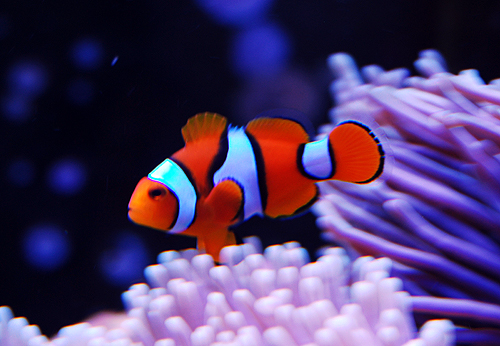
Amphiprion percula inhabits tropical marine lagoons and seaweed reefs at recorded depths of 1–15 metres. It has a bright orange body with three white bands, a forward-projecting bulge on the middle band and black-edged fins.
Written 26 November 2026 from the sources listed below. Each statement was checked against the passage it cites; statements that could not be supported were removed.
Appearance
Its fins have black edging of varying thickness. Its first dorsal fin has 10 spines, occasionally nine, and its lateral line has 30–38 uninterrupted pored scales.[1][2][3]
Habitat
The Orange Clownfish inhabits tropical marine lagoons and seaweed reefs. Its recorded depth range is 1–15 metres, although it generally inhabits shallow waters not exceeding 12 metres.[4][5][6]
Diet
The Orange Clownfish eats algae, zooplankton, worms and small crustaceans. Its diet also includes dead tentacles and leftover prey from its host anemone.[7][8]
It obtains food from its host anemone and forages on algae and plankton.[9]
Behaviour
The Orange Clownfish maintains a symbiotic relationship with host sea anemones, which provide protection from predators. The fish helps its host by consuming algae residue and zooplankton and by protecting it from polyp-consuming fish and other predators.[10][11][12]
Individuals generally remain associated with their particular host anemone rather than moving between distant anemones. During its larval stage, the species uses chemical cues released by anemones to identify suitable hosts.[13][14]
Reproduction and life cycle
The Orange Clownfish exhibits protandrous hermaphroditism, with individuals developing as males before potentially becoming females. Social groups typically consist of one breeding female, one breeding male and up to four nonbreeding individuals.[15][16]
The largest individual in a social group is the female, and the second largest is the breeding male. The species can reproduce throughout the year in warm tropical waters.[17][18]
Females produce approximately 400–1,500 eggs per spawning cycle, depending on their size. Spawning activity is associated with the lunar cycle.[19][20]
Before spawning, the male prepares the nesting site by cleaning the substrate. The male externally fertilizes the eggs as the female deposits them on the nest.[21][22]
Conservation
Aquaculture production of the Orange Clownfish helps reduce harvesting pressure on wild populations for the aquarium trade.[23]
Uses
The Orange Clownfish is popular in the aquarium trade and is frequently kept by home aquarists because it is hardy in captivity.[24][25]
Similar species
The Orange Clownfish also has thicker black bands separating its orange and white body coloration than Amphiprion ocellaris.[26]
Classification of the Orange Clownfish
| Kingdom | Animalia |
|---|---|
| Phylum | Chordata |
| Subphylum | Vertebrata |
| Infraphylum | Gnathostomata |
| Parvphylum | Osteichthyes |
| Gigaclass | Actinopterygii |
| Superclass | Actinopteri |
| Class | Teleostei (Teleost) |
| Order | Perciformes |
| Family | Pomacentridae (Damselfishes) |
| Subfamily | Amphiprioninae |
| Genus | Amphiprion (Clownfish) |
| Species | Amphiprion percula (Lacepède, 1802) |
Where the Orange Clownfish is found
Checklists and occurrence records place Amphiprion percula in 13 countries. GBIF holds 835 georeferenced records of it.
Countries
- Australia 350
- Fiji 10
- French Polynesia 4
- India 8
- Indonesia 79
- Malaysia 30
- Papua New Guinea 160
- Philippines 50
- Singapore 5
- Solomon Islands 105
- Sri Lanka 7
- Taiwan 3
- Thailand 24
Regions and cities with the most records
- Queensland, Australia 22
- Central Province, Solomon Islands 14
- Honiara, Solomon Islands 13
- Tandai, Solomon Islands 13
- Madang, Papua New Guinea 11
- Biak, Indonesia 9
- Danao, Philippines 9
- East New Britain Province, Papua New Guinea 9
- Malango, Solomon Islands 9
- Papua, Indonesia 9
- Port Moresby, Papua New Guinea 9
- Donggongon, Malaysia 8
- Kota Kinabalu, Malaysia 8
- Madang Province, Papua New Guinea 8
- Petagas, Malaysia 8
- Putatan, Malaysia 8
- Western Province, Solomon Islands 8
- Milne Bay Province, Papua New Guinea 6
- New Ireland, Papua New Guinea 6
- Oro Province, Papua New Guinea 6
- Kinarut, Malaysia 5
- Bang Pakong, Thailand 4
- Chachoengsao, Thailand 4
- Chachoengsao, Thailand 4
- Guadalcanal Province, Solomon Islands 4
- Johor, Malaysia 4
- Kimbe, Papua New Guinea 4
- Kokopo, Papua New Guinea 4
- Tagbilaran City, Philippines 4
- Krabi, Thailand 3
- Manado, Indonesia 3
- Taipei, Taiwan 3
- West New Britain Province, Papua New Guinea 3
2 more countries have a few records outside this range
These countries hold a few records of Amphiprion percula but lie outside the range the checklists give for it. Such records are often zoo or garden specimens, museum material or vagrants, so the species is not counted as occurring there.
A number beside a place is its count of GBIF occurrence records. A place without a number comes from a checklist alone. Records show where a species has been observed or collected, which can include escapes and vagrants.
Common names
English
- Orange Clownfish
- Eastern Clown Anemonefish
- Eastern Clownfish
- Nemo
- Orange Anemone-fish
- Orange Anemonefish
- Percula Anemonefish
- Blackfinned Clownfish
- Clown Anemonefish
- Clown Fish
- Orange Clown Fish
Names in 14 other languages
- Catalan
- Peix pallasso percula
- Czech
- klaun zdobený
- Danish
- Orangegul klovnfisk
- French
- Poisson-clown du Pacifique
- German
- Echter Clownfisch, Trauerband-Anemonenfisch
- Italian
- Pesce pagliaccio orientale
- Malay
- Gombing, Inggu, Rombin
- Polish
- błazenek ukwiałowy
- Portuguese
- Peixe-palhaço-percula
- Russian
- Оранжевый амфиприон
- Spanish
- Pez Payaso del Este
- Thai
- ปลาการ์ตูนเพอร์คูลา
- Ukrainian
- Риба-клоун помаранчева
- cgc
- Samok-samok
Synonyms
3 other scientific names have been used for this species and are now treated as synonyms of Amphiprion percula.
- Actinicola percula (Lacepède, 1802)
- Amphiprion tunicatus Cuvier, 1830
- Lutjanus percula Lacepède, 1802
Related species
-
 Ocellaris ClownfishAmphiprion ocellaris
-
 Clark's AnemonefishAmphiprion clarkii
-
 Tomato ClownfishAmphiprion frenatus
-
 Pink Skunk ClownfishAmphiprion perideraion
-
 Barrier Reef AnemonefishAmphiprion akindynos
-
 Red Sea ClownfishAmphiprion bicinctus
-
 Saddleback ClownfishAmphiprion polymnus
-
 Wide-band AnemonefishAmphiprion latezonatus
Compare
Questions and answers
What is the scientific name of the Orange Clownfish?
The scientific name of the Orange Clownfish is Amphiprion percula. Written with its author, the full name is Amphiprion percula (Lacepède, 1802).
Which family does the Orange Clownfish belong to?
Amphiprion percula belongs to the family Pomacentridae, in the order Perciformes and the class Teleostei.
Where is the Orange Clownfish found?
Checklists and occurrence records place Amphiprion percula in 13 countries, including Australia, Papua New Guinea, Solomon Islands, Indonesia, Philippines and Malaysia.
What is the conservation status of the Orange Clownfish?
The IUCN Red List category recorded for Amphiprion percula is Least Concern (LC).
What other names does the Orange Clownfish have?
Amphiprion percula is also known in English as Eastern Clown Anemonefish, Eastern Clownfish, Nemo, Orange Anemone-fish, Orange Anemonefish and Percula Anemonefish.
What type of habitat do clownfish live in?
The Orange Clownfish inhabits tropical marine lagoons and seaweed reefs, generally in shallow waters not exceeding 12 metres.[4][6]
What is the diet of a clownfish?
The Orange Clownfish eats algae, zooplankton, worms and small crustaceans. It also consumes dead tentacles and leftover prey from its host anemone.[7][8]
How big do Percula clownfish get?
The Orange Clownfish reaches a maximum reported total length of 11 cm and has an average length of approximately 8 cm.[27][28]
Are clownfish carnivores, herbivores, or omnivores?
The Orange Clownfish consumes both algae and animal matter, including zooplankton, worms and small crustaceans.[7]
Sources
Passages the profile rests on
- Its fins are outlined with black edging of varying thickness. Source passage: “black edging outlines each fin with varying thickness.” — English Wikipedia
- The species has 10 spines in its first dorsal fin, occasionally having nine. Source passage: “A. percula has 10 spines in the first dorsal fin (rarely having 9)” — English Wikipedia
- Its lateral line has 30–38 pored scales without interruptions. Source passage: “30-38 pored scales with no interruptions along the lateral line.” — floridamuseum.ufl.edu
- The species inhabits tropical marine lagoons and seaweed reefs. Source passage: “lives in tropical marine lagoons and seaweed reefs” — floridamuseum.ufl.edu
- Its recorded depth range is 1–15 metres. Source passage: “at depths ranging from 3 to 49 feet (1 to 15 m).” — floridamuseum.ufl.edu
- The species inhabits shallow waters generally not exceeding 12 metres in depth. Source passage: “the depth usually does not exceed 12 m” — English Wikipedia
- Its diet includes algae, zooplankton, worms and small crustaceans. Source passage: “The fish feed on algae, zooplankton, worms, and small crustaceans.” — English Wikipedia
- The species consumes dead tentacles and leftover prey from its host anemone. Source passage: “The anemonefish will eat the dead tentacles of the anemone and any leftover food prey from the stinging tentacles of the anemone.” — floridamuseum.ufl.edu
- The species obtains food from its host anemone as well as foraging on algae and plankton. Source passage: “They forage on algae and plankton as well as obtain food from the host anemone.” — floridamuseum.ufl.edu
- The species maintains a symbiotic relationship with host sea anemones that provide protection from predators. Source passage: “The anemone helps the fish by giving it protection from predators” — English Wikipedia
- The fish helps its host anemone by consuming algae residue and zooplankton. Source passage: “A. percula cleans the host anemone by consuming algae residue and zooplankton such as copepods and larval tunicates.” — English Wikipedia
- The species helps protect its host anemone from polyp-consuming fish and other predators. Source passage: “They also protect the anemone from polyp-consuming fish and other predators” — English Wikipedia
- Individuals generally remain associated with their particular host anemone rather than moving between distant anemones. Source passage: “Most anemonefish are site-attached and do not move from one anemone to another that are spatially distributed more than a few meters.” — English Wikipedia
- The species uses chemical cues released by anemones to identify suitable hosts during its larval stage. Source passage: “as larvae use chemical cues released from the anemones to identify and locate the appropriate host species” — English Wikipedia
- The species exhibits protandrous hermaphroditism, with individuals developing as males before potentially becoming females. Source passage: “each fish is born male, but changes to female if the sole breeding female dies.” — English Wikipedia
- Social groups typically consist of one breeding female, one breeding male and up to four nonbreeding individuals. Source passage: “Each group of fish consists of a breeding pair and none to four nonbreeders.” — English Wikipedia
- The largest individual in a social group is the female and the second largest is the breeding male. Source passage: “The larger fish is always the female while the second largest is the male.” — floridamuseum.ufl.edu
- The species can reproduce throughout the year in warm tropical waters. Source passage: “The warm tropical waters where this species resides allows for year-round spawing.” — floridamuseum.ufl.edu
- Females produce approximately 400–1,500 eggs per spawning cycle, depending on their size. Source passage: “Depending on her size, the female spawns about 400–1500 eggs per cycle.” — English Wikipedia
- Spawning activity is associated with the lunar cycle. Source passage: “The spawning process is correlated with the lunar cycle.” — English Wikipedia
- The male prepares the nesting site by cleaning the substrate before spawning. Source passage: “This bare rock is initially cleaned by the male with his mouth” — floridamuseum.ufl.edu
- The male externally fertilizes eggs as the female deposits them on the nest. Source passage: “She is closely followed by the male who externally fertilizes the eggs as she releases them.” — floridamuseum.ufl.edu
- Aquaculture production of this species helps reduce harvesting pressure on wild populations for the aquarium trade. Source passage: “This fish is successfully raised in aquaculture facilities which decreases the pressure on wild populations to supply the saltwater aquarium trade.” — floridamuseum.ufl.edu
- The species is popular in the aquarium trade. Source passage: “This species is not harvested for consumption but is popular in the aquarium trade.” — floridamuseum.ufl.edu
- The species is frequently kept by home aquarists because it is hardy in captivity. Source passage: “This species is often kept by home aquarists due to its hardiness in captivity.” — floridamuseum.ufl.edu
- Amphiprion percula has thicker black bands separating its orange and white body coloration than Amphiprion ocellaris. Source passage: “The orange clownfish has thick black bands that separate the orange and white coloration on the body” — floridamuseum.ufl.edu
- The species reaches a maximum reported total length of 11 cm. Source passage: “The maximum reported total length of this anemonefish is 4.33 inches (11.0 cm).” — floridamuseum.ufl.edu
- Its average length is approximately 8 cm. Source passage: “is on average 8 cm (3.1 in)” — English Wikipedia
Data
- Catalogue of Life, 2026-10-16 XR cc by
- Global Biodiversity Information Facility CC BY 4.0
- Wikidata CC0
- GeoNames CC BY 4.0
- Wikimedia Commons per image; credit shown with each image
- Within the Catalogue of Life, this name comes from World Register of Marine Species cc by
References
- Lacepede, B. G. E. (1802) Histoire naturelle des poissons. Tome quatrieme. Plassan, Paris, xliv + 728 pp, pls. 1 - 16. [Year given as " l'an X de la republique. "] where the name was published
This species in other databases
- Catalogue of Life D564
- Wikidata Q926234
- iNaturalist 119391
- WoRMS urn:lsid:marinespecies.org:taxname:278402
- ITIS 170144
Page built on 28 November 2026. See how the catalog is made and all sources and licences.
Cite this page
ScientificNames.org. (2026). Amphiprion percula (Orange Clownfish). Retrieved November 28, 2026, from https://scientificnames.org/species/amphiprion-percula
“Amphiprion percula (Orange Clownfish).” ScientificNames.org, 2026, scientificnames.org/species/amphiprion-percula. Accessed 28 Nov. 2026.
ScientificNames.org. “Amphiprion percula (Orange Clownfish).” Accessed November 28, 2026. https://scientificnames.org/species/amphiprion-percula.
@misc{scientificnames_amphiprion_percula_orange_clownfish,
  author = {{ScientificNames.org}},
  title = {Amphiprion percula (Orange Clownfish)},
  year = {2026},
  url = {https://scientificnames.org/species/amphiprion-percula},
  note = {Accessed 2026-11-28}
}