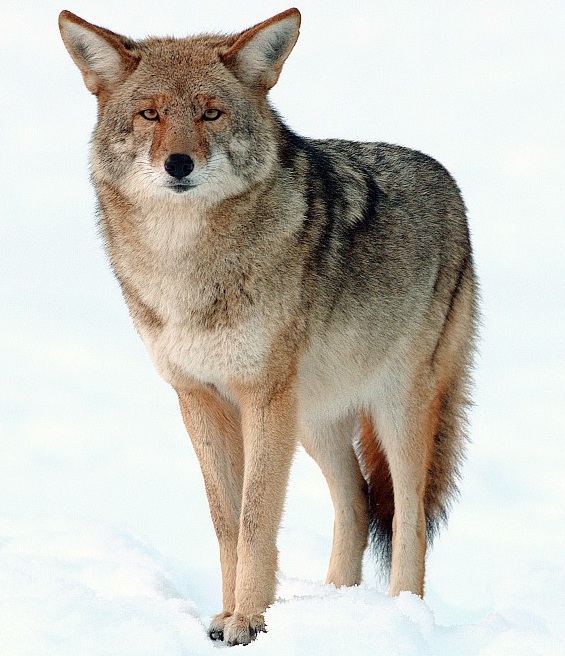
| Appearance | | - The coyote typically has a coat combining light gray, reddish or fulvous, black, and white coloration. English Wikipedia
- Coyotes have pointed ears, a narrow muzzle, and a bushy tail with a black tip. nps.gov
- Coyotes generally have a grey-brown coat with black-tipped hairs along their backs. nps.gov
- The coyote has longer ears and a relatively larger braincase than the gray wolf. English Wikipedia
- Coyotes carry their tails downward when walking or running. English Wikipedia
|
|---|
| Size | | - Male coyotes typically weigh between 8 and 20 kg. English Wikipedia
- Female coyotes typically weigh between 7 and 18 kg. English Wikipedia
- Adult coyotes have an average total body length, including the tail, of 1.0 to 1.35 m. English Wikipedia
- The coyote's tail measures approximately 40 cm in length. English Wikipedia
- The average shoulder height of coyotes ranges from 18 to 23 inches. nps.gov
- Coyotes average approximately 20 to 35 pounds in weight according to the Jewel Cave National Monument account. nps.gov
- Northern coyote subspecies average approximately 18 kg, compared with 11.5 kg for southern Mexican subspecies. English Wikipedia
|
|---|
| Habitat | - Fossils of Dusicyon avus have been found in the Luján Formation of Argentina. English Wikipedia
- Fossils of Dusicyon avus have been found in the Chui Formation of Brazil. English Wikipedia
- Fossils of Dusicyon avus have been found in Milodón Cave in Chile. English Wikipedia
- Fossils of Dusicyon avus have been found in the Sopas Formation of Uruguay. English Wikipedia
| |
|---|
| Diet | | - Coyotes preferentially prey on Dall's sheep, white-tailed deer, eastern cottontail rabbits, and California voles. pmc.ncbi.nlm.nih.gov
- Coyotes avoid preying on small mammals, including carnivorans and arboreal species. pmc.ncbi.nlm.nih.gov
- Coyotes consume deer, rabbits, hares, rodents, birds, reptiles, amphibians, fish, and invertebrates. English Wikipedia
- Coyotes occasionally consume fruits and vegetables. English Wikipedia
- Coyotes in the southern United States may consume more frogs than coyotes in other regions. nps.gov
- Coyotes in the Yukon may consume more berries. nps.gov
- Vegetation consumption by coyotes is greatest during summer and autumn. research.fs.usda.gov
|
|---|
| Behaviour | | - Coyotes can live either in family units or in loosely organized packs of unrelated individuals. English Wikipedia
- Coyotes can hunt either individually or in groups. pmc.ncbi.nlm.nih.gov
- Coyotes may form groups of five to six adults under favorable conditions. nps.gov
- Coyote packs containing more than ten animals have been observed. nps.gov
- Coyotes may establish and defend territories or survive as nonterritorial transient individuals. pmc.ncbi.nlm.nih.gov
- Coyotes characteristically produce howls that rapidly change in tone and pitch. English Wikipedia
|
|---|
| Reproduction | No checked fact yet | |
|---|
| Distribution | - Dusicyon avus occurred across the Pampas and Patagonia in south-central and southern South America. English Wikipedia
- The estimated geographic range of Dusicyon avus was approximately 762,351 square kilometres. English Wikipedia
- Dusicyon avus fossils have been recorded in Argentina, Brazil, Chile and Uruguay. English Wikipedia
| - Coyotes are native to North America. English Wikipedia
- Coyotes occur throughout North and Central America. animaldiversity.org
- Coyotes have expanded their geographic range by approximately 40 percent over the past 120 years. research.fs.usda.gov
- Coyotes currently occur in every US state except Hawaii and extend as far north as the Arctic. nps.gov
- Coyotes were first sighted in eastern Panama in 2013. English Wikipedia
|
|---|
| Conservation | - Dusicyon avus is extinct. English Wikipedia
- The last recorded appearance of Dusicyon avus in the Pampean Region dates to approximately 700 years BP. English Wikipedia
- The last recorded appearance of Dusicyon avus in southernmost Patagonia dates to approximately 400 years BP. English Wikipedia
- The extinction of Dusicyon avus has no established single cause. English Wikipedia
- Available evidence does not establish climatic change as the cause of Dusicyon avus extinction. English Wikipedia
- Available evidence does not establish hybridisation with domestic dogs as the cause of Dusicyon avus extinction. English Wikipedia
- Tested samples of Dusicyon avus indicate low genetic diversity despite its extensive geographic range. English Wikipedia
- A combination of climatic and human-related factors is considered a likely contributor to the extinction of Dusicyon avus. English Wikipedia
| - The coyote is classified as Least Concern by the International Union for Conservation of Nature. English Wikipedia
- Human persecution is a major cause of coyote mortality. nps.gov
- Trapping for their pelts is one of the major causes of coyote mortality throughout their range. nps.gov
- Coyotes have expanded their range despite substantial persecution related to actual or perceived livestock predation. pmc.ncbi.nlm.nih.gov
|
|---|
| Uses | - Dusicyon remains were used for ritual purposes by Indigenous peoples during the Late Holocene. English Wikipedia
- Dusicyon remains, particularly teeth, occur at numerous archaeological sites. English Wikipedia
| No checked fact yet |
|---|
| Similar species | - Dusicyon avus was closely related to the Falkland Islands wolf (Dusicyon australis). English Wikipedia
- The Falkland Islands wolf descended from a population of Dusicyon avus. English Wikipedia
| No checked fact yet |
|---|
| Name origin | No checked fact yet | |
|---|
| Other | - The genetic divergence between Dusicyon australis and Dusicyon avus occurred between approximately 31,000 and 8,000 years BP. pmc.ncbi.nlm.nih.gov
| No checked fact yet |
|---|