Comparison
Darth Vader Supergiant Isopod vs Giant Isopod
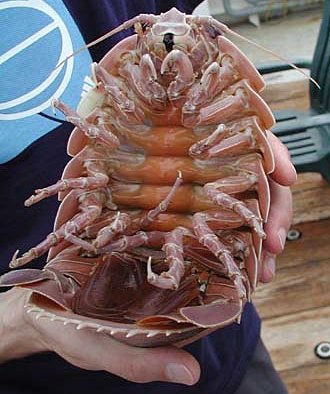
Darth Vader Supergiant Isopod (Bathynomus vaderi) and Giant Isopod (Bathynomus giganteus) both belong to the genus Bathynomus (giant isopod) and part ways below it.

Darth Vader Supergiant Isopod
Bathynomus vaderi
Peter K. L. Ng, Conni M. Sidabalok, Thanh Son Nguyen, CC BY 4.0, via Wikimedia Commons


Side by side
| Darth Vader Supergiant Isopod | Giant Isopod | |
|---|---|---|
| Scientific name | Bathynomus vaderi Ng, Sidabalok & Nguyen, 2025 | Bathynomus giganteus A. Milne-Edwards, 1879 |
| English name | Darth Vader Supergiant Isopod | Giant Isopod |
| Group | Crustaceans | Crustaceans |
| Class | Malacostraca | Malacostraca |
| Order | Isopoda | Isopoda |
| Family | Cirolanidae | Cirolanidae |
| Genus | Bathynomus Giant Isopod | Bathynomus Giant Isopod |
| Named in | 2025 | 1879 |
| Environment | marine | marine |
| Countries on record | 2 countries | 22 countries |
| GBIF occurrence records | 24 records | 1,441 records |
Rows where the two agree are shown in grey.
Where each is found
Only Darth Vader Supergiant Isopod (2)
Only Giant Isopod (22)
- Anguilla
- Bahamas
- Belize
- Brazil
- China
- Colombia
- Costa Rica
- Cuba
- Dominica
- French Guiana
- Guadeloupe
- Honduras
- India
- Jamaica
- Mexico
- Nepal
- Nicaragua
- Panama
- Saint Barthelemy
- Suriname
- United States
- Venezuela
From Catalogue of Life checklists and GBIF occurrence records. A country missing from a list means no record is held, which is not proof of absence.
Checked facts
| Darth Vader Supergiant Isopod | Giant Isopod | |
|---|---|---|
| Appearance |
|
|
| Size |
|
|
| Habitat |
| No checked fact yet |
| Diet | No checked fact yet |
|
| Behaviour | No checked fact yet |
|
| Reproduction | No checked fact yet |
|
| Distribution |
| No checked fact yet |
| Conservation | No checked fact yet |
|
| Name origin |
| No checked fact yet |
| Other |
| No checked fact yet |
In brief
Darth Vader Supergiant Isopod
Bathynomus vaderi occurs in the South China Sea off the coast of Vietnam near the Spratly Islands. It has a facial structure resembling Darth Vader's helmet. Full profile
Giant Isopod
Bathynomus giganteus has large triangular compound eyes containing more than 4,000 individual facets. Full profile
Compare something else
Page built on 28 November 2026 from the data on the two species pages, where every source is listed.
Cite this page
ScientificNames.org. (2026). Darth Vader Supergiant Isopod vs Giant Isopod. Retrieved November 28, 2026, from https://scientificnames.org/compare/darth-vader-supergiant-isopod-vs-giant-isopod
“Darth Vader Supergiant Isopod vs Giant Isopod.” ScientificNames.org, 2026, scientificnames.org/compare/darth-vader-supergiant-isopod-vs-giant-isopod. Accessed 28 Nov. 2026.
ScientificNames.org. “Darth Vader Supergiant Isopod vs Giant Isopod.” Accessed November 28, 2026. https://scientificnames.org/compare/darth-vader-supergiant-isopod-vs-giant-isopod.
@misc{scientificnames_darth_vader_supergiant_isopod_vs_giant_isopod,
  author = {{ScientificNames.org}},
  title = {Darth Vader Supergiant Isopod vs Giant Isopod},
  year = {2026},
  url = {https://scientificnames.org/compare/darth-vader-supergiant-isopod-vs-giant-isopod},
  note = {Accessed 2026-11-28}
}