| Appearance | - The black-backed jackal has a slender, fox-like body, long legs, and large ears. English Wikipedia
- Its coat ranges from reddish brown to tan, with particularly pronounced coloration on the flanks and legs. English Wikipedia
- A black saddle containing silvery hairs extends from its shoulders to the base of its tail. English Wikipedia
- A long black stripe along each flank separates the saddle from the surrounding coat. English Wikipedia
- Its bushy tail has a black tip. English Wikipedia
- The lips, throat, chest, and inner surfaces of the limbs are white. English Wikipedia
- Its winter coat is a deeper reddish brown than its usual coat. English Wikipedia
- Albino individuals occur occasionally in this species. English Wikipedia
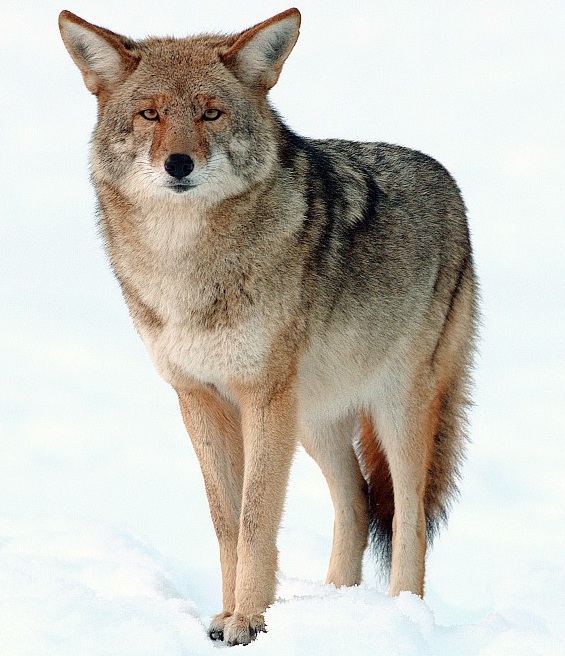
| - The coyote typically has a coat combining light gray, reddish or fulvous, black, and white coloration. English Wikipedia
- Coyotes have pointed ears, a narrow muzzle, and a bushy tail with a black tip. nps.gov
- Coyotes generally have a grey-brown coat with black-tipped hairs along their backs. nps.gov
- The coyote has longer ears and a relatively larger braincase than the gray wolf. English Wikipedia
- Coyotes carry their tails downward when walking or running. English Wikipedia
|
|---|
| Size | | - Male coyotes typically weigh between 8 and 20 kg. English Wikipedia
- Female coyotes typically weigh between 7 and 18 kg. English Wikipedia
- Adult coyotes have an average total body length, including the tail, of 1.0 to 1.35 m. English Wikipedia
- The coyote's tail measures approximately 40 cm in length. English Wikipedia
- The average shoulder height of coyotes ranges from 18 to 23 inches. nps.gov
- Coyotes average approximately 20 to 35 pounds in weight according to the Jewel Cave National Monument account. nps.gov
- Northern coyote subspecies average approximately 18 kg, compared with 11.5 kg for southern Mexican subspecies. English Wikipedia
|
|---|
| Habitat | - The species generally prefers open habitats with little dense vegetation. English Wikipedia
- It occupies habitats ranging from arid coastal deserts to areas receiving more than 2,000 mm of rainfall. English Wikipedia
- Its recorded habitats include semi-desert scrublands and alpine regions. English Wikipedia
- The species occurs in agricultural fields and peri-urban environments. English Wikipedia
- Its recorded habitats include farmlands and savannas. English Wikipedia
| |
|---|
| Diet | - The black-backed jackal is omnivorous. English Wikipedia
- Its invertebrate prey includes beetles, grasshoppers, crickets, termites, millipedes, spiders, and scorpions. English Wikipedia
- Its mammalian prey includes rodents, hares, and young antelopes up to the size of topi calves. English Wikipedia
- The species also consumes carrion, birds, bird eggs, lizards, and snakes. English Wikipedia
- Jackals living in coastal areas consume beached marine mammals, seals, fish, and mussels. English Wikipedia
- The species occasionally eats fruits and berries. English Wikipedia
- In South Africa, impalas and springboks are among its principal antelope prey. English Wikipedia
- Jackals along the Namib Desert coastline primarily consume marine birds, marine mammals, fish, and insects. English Wikipedia
- The species consumes the fruits of the !nara melon in the Namib Desert and disperses its seeds through defecation. English Wikipedia
| - Coyotes preferentially prey on Dall's sheep, white-tailed deer, eastern cottontail rabbits, and California voles. pmc.ncbi.nlm.nih.gov
- Coyotes avoid preying on small mammals, including carnivorans and arboreal species. pmc.ncbi.nlm.nih.gov
- Coyotes consume deer, rabbits, hares, rodents, birds, reptiles, amphibians, fish, and invertebrates. English Wikipedia
- Coyotes occasionally consume fruits and vegetables. English Wikipedia
- Coyotes in the southern United States may consume more frogs than coyotes in other regions. nps.gov
- Coyotes in the Yukon may consume more berries. nps.gov
- Vegetation consumption by coyotes is greatest during summer and autumn. research.fs.usda.gov
|
|---|
| Behaviour | - The black-backed jackal is monogamous and territorial. English Wikipedia
- Its basic social unit consists of a monogamous breeding pair that defends its territory. English Wikipedia
- Breeding pairs mark territorial boundaries using faeces and urine. English Wikipedia
- Older offspring may remain with their parents to help raise subsequent litters. English Wikipedia
- The species communicates through vocalisations including yelling, yelping, woofing, whining, growling, and cackling. English Wikipedia
- The species caches surplus food. English Wikipedia
| - Coyotes can live either in family units or in loosely organized packs of unrelated individuals. English Wikipedia
- Coyotes can hunt either individually or in groups. pmc.ncbi.nlm.nih.gov
- Coyotes may form groups of five to six adults under favorable conditions. nps.gov
- Coyote packs containing more than ten animals have been observed. nps.gov
- Coyotes may establish and defend territories or survive as nonterritorial transient individuals. pmc.ncbi.nlm.nih.gov
- Coyotes characteristically produce howls that rapidly change in tone and pitch. English Wikipedia
|
|---|
| Reproduction | | |
|---|
| Distribution | - The black-backed jackal is native to eastern and southern Africa. English Wikipedia
- Its southern African distribution includes South Africa, Namibia, Botswana, and Zimbabwe. English Wikipedia
- Its eastern African distribution includes Kenya, Somalia, Djibouti, Eritrea, and Ethiopia. English Wikipedia
| - Coyotes are native to North America. English Wikipedia
- Coyotes occur throughout North and Central America. animaldiversity.org
- Coyotes have expanded their geographic range by approximately 40 percent over the past 120 years. research.fs.usda.gov
- Coyotes currently occur in every US state except Hawaii and extend as far north as the Arctic. nps.gov
- Coyotes were first sighted in eastern Panama in 2013. English Wikipedia
|
|---|
| Conservation | - The black-backed jackal is classified as Least Concern on the IUCN Red List. English Wikipedia
- Its Least Concern classification is attributed to its widespread distribution and adaptability. English Wikipedia
- The species experiences persecution because it is considered a livestock predator and rabies vector. English Wikipedia
| - The coyote is classified as Least Concern by the International Union for Conservation of Nature. English Wikipedia
- Human persecution is a major cause of coyote mortality. nps.gov
- Trapping for their pelts is one of the major causes of coyote mortality throughout their range. nps.gov
- Coyotes have expanded their range despite substantial persecution related to actual or perceived livestock predation. pmc.ncbi.nlm.nih.gov
|
|---|
| Similar species | - The black-backed jackal is closely related to the side-striped jackal. English Wikipedia
- The black-backed jackal is more distantly related to the golden jackal. English Wikipedia
| No checked fact yet |
|---|
| Name origin | No checked fact yet | |
|---|