Comparison
Black Mamba vs Common Krait
Black Mamba (Dendroaspis polylepis) and Common Krait (Bungarus caeruleus) both belong to the family Elapidae (cobras) and part ways below it.

Black Mamba
Dendroaspis polylepis
Bill Love/Blue Chameleon Ventures, CC BY-SA 3.0, via Wikimedia Commons


How they differ
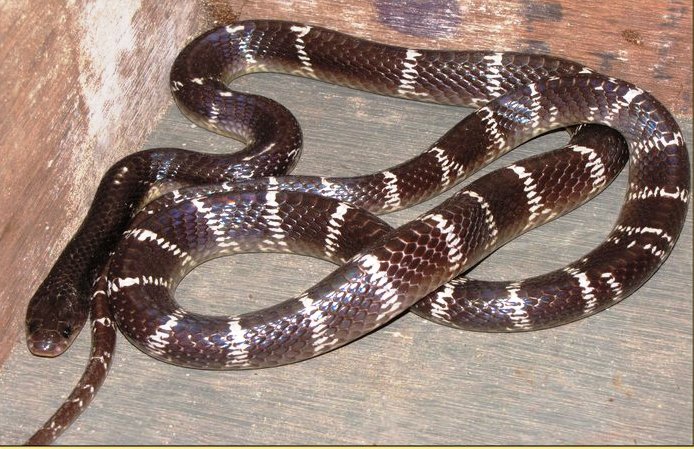
The black mamba has a long, slender body, a coffin-shaped head and a mouth that is dark bluish-grey to nearly black, whereas the common krait has a flat head, small eyes and a generally black or bluish-black body with narrow white crossbands. The black mamba is active during daylight hours, whereas the common krait is nocturnal and hides during the day. The black mamba primarily preys on small mammals, whereas the common krait primarily feeds on other snakes.
| Black Mamba | Common Krait | |
|---|---|---|
| Appearance | The black mamba has 23–25 rows of dorsal scales at midbody and front-facing fangs measuring up to 6.5 mm. | The common krait has 15–17 rows of highly polished scales and an enlarged hexagonal vertebral row. |
| Behaviour | Black mambas may return daily to the same basking location and maintain permanent lairs. | The common krait generally avoids confrontation, rarely bites unless provoked and may coil tightly with its head tucked underneath when threatened. |
| Habitat | Black mambas inhabit savannah, woodland, rocky slopes and, in some regions, dense forest. | The common krait inhabits scrub jungles, grasslands, agricultural fields, semi-desert environments and rocky terrain. |
| Shelter | Black mambas use termite mounds, abandoned burrows, rock crevices and tree cracks as shelters. | The common krait takes refuge in termite mounds, rat burrows and locations beneath debris. |
| Conservation | The black mamba is classified as Least Concern on the IUCN Red List. | The common krait is reported to have a stable population despite localized habitat fragmentation and persecution. |
| Other | The black mamba was formally described by Albert Günther in 1864. | The common krait is highly venomous and its venom is predominantly neurotoxic. |
Written from the checked facts listed further down. Statements that the sources did not support were removed.
Side by side
| Black Mamba | Common Krait | |
|---|---|---|
| Scientific name | Dendroaspis polylepis Günther, 1864 | Bungarus caeruleus (Schneider, 1801) |
| English name | Black Mamba | Common Krait |
| Group | Reptiles | Reptiles |
| Class | Reptilia Reptile | Reptilia Reptile |
| Order | Squamata Snakes | Squamata Snakes |
| Family | Elapidae Cobras | Elapidae Cobras |
| Genus | Dendroaspis Mamba | Bungarus Deathpickers |
| Named in | 1864 | 1801 |
| Red List category | Least Concern | Least Concern |
| Countries on record | 26 countries | 8 countries |
| GBIF occurrence records | 1,531 records | 1,003 records |
Rows where the two agree are shown in grey.
Where each is found
Only Black Mamba (26)
- Angola
- Botswana
- Burkina Faso
- Cameroon
- Central African Republic
- Democratic Republic of the Congo
- Eritrea
- Eswatini
- Ethiopia
- Guinea
- Guinea-Bissau
- Ivory Coast
- Kenya
- Malawi
- Mozambique
- Namibia
- Rwanda
- Senegal
- Somalia
- South Africa
- South Sudan
- Sudan
- Tanzania
- Uganda
- Zambia
- Zimbabwe
Only Common Krait (8)
From Catalogue of Life checklists and GBIF occurrence records. A country missing from a list means no record is held, which is not proof of absence.
Checked facts
| Black Mamba | Common Krait | |
|---|---|---|
| Appearance |
|
|
| Size |
|
|
| Habitat |
|
|
| Diet |
|
|
| Behaviour |
|
|
| Reproduction |
|
|
| Distribution |
|
|
| Conservation |
|
|
| Uses |
| No checked fact yet |
| Other |
|
|
In brief
Black Mamba
The Black Mamba is a snake species formally described by Albert Günther in 1864. It occurs across sub-Saharan Africa, from Eritrea southwards through South Africa and westwards to Namibia. It is the longest venomous snake species in Africa. Full profile
Common Krait
The Common Krait (Bungarus caeruleus) is a highly venomous snake in the family Elapidae, order Squamata and class Reptilia. It occurs in India, Pakistan, Bangladesh, Sri Lanka and Nepal, with a reported western extent including Afghanistan and potentially parts of Iran. It is predominantly nocturnal and feeds primarily on other snakes, including venomous kraits and vipers. Full profile
Compare something else
Page built on 24 November 2026 from the data on the two species pages, where every source is listed.
Cite this page
ScientificNames.org. (2026). Black Mamba vs Common Krait. Retrieved November 24, 2026, from https://scientificnames.org/compare/black-mamba-vs-common-krait
“Black Mamba vs Common Krait.” ScientificNames.org, 2026, scientificnames.org/compare/black-mamba-vs-common-krait. Accessed 24 Nov. 2026.
ScientificNames.org. “Black Mamba vs Common Krait.” Accessed November 24, 2026. https://scientificnames.org/compare/black-mamba-vs-common-krait.
@misc{scientificnames_black_mamba_vs_common_krait,
  author = {{ScientificNames.org}},
  title = {Black Mamba vs Common Krait},
  year = {2026},
  url = {https://scientificnames.org/compare/black-mamba-vs-common-krait},
  note = {Accessed 2026-11-24}
}