Species · Reptiles
Black Mamba Dendroaspis polylepis
The scientific name of the Black Mamba is Dendroaspis polylepis. It is a species of reptile in the family Elapidae (cobras), order Squamata. The name dates from 1864.
- Scientific name
- Dendroaspis polylepis Günther, 1864
- Common name
- Black Mamba
- Genus
- Dendroaspis
- Family
- Elapidae (Cobras)
- Order
- Squamata
- Class
- Reptilia
- Red List category
- LC Least Concern
- Recorded in
- 26 countries
- Name status
- accepted in the Catalogue of Life

Overview
The Black Mamba is a snake species formally described by Albert Günther in 1864. It occurs across sub-Saharan Africa, from Eritrea southwards through South Africa and westwards to Namibia. It is the longest venomous snake species in Africa.
Written 24 November 2026 from the sources listed below. Each statement was checked against the passage it cites; statements that could not be supported were removed.
Appearance
The Black Mamba has a long, slender, cylindrical body and a coffin-shaped head with a pronounced brow ridge. Adult coloration ranges from olive and yellowish-brown to khaki and gunmetal, while black coloration is rare. Juveniles are generally grey or olive green and darken as they mature.[1][2][3]
The inside of the mouth is dark bluish-grey to nearly black, and the underbelly is greyish-white. The species has 23–25 rows of dorsal scales at midbody and front-facing fangs measuring up to 6.5 mm.[4][5][6][7]
Adult Black Mambas typically measure between 2 and 3 metres in length, while exceptional specimens have been reported to reach 4.5 metres. The tail accounts for approximately 17–25% of body length.[8][9][10]
A study of seven Black Mambas recorded an average body mass of 1.03 kg.[11]
Habitat
The Black Mamba inhabits savannah, woodland, rocky slopes and, in some regions, dense forest. It occurs in moderately dry environments, including light woodland, scrub, rocky outcrops and semi-arid savanna, as well as moist savanna and lowland forests.[12][13][14]
The species prefers wooded savannah, rocky hills and riverine forests containing rocks or fallen trees that provide cover. It uses termite mounds, abandoned burrows, rock crevices, tree cracks and hollow trees as shelters.[15][16][17]
Black Mambas are predominantly ground-travelling but can also live in trees. They are generally uncommon above elevations of 1,000 metres.[18][19]
Diet
The Black Mamba primarily preys on small mammals, including rodents, squirrels, hyraxes and small antelope. It occasionally consumes birds and other snakes.[20][21][22]
After biting prey, the Black Mamba generally releases it and waits for paralysis and death before swallowing it. Prey can be digested completely within eight to ten hours.[23][24]
Behaviour
The Black Mamba is active during daylight hours and may return daily to the same basking location. It maintains permanent lairs and returns to them when undisturbed.[25][26][27]
When provoked, Black Mambas can deliver several rapid strikes. They can move at speeds of up to 16 km/h over suitable surfaces for short distances.[28][29]
Reproduction and life cycle
The Black Mamba reproduces by laying eggs. Breeding takes place between September and February, and females lay clutches containing between 6 and 17 eggs.[30][31][32]
After mating, females deposit their eggs in a burrow or another suitable hatching location and abandon them. The eggs typically measure 60–80 mm long and 30–36 mm in diameter.[33][34]
Newly hatched Black Mambas measure approximately 40–60 cm in length. Hatchlings can reach 2 metres in length after their first year.[35][36]
Conservation
The Black Mamba is classified as Least Concern on the IUCN Red List.[37]
Uses
The Black Mamba helps control rodent populations through predation.[38]
Classification of the Black Mamba
| Kingdom | Animalia |
|---|---|
| Phylum | Chordata |
| Subphylum | Vertebrata |
| Infraphylum | Gnathostomata |
| Parvphylum | Osteichthyes |
| Megaclass | Tetrapoda |
| Class | Reptilia (Reptile) |
| Order | Squamata (Snakes) |
| Suborder | Serpentes (Snakes) |
| Infraorder | Alethinophidia |
| Family | Elapidae (Cobras) |
| Genus | Dendroaspis (Mamba) |
| Species | Dendroaspis polylepis Günther, 1864 |
Where the Black Mamba is found
Checklists and occurrence records place Dendroaspis polylepis in 26 countries across Africa. GBIF holds 1,531 georeferenced records of it.
Countries
- Angola 17
- Botswana 48
- Burkina Faso
- Cameroon 1
- Central African Republic 6
- Democratic Republic of the Congo 18
- Eritrea 1
- Eswatini 15
- Ethiopia 9
- Guinea 6
- Guinea-Bissau 1
- Ivory Coast 1
- Kenya 116
- Malawi 19
- Mozambique 16
- Namibia 74
- Rwanda 4
- Senegal 3
- Somalia 8
- South Africa 671
- South Sudan 2
- Sudan
- Tanzania 50
- Uganda 6
- Zambia 224
- Zimbabwe 215
Regions and cities with the most records
- Limpopo, South Africa 225
- KwaZulu-Natal, South Africa 189
- Mpumalanga, South Africa 150
- Lusaka Province, Zambia 52
- Ntuzuma, South Africa 45
- Central Province, Zambia 36
- Southern Province, Zambia 36
- Pinetown, South Africa 32
- Mbombela, South Africa 30
- Durban, South Africa 29
- North West, South Africa 28
- North-Western, Zambia 27
- Madido, Zambia 25
- North-West, Botswana 25
- Lusaka, Zambia 18
- Copperbelt, Zambia 17
- Tongaat, South Africa 17
- Western Province, Zambia 17
- Narok County, Kenya 16
- Otjozondjupa Region, Namibia 16
- Chilanga Township, Zambia 14
- Eastern Province, Zambia 14
- Samburu County, Kenya 14
- Kilifi, Kenya 12
- Kilifi County, Kenya 12
- Taita Taveta, Kenya 12
- Kafue, Zambia 11
- Kitui County, Kenya 11
- Matsulu, South Africa 10
- Muchinga, Zambia 10
- Zambezi Region, Namibia 10
- Hardap Region, Namibia 9
- Luapula Province, Zambia 9
- Mtwapa, Kenya 8
- Central, Botswana 7
- Kisumu County, Kenya 7
Range as the checklists state it
Angola, Botswana, Burkina Faso, Central African Republic, Eritrea, Senegal, Guinea (Conakry), Guinea-Bissau, Cameroon (Adamaoua [HR 35: 191]), Ethiopia, Ivory Coast, Kenya, Malawi, Mozambique, Namibia, Republic of South Africa (Eastern Cape etc.), Somalia, Eswatini (Swaziland), Tanzania, Uganda, N/S Democratic Republic of the Congo (Zaire), Zambia, Zimbabwe, Republic of South Sudan (RSS), Sudan (Jumhūriyyat)
A number beside a place is its count of GBIF occurrence records. A place without a number comes from a checklist alone. Records show where a species has been observed or collected, which can include escapes and vagrants.
Common names
English
- Black Mamba
- Black Current
- Common Black Mamba
- Ethiopian Black Mamba
Names in 30 other languages
- Afrikaans
- Swartmamba
- Asturian
- mamba prieta
- Belarusian
- Чорная мамба
- Chinese
- 黑曼巴蛇
- Czech
- mamba černá
- Danish
- Sort Mamba
- Dutch
- Zwarte Mamba
- Finnish
- Mustamamba
- French
- Mamba Noir
- German
- Schwarze Mamba
- Hungarian
- fekete mamba
- Indonesian
- Mamba hitam
- Italian
- Mamba nero, Serpente dei sette passi
- Japanese
- ブラックマンバ
- Norwegian Bokmål
- Svart Mamba
- Polish
- mamba czarna
- Portuguese
- Mamba-preta
- Russian
- Чёрная мамба
- Spanish
- Mamba Negra
- Swahili
- koboko
- Thai
- งูแบล็คแมมบา, งูแบล็คแมมบ้า
- Tswana
- Mokôpa, Phika, mokwepa, mokwepa o montsho
- Turkish
- Kara mamba
- Ukrainian
- Мамба чорна
- Xhosa
- iMamba emnyama
- dav
- ilimanjighu
- din
- Choch
- kth
- Mhakure, Rovambira, nyamubobo
- sna
- Hangara
- ven
- Khangala
Synonyms
4 other scientific names have been used for this species and are now treated as synonyms of Dendroaspis polylepis.
- Dendraspis antinorii Peters, 1873
- Dendraspis mamba Gough, 1908
- Dendroaspis polylepis antinorii (W. C. H. Peters, 1873)
- Dendraspis angusticeps Boulenger, 1896 ambiguous synonym
Related species
-
 Eastern Green MambaDendroaspis angusticeps
-
 Jameson's MambaDendroaspis jamesoni
-
 Western Green MambaDendroaspis viridis
-
 King CobraOphiophagus hannah
-
 Inland TaipanOxyuranus microlepidotus
-
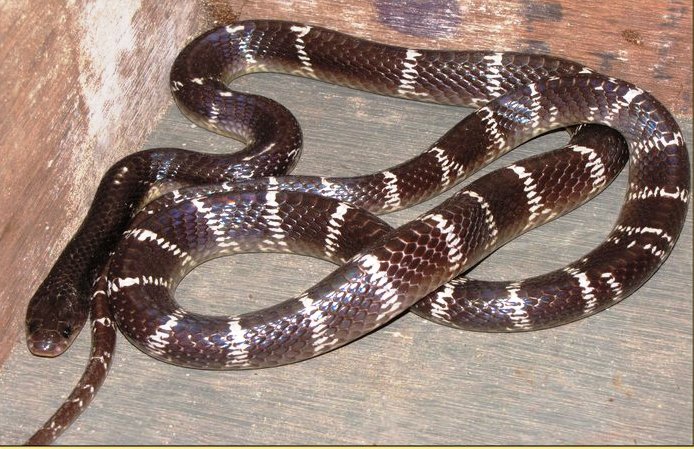 Common KraitBungarus caeruleus
-
 Eastern Brown SnakePseudonaja textilis
-
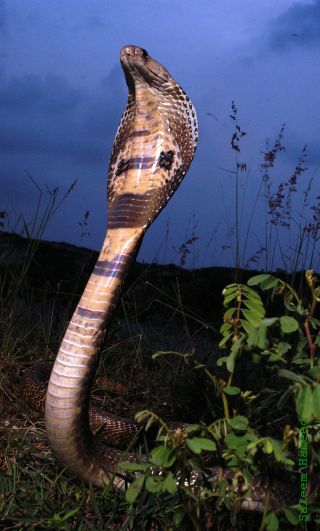 Indian CobraNaja naja
Compare
Questions and answers
What is the scientific name of the Black Mamba?
The scientific name of the Black Mamba is Dendroaspis polylepis. Written with its author, the full name is Dendroaspis polylepis Günther, 1864.
Which family does the Black Mamba belong to?
Dendroaspis polylepis belongs to the family Elapidae, in the order Squamata and the class Reptilia.
Where is the Black Mamba found?
Checklists and occurrence records place Dendroaspis polylepis in 26 countries, including South Africa, Zambia, Zimbabwe, Kenya, Namibia and Tanzania.
What is the conservation status of the Black Mamba?
The IUCN Red List category recorded for Dendroaspis polylepis is Least Concern (LC).
What other names does the Black Mamba have?
Dendroaspis polylepis is also known in English as Black Current, Common Black Mamba and Ethiopian Black Mamba.
Sources
Passages the profile rests on
- The black mamba has a long, slender, cylindrical body and a coffin-shaped head with a pronounced brow ridge. Source passage: “The black mamba is a long, slender, cylindrical snake. It has a coffin-shaped head with a somewhat pronounced brow ridge” — English Wikipedia
- Adult black mambas vary in colour from olive and yellowish-brown to khaki and gunmetal, with black coloration being rare. Source passage: “Specimens vary considerably in colour, including olive, yellowish-brown, khaki and gunmetal but are rarely black.” — English Wikipedia
- Juvenile black mambas are generally grey or olive green and darken as they mature. Source passage: “Juvenile snakes are lighter in colour than adults; these are typically grey or olive green and darken as they age.” — English Wikipedia
- The inside of the black mamba's mouth is dark bluish-grey to nearly black. Source passage: “The common name is derived from the appearance of the inside of the mouth, dark bluish-grey to nearly black.” — English Wikipedia
- The black mamba has greyish-white underbellies. Source passage: “Black mambas have greyish-white underbellies.” — English Wikipedia
- The black mamba has 23–25 rows of dorsal scales at midbody. Source passage: “The black mamba has between 23 and 25 rows of dorsal scales at midbody” — English Wikipedia
- The black mamba has front-facing fangs measuring up to 6.5 mm. Source passage: “with fangs up to 6.5 mm (0.26 in) in length, located at the front of the maxilla.” — English Wikipedia
- Adult black mambas typically measure between 2 and 3 metres in length. Source passage: “The adult snake's length typically ranges from 2 to 3 m (6 ft 7 in to 9 ft 10 in)” — English Wikipedia
- Exceptional black mamba specimens have been reported to reach 4.5 metres in length. Source passage: “specimens have grown to lengths of 4.3 to 4.5 m (14 ft 1 in to 14 ft 9 in).” — English Wikipedia
- The black mamba's tail accounts for approximately 17–25% of its body length. Source passage: “the caudal vertebrae making up 17–25% of its body length.” — English Wikipedia
- A study of seven black mambas recorded an average body mass of 1.03 kg. Source passage: “a study of seven black mambas found an average weight of 1.03 kg (2.3 lb)” — English Wikipedia
- Black mambas inhabit savannah, woodland, rocky slopes and, in some regions, dense forest. Source passage: “it inhabits savannah, woodland, rocky slopes and in some regions, dense forest.” — English Wikipedia
- The species prefers moderately dry environments, including light woodland, scrub, rocky outcrops and semi-arid savanna. Source passage: “The species prefers moderately dry environments such as light woodland and scrub, rocky outcrops and semi-arid savanna.” — English Wikipedia
- Black mambas also inhabit moist savanna and lowland forests. Source passage: “It also inhabits moist savanna and lowland forests.” — English Wikipedia
- Black mambas use termite mounds, abandoned burrows, rock crevices and tree cracks as shelters. Source passage: “typically uses termite mounds, abandoned burrows, rock crevices and tree cracks as shelter.” — English Wikipedia
- Black mambas prefer wooded savannah, rocky hills and riverine forests containing rocks or fallen trees that provide cover. Source passage: “Dendroaspis polylepis individuals prefer wooded savannah, rocky hills, or riverine forests with rocks or downed trees that provide cover.” — animaldiversity.org
- Black mambas can shelter in hollow trees and termite mounds. Source passage: “They may also be found hiding in hollow trees or termite mounds.” — animaldiversity.org
- Black mambas are predominantly ground-travelling but can also live in trees. Source passage: “Though they prefer traveling on the ground, they are also arboreal.” — animaldiversity.org
- Black mambas are generally uncommon above elevations of 1,000 metres. Source passage: “It is not commonly found at altitudes above 1,000 m (3,300 ft)” — English Wikipedia
- Black mambas primarily prey on small mammals, including rodents, squirrels, hyraxes and small antelope. Source passage: “It mostly preys on small vertebrates such as birds, particularly fledglings, and small mammals like rodents, squirrels, hyraxes and small antelope.” — English Wikipedia
- Black mambas occasionally consume birds and other snakes. Source passage: “They generally prefer warm-blooded prey but will also consume other snakes.” — English Wikipedia
- Black mambas primarily consume small mammals such as rodents, squirrels and hyraxes, with birds taken occasionally. Source passage: “Black mambas feed mostly on small mammals, including rodents , squirrels , and dassies or hyraxes . They also take birds occasionally.” — animaldiversity.org
- Black mambas generally release bitten prey and wait for paralysis and death before swallowing it. Source passage: “The black mamba does not typically hold onto its prey after biting; rather it releases its quarry and waits for it to succumb to paralysis and death before it is swallowed.” — English Wikipedia
- Black mambas can digest their prey completely within eight to ten hours. Source passage: “The snake's potent digestive system has been recorded to fully digest prey in eight to ten hours.” — English Wikipedia
- Black mambas are active during daylight hours. Source passage: “Black mambas are diurnal” — English Wikipedia
- Black mambas may return daily to the same basking location. Source passage: “They may return daily to the same basking site.” — English Wikipedia
- Black mambas maintain permanent lairs and return to them when undisturbed. Source passage: “If undisturbed, D. polylepis will maintain a permanent lair to which it returns when not hunting, basking, mating, or seeking refuge elsewhere.” — animaldiversity.org
- Black mambas can deliver several rapid strikes when provoked. Source passage: “During the threat display, any sudden movement by the intruder may provoke the snake into performing a series of rapid strikes” — English Wikipedia
- Black mambas can move at speeds of up to 16 km/h over suitable surfaces for short distances. Source passage: “Over suitable surfaces, it can move at speeds up to 16 km/h (10 mph) for short distances.” — English Wikipedia
- Black mambas reproduce by laying eggs. Source passage: “The black mamba is oviparous;” — English Wikipedia
- Female black mambas lay clutches containing between 6 and 17 eggs. Source passage: “the female lays a clutch of 6–17 eggs.” — English Wikipedia
- Black mambas breed between September and February. Source passage: “The black mamba's breeding season spans from September to February” — English Wikipedia
- Black mamba eggs typically measure 60–80 mm long and 30–36 mm in diameter. Source passage: “typically 60–80 mm (2.4–3.1 in) long and 30–36 mm (1.2–1.4 in) in diameter.” — English Wikipedia
- After mating, female black mambas deposit their eggs in a burrow or another suitable hatching location and abandon them. Source passage: “After the eggs have developed inside the female, she will deposit them in a burrow or other suitable hatching location and then abandon them.” — animaldiversity.org
- Newly hatched black mambas measure approximately 40–60 cm in length. Source passage: “When hatched, the young range from 40–60 cm (16–24 in) in length.” — English Wikipedia
- Black mamba hatchlings can reach 2 metres in length after their first year. Source passage: “They may grow quickly, reaching 2 m (6 ft 7 in) after their first year.” — English Wikipedia
- The black mamba is classified as Least Concern on the IUCN Red List. Source passage: “It is rated as a species of least concern on the International Union for Conservation of Nature (IUCN)'s Red List of endangered species” — English Wikipedia
- Black mambas help control rodent populations through their predation. Source passage: “They are important in controlling rodent populations.” — animaldiversity.org
Data
- Catalogue of Life, 2026-10-16 XR cc by
- Global Biodiversity Information Facility CC BY 4.0
- Wikidata CC0
- GeoNames CC BY 4.0
- Wikimedia Commons per image; credit shown with each image
- Within the Catalogue of Life, this name comes from The Reptile Database cc by
References
- Günther, A. (1864). Report on a collection of reptiles and fishes made by Dr. Kirk in the Zambesi and Nyassa Regions. Proc. Zool. Soc. London 1864: 303-314 [310].
- Peters, & Wilhem Carl Hartwig. (1873). Über zwei Giftschlangen aus Afrika und über neue oder weniger bekannte Gattungen und Arten von Batrachiern. Monatsber. Königl. Akad. Wiss. Berlin. 1873 (Mai): 411-418.
- Gough, & Lewis Henry. (1908). Description of a new snake from the Transvaal. Zool. Anz. 32: 454.
- FitzSimons, F. W. (1912). The snakes of South Africa : their venom and the treatment of snake bite. William Clowes and Sons, London, 547 Pp.
- Loveridge, A. (1936). African reptiles and amphibians in the Field Museum of Natural History. Zool. Ser. Field Mus. Nat. Hist., Chicago, 22 (1): 1-122.
- Loveridge, A. (1956). On snakes collected in the Anglo-Egyptian Sudan by J.S. Owen, Esq. Sudan Notes Rec. 36: 37-56 [1955].
- Loveridge, A. (1957). On a third collection of reptiles taken in Tanganyika by C.J.P. Ionides, Esq. Tanganyika Notes and Records 43: 1-19.
- Broadley, D. G. (1959). The herpetology of Southern Rhodesia. Part I--the snakes. Bull. Mus. Comp. Zool. Harvard 120 (1): 1-100 [Reprint 1972].
- Broadley, D. G. (1961). Snakes of Southem Rhodesia. 11. The Black Mamba (Dendroaspis polylepis polylepis). Afr. Wild Life 15: 299-302.
- Broadley, D. G. (1962). On some reptile collections from the North-Western and North-Eastern Districts of Southern Rhodesia 1958-1961, with descriptions of four new lizards. Occ. Pap. Nat. Mus. South. Rhodesia 26 (B): 787-843.
- Robertson, I. A. D., B. M. Chapman and N. F. Chapman. (1963). Notes on some reptiles collected in the Rukwa Valley, S. W. Tanganyika. Ann. Mag. Nat. Hist. Ser. 13, 5(55): 421‑432.
- Armitage, W. W. (1965). Observations on Differences in Morphology and Behavior of Dendroaspis angusticeps and Dendroaspis polylepis. J. Herp. Assoc. Africa (1): 12-16.
- Pitman, C. R. S. (1974). A guide to the snakes of Uganda. Codicote, Wheldon & Wesley, L., 290 Pp.
- Pienaar, & Uys de Villiers. (1978). The Reptile Fauna of the Kruger National Park. Pretoria: National Parks Board of South Africa, I-Vii, 222 S.
- Spawls, S. (1978). A checklist of the snakes of Kenya. East Afr. Natur. Hist. Soc. And Natl. Mus., Nairobi, J. No. 167 18 Pp.
- Branch, W. R. (1981). The venomous snakes of southern Africa 2. Elapidae and Hydrophidae. Bull. Maryland Herp. Soc. 17 (1): 1-47.
- Föhrenbach, H. (1982). Dendroaspis polylepis in Westafrika. Herpetofauna 4 (17): 34.
- Håkansson, T. & T. Madsen. (1983). On the Distribution of the Black Mamba (Dendroaspis polylepis) in West Africa. Journal of Herpetology 17 (2): 186-189.
- Auerbach, R. D. (1987). The Amphibians and Reptiles of Botswana. Mokwepa Consultants, Botswana, 295 Pp.
- Lanza, B. (1990). Amphibians and reptiles of the Somali Democratic Republic: check list and biogeography. Biogeographia, 14: 407-465 [1988].
- Haagner, G. V. (1990). Venoms and Snakebite: Dendroaspis polylepis: Envenomation. J. Herp. Assoc. Africa (37): 59-59.
- Chifundera, K. (1990). Snakes of Zaire and their bites. Afr. Stud. Monogr. (Kyoto) 10(3): 137-157.
- Broadley, D. G., & HOWELL, K. M. (1991). A check list of the reptiles of Tanzania, with synoptic keys. Syntarsus 1: 1—70.
- Haagner, G. V. (1991). Venoms and Snakebite: Dendroaspis polylepis: Envenomation. J. Herp. Assoc. Africa (39): 28-29.
- Broadley, D. G. (1991). The Herpetofauna of Northern Mwinilunga Distr., Northw. Zambia. Arnoldia Zimbabwe 9 (37): 519-538.
This species in other databases
Page built on 24 November 2026. See how the catalog is made and all sources and licences.
Cite this page
ScientificNames.org. (2026). Dendroaspis polylepis (Black Mamba). Retrieved November 24, 2026, from https://scientificnames.org/species/dendroaspis-polylepis
“Dendroaspis polylepis (Black Mamba).” ScientificNames.org, 2026, scientificnames.org/species/dendroaspis-polylepis. Accessed 24 Nov. 2026.
ScientificNames.org. “Dendroaspis polylepis (Black Mamba).” Accessed November 24, 2026. https://scientificnames.org/species/dendroaspis-polylepis.
@misc{scientificnames_dendroaspis_polylepis_black_mamba,
  author = {{ScientificNames.org}},
  title = {Dendroaspis polylepis (Black Mamba)},
  year = {2026},
  url = {https://scientificnames.org/species/dendroaspis-polylepis},
  note = {Accessed 2026-11-24}
}