Comparison
Black Mamba vs Indian Cobra
Black Mamba (Dendroaspis polylepis) and Indian Cobra (Naja naja) both belong to the family Elapidae (cobras) and part ways below it.

Black Mamba
Dendroaspis polylepis
Bill Love/Blue Chameleon Ventures, CC BY-SA 3.0, via Wikimedia Commons


How they differ
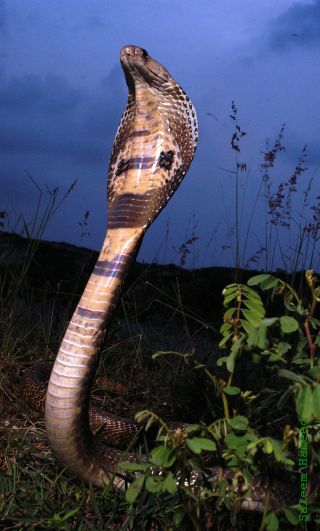
The black mamba has a long, slender, cylindrical body and a coffin-shaped head, while the Indian cobra has a moderately sized, heavy-bodied form and a relatively large hood. The black mamba varies from olive and yellowish-brown to khaki and gunmetal, while many Indian cobras have two circular, eye-like hood patterns connected by a curved line. The black mamba primarily preys on small mammals, while the Indian cobra feeds on rodents, plovers, grebes, lizards, and frogs.
| Black Mamba | Indian Cobra | |
|---|---|---|
| Body shape | The black mamba has a long, slender, cylindrical body and a coffin-shaped head with a pronounced brow ridge. | The Indian cobra has a moderately sized, heavy-bodied form with a relatively large hood. |
| Defensive behaviour | Black mambas can deliver several rapid strikes when provoked. | The Indian cobra expands its hood when threatened. |
| Habitat | Black mambas inhabit savannah, woodland, rocky slopes and, in some regions, dense forest. | The Indian cobra inhabits dense and open forests, plains, agricultural lands, rocky terrain, and wetlands. |
| Prey consumption | Black mambas generally release bitten prey and wait for paralysis and death before swallowing it. | The Indian cobra bites its prey quickly and subsequently waits for its venom to paralyse or kill it before swallowing its prey whole. |
| Conservation status | The black mamba is classified as Least Concern on the IUCN Red List. | The Indian cobra is protected under India's Wildlife Protection Act of 1972. |
Written from the checked facts listed further down. Statements that the sources did not support were removed.
Side by side
| Black Mamba | Indian Cobra | |
|---|---|---|
| Scientific name | Dendroaspis polylepis Günther, 1864 | Naja naja (Linnaeus, 1758) |
| English name | Black Mamba | Indian Cobra |
| Group | Reptiles | Reptiles |
| Class | Reptilia Reptile | Reptilia Reptile |
| Order | Squamata Snakes | Squamata Snakes |
| Family | Elapidae Cobras | Elapidae Cobras |
| Genus | Dendroaspis Mamba | Naja Cobras |
| Named in | 1864 | 1758 |
| Red List category | Least Concern | Least Concern |
| Environment | Not recorded | terrestrial |
| Countries on record | 26 countries | 15 countries |
| GBIF occurrence records | 1,531 records | 2,471 records |
Rows where the two agree are shown in grey.
Where each is found
Only Black Mamba (26)
- Angola
- Botswana
- Burkina Faso
- Cameroon
- Central African Republic
- Democratic Republic of the Congo
- Eritrea
- Eswatini
- Ethiopia
- Guinea
- Guinea-Bissau
- Ivory Coast
- Kenya
- Malawi
- Mozambique
- Namibia
- Rwanda
- Senegal
- Somalia
- South Africa
- South Sudan
- Sudan
- Tanzania
- Uganda
- Zambia
- Zimbabwe
Only Indian Cobra (15)
- Bangladesh
- Bhutan
- China
- India
- Indonesia
- Malaysia
- Myanmar
- Nepal
- Pakistan
- Philippines
- Singapore
- Sri Lanka
- Taiwan
- Thailand
- Vietnam
From Catalogue of Life checklists and GBIF occurrence records. A country missing from a list means no record is held, which is not proof of absence.
Checked facts
| Black Mamba | Indian Cobra | |
|---|---|---|
| Appearance |
|
|
| Size |
| No checked fact yet |
| Habitat |
|
|
| Diet |
|
|
| Behaviour |
|
|
| Reproduction |
|
|
| Distribution |
|
|
| Conservation |
|
|
| Uses |
|
|
| Similar species | No checked fact yet |
|
| Other |
|
|
In brief
Black Mamba
The Black Mamba is a snake species formally described by Albert Günther in 1864. It occurs across sub-Saharan Africa, from Eritrea southwards through South Africa and westwards to Namibia. It is the longest venomous snake species in Africa. Full profile
Indian Cobra
The Indian Cobra (Naja naja) is a reptile in the family Elapidae, order Squamata, and genus Naja. It is native to the Indian subcontinent, with a documented distribution in India, Pakistan, Sri Lanka, Bangladesh, and southern Nepal. It is a moderately sized, heavy-bodied snake with a relatively large hood that expands when threatened. Full profile
Compare something else
Page built on 24 November 2026 from the data on the two species pages, where every source is listed.
Cite this page
ScientificNames.org. (2026). Black Mamba vs Indian Cobra. Retrieved November 24, 2026, from https://scientificnames.org/compare/black-mamba-vs-indian-cobra
“Black Mamba vs Indian Cobra.” ScientificNames.org, 2026, scientificnames.org/compare/black-mamba-vs-indian-cobra. Accessed 24 Nov. 2026.
ScientificNames.org. “Black Mamba vs Indian Cobra.” Accessed November 24, 2026. https://scientificnames.org/compare/black-mamba-vs-indian-cobra.
@misc{scientificnames_black_mamba_vs_indian_cobra,
  author = {{ScientificNames.org}},
  title = {Black Mamba vs Indian Cobra},
  year = {2026},
  url = {https://scientificnames.org/compare/black-mamba-vs-indian-cobra},
  note = {Accessed 2026-11-24}
}