Species · Insects
Bullet Ant Paraponera clavata
The scientific name of the Bullet Ant is Paraponera clavata. It is a species of insect in the family Formicidae (ant), order Hymenoptera. The name dates from 1775.
- Scientific name
- Paraponera clavata (Fabricius, 1775)
- Common name
- Bullet Ant
- Genus
- Paraponera
- Family
- Formicidae (Ant)
- Order
- Hymenoptera
- Class
- Insecta
- Recorded in
- 13 countries
- Name status
- accepted in the Catalogue of Life

Overview
Paraponera clavata inhabits humid lowland rainforests in Central and South America. Its sting causes severe pain lasting up to 24 hours.
Written 24 November 2026 from the sources listed below. Each statement was checked against the passage it cites; statements that could not be supported were removed.
Appearance
Worker ants have stout, reddish-black bodies and are wingless. They measure between 18 and 30 mm in length, and the queen is only slightly larger than the workers.[1][2][3]
Habitat
The Bullet Ant inhabits humid lowland rainforests in Central and South America. Colonies are generally established at the bases of trees and typically occur at elevations between sea level and 750 metres.[4][5][6]
Workers forage in vegetation above their nests, sometimes reaching the upper canopy. They forage in tree canopies to obtain food.[7][8]
On Barro Colorado Island, nests have been recorded beneath 70 tree species, six shrub species, two liana species, and one palm species.[9]
Diet
The Bullet Ant feeds on small arthropods and nectar collected in vegetation above its nest. It is predatory and preys on the glasswing butterfly.[10][11][12]
Nectar is the most frequently returned food resource brought to the nest by workers.[13]
Behaviour
Workers do not exhibit polymorphism within the worker caste. The ants are generally nonaggressive but defend their nests fiercely, producing stridulating sounds during nest defence.[14][15][16]
The ants use their stings defensively when provoked. A sting can cause severe pain lasting up to 24 hours.[17][18]
The venom contains poneratoxin, a neurotoxic peptide that affects voltage-dependent sodium ion channels. A sting releases chemicals that signal nearby bullet ants to sting repeatedly.[19][20]
Reproduction and life cycle
The nuptial phase occurs once or twice annually. Reproductive males and virgin queens leave their nests to seek mates, and females participate in mating swarms with males.[21][22][23]
Both sexes lose their wings after mating. Females then establish nests of their own.[24][25]
Conservation
Paraponera clavata is the only living species in its subfamily.[26]
Uses
The Sateré-Mawé people of Brazil use bullet ant stings in initiation ceremonies for prospective warriors or leaders.[27]
The species' venom is being investigated for possible medical applications.[28]
Classification of the Bullet Ant
| Kingdom | Animalia |
|---|---|
| Phylum | Arthropoda |
| Subphylum | Hexapoda |
| Class | Insecta (Insect) |
| Order | Hymenoptera (Ants) |
| Suborder | Apocrita (Ants) |
| Infraorder | Aculeata |
| Superfamily | Formicoidea |
| Family | Formicidae (Ant) |
| Subfamily | Paraponerinae |
| Tribe | Paraponerini |
| Genus | Paraponera |
| Species | Paraponera clavata (Fabricius, 1775) |
Where the Bullet Ant is found
Checklists and occurrence records place Paraponera clavata in 13 countries. GBIF holds 6,209 georeferenced records of it.
Countries
- Bolivia 158
- Brazil 510
- Colombia 363
- Costa Rica 2,051
- Ecuador 1,048
- French Guiana 211
- Guyana 33
- Honduras 21
- Nicaragua 93
- Panama 358
- Peru 1,289
- Suriname 26
- Venezuela 48
Regions and cities with the most records
- Heredia Province, Costa Rica 1,285
- Madre de Dios, Peru 729
- Limón Province, Costa Rica 433
- Orellana Province, Ecuador 324
- Alajuela Province, Costa Rica 264
- Napo, Ecuador 188
- Sucumbíos, Ecuador 187
- Cuzco Department, Peru 149
- Panamá Oeste Province, Panama 148
- Loreto, Peru 131
- San Martín Department, Peru 126
- Amazonas, Brazil 85
- Cayenne, French Guiana 84
- Esmeraldas, Ecuador 84
- Panamá, Panama 74
- Valle del Cauca Department, Colombia 72
- Puerto Maldonado, Peru 71
- Pichincha, Ecuador 59
- Colón, Panama 57
- La Paz Department, Bolivia 56
- Meta Department, Colombia 56
- Río San Juan Department, Nicaragua 55
- Pará, Brazil 54
- Pasco, Peru 50
- Putumayo Department, Colombia 48
- Chocó, Colombia 47
- Cochabamba, Bolivia 47
- Panama City, Panama 46
- Buenaventura, Colombia 43
- Acre, Brazil 39
- Manabí, Ecuador 37
- Mato Grosso, Brazil 37
- Zamora Chinchipe, Ecuador 37
- Arraiján, Panama 36
- Beni Department, Bolivia 35
- Mato Grosso do Sul, Brazil 34
A number beside a place is its count of GBIF occurrence records. A place without a number comes from a checklist alone. Records show where a species has been observed or collected, which can include escapes and vagrants.
Common names
English
- Bullet Ant
Names in 8 other languages
- Chinese
- 子彈蟻
- Dutch
- Kogelmier
- French
- Fourmi armée, Fourmi balle de fusil, fourmi flamande
- German
- 24-Stunden-Ameise
- Hebrew
- נמלת הקליע
- Italian
- Formica proiettile
- Portuguese
- Formiga-Bala, Formiga-Cabo-Verde, Tocandira
- Spanish
- Conga, Hormiga bala
Synonyms
8 other scientific names have been used for this species and are now treated as synonyms of Paraponera clavata.
- Formica aculeata Olivier, 1792
- Formica armata , Oliv.
- Formica clavata Fabricius, 1775
- Formica spininoda , Latr.
- Paraponera aculeata (Olivier, 1792)
- Paraponera tarsalis (Perty, 1833)
- Ponera clavata , Erichs
- Ponera tarsalis Perty, 1833
Related species
- Paraponera dieteri
-
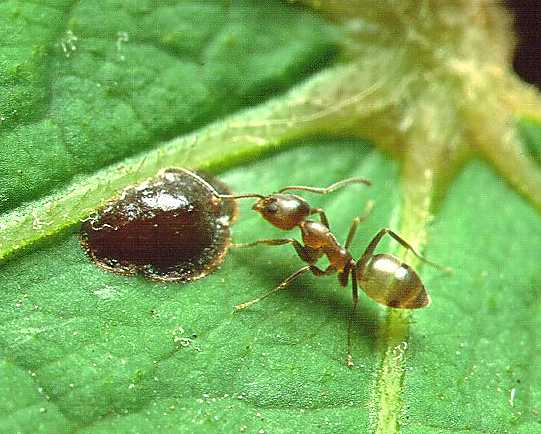 Argentine AntLinepithema humile
-
 Red Imported Fire AntSolenopsis invicta
-
 Yellow Crazy AntAnoplolepis gracilipes
-
 Pharaoh AntMonomorium pharaonis
- Jack Jumper AntMyrmecia pilosula
- Meat AntIridomyrmex purpureus
-
 Black Garden AntLasius niger
Compare
Questions and answers
What is the scientific name of the Bullet Ant?
The scientific name of the Bullet Ant is Paraponera clavata. Written with its author, the full name is Paraponera clavata (Fabricius, 1775).
Which family does the Bullet Ant belong to?
Paraponera clavata belongs to the family Formicidae, in the order Hymenoptera and the class Insecta.
Where is the Bullet Ant found?
Checklists and occurrence records place Paraponera clavata in 13 countries, including Costa Rica, Peru, Ecuador, Brazil, Colombia and Panama.
How venomous is a bullet ant?
Its sting causes severe pain lasting up to 24 hours. Its venom contains poneratoxin, a neurotoxic peptide that affects voltage-dependent sodium ion channels.[17][19]
Why is bullet ant venom so painful?
The venom contains poneratoxin, a neurotoxic peptide that affects voltage-dependent sodium ion channels. A sting causes severe pain lasting up to 24 hours.[17][19]
What do bullet ants eat?
They feed on small arthropods and nectar collected in vegetation above their nests. They are predatory and prey on the glasswing butterfly. Nectar is the most frequently returned food resource brought to the nest by workers.[10][13][11][12]
Where do bullet ants live?
They inhabit humid lowland rainforests in Central and South America. Their recorded distribution includes Honduras, El Salvador, Nicaragua, Costa Rica, Panama, Venezuela, Colombia, Ecuador, Peru, Bolivia, and Brazil. Colonies typically occur at elevations between sea level and 750 metres.[4][6][29][30]
Sources
Passages the profile rests on
- Worker ants have stout, reddish-black bodies and are wingless. Source passage: “resemble stout, reddish-black wingless wasps.” — English Wikipedia
- Worker ants measure between 18 and 30 mm in length. Source passage: “Worker ants are 18–30 mm (0.7–1.2 in) long” — English Wikipedia
- The queen is only slightly larger than the workers. Source passage: “the queen ant is not much larger than the workers.” — English Wikipedia
- The species inhabits humid lowland rainforests in Central and South America. Source passage: “It inhabits humid lowland rainforests in Central and South America.” — English Wikipedia
- Colonies are generally established at the bases of trees. Source passage: “Colonies consist of several hundred individuals and are usually situated at the bases of trees.” — English Wikipedia
- Colonies typically occur at elevations between sea level and 750 metres. Source passage: “Colonies are found in lowland areas, at elevations ranging from sea level to 750 metres (2,461 ft).” — English Wikipedia
- Workers forage in vegetation above their nests, sometimes reaching the upper canopy. Source passage: “Workers forage arboreally for small arthropods and nectar in the area directly above the nest, often as far as the upper canopy” — English Wikipedia
- Workers forage in tree canopies to obtain food. Source passage: “Bullet Ants will go into the canopy of trees to forage and find food.” — soil.evs.buffalo.edu
- On Barro Colorado Island, nests have been recorded beneath 70 tree species, six shrub species, two liana species, and one palm species. Source passage: “On BCI, the nests were found under 70 species of trees, six species of shrubs, two species of lianas, and one species of palm.” — English Wikipedia
- The species feeds on small arthropods and nectar collected in vegetation above its nest. Source passage: “Workers forage arboreally for small arthropods and nectar” — English Wikipedia
- The species is predatory. Source passage: “Paraponera is predatory” — English Wikipedia
- The bullet ant preys on the glasswing butterfly. Source passage: “The ant is a predator of Greta oto, the glasswing butterfly.” — English Wikipedia
- Nectar is the most frequently returned food resource brought to the nest by workers. Source passage: “Nectar, carried between the mandibles, is the most common food taken back to the nest by foragers.” — English Wikipedia
- Workers do not exhibit polymorphism within the worker caste. Source passage: “does not display polymorphism in the worker caste” — English Wikipedia
- The ants are generally nonaggressive but defend their nests fiercely. Source passage: “They are not aggressive ants but are vicious when defending the nest” — English Wikipedia
- The ants produce stridulating sounds when defending their nests. Source passage: “they produce a stridulating sound” — English Wikipedia
- The species can inflict a sting that causes severe pain lasting up to 24 hours. Source passage: “waves of burning, throbbing, all-consuming pain that continues unabated for up to 24 hours” — English Wikipedia
- The ants use their stings defensively when provoked. Source passage: “Although nonaggressive, bullet ants will sting when provoked.” — soil.evs.buffalo.edu
- The venom contains poneratoxin, a neurotoxic peptide that affects voltage-dependent sodium ion channels. Source passage: “Poneratoxin, a paralyzing neurotoxic peptide isolated from the venom, affects voltage-dependent sodium ion channels” — English Wikipedia
- A sting releases chemicals that signal nearby bullet ants to sting repeatedly. Source passage: “When one stings, it releases chemicals that signal other bullet ants in the vicinity to sting repeatedly.” — soil.evs.buffalo.edu
- Reproductive males and virgin queens leave their nests to seek mates during the nuptial phase. Source passage: “Reproductive males and virgin queens leave their nests in search of mates.” — soil.evs.buffalo.edu
- The nuptial phase occurs once or twice annually. Source passage: “The Nuptial phase, which occurs once or twice a year.” — soil.evs.buffalo.edu
- Female ants participate in mating swarms with males. Source passage: “Female ants set out with male Bullet Ants in large swarms.” — soil.evs.buffalo.edu
- Both sexes lose their wings after mating. Source passage: “After mating, both male and female ants lose their wings.” — soil.evs.buffalo.edu
- After mating, females establish nests of their own. Source passage: “Female ants find a place of their own.” — soil.evs.buffalo.edu
- Paraponera clavata is the only living species in its subfamily. Source passage: “P. clavata is the only living species in its subfamily.” — English Wikipedia
- The Sateré-Mawé people of Brazil use bullet ant stings in initiation ceremonies for prospective warriors or leaders. Source passage: “The Sateré-Mawé people of Brazil use intentional bullet ant stings as part of their initiation rites to become warriors or leaders.” — English Wikipedia
- The species' venom is being investigated for possible medical applications. Source passage: “It is being investigated for possible medical applications.” — English Wikipedia
- The species occurs in Honduras, El Salvador, Nicaragua, Costa Rica, Panama, Venezuela, Colombia, Ecuador, Peru, Bolivia, and Brazil. Source passage: “These ants are found in Honduras, El Salvador, Nicaragua, Costa Rica and Panama from the north, and in Venezuela, Colombia, Ecuador, Peru, Bolivia, and Brazil from the south.” — English Wikipedia
- The species is distributed throughout Central and South America. Source passage: “Paraponera is distributed throughout Central and South America” — English Wikipedia
Data
- Catalogue of Life, 2026-10-16 XR cc by
- Global Biodiversity Information Facility CC BY 4.0
- Wikidata CC0
- GeoNames CC BY 4.0
- Wikimedia Commons per image; credit shown with each image
- Within the Catalogue of Life, this name comes from An Online Catalog of the Ants of the World cc by
References
- Fabricius, J. C. (1775). Systema entomologiae, sistens insectorum classes, ordines, genera, species adiectis synonymis, locis, descriptionibus, observationibus (p. 832 pp.). Korte, Flensburgi et Lipsiae [= Flensburg and Leipzig]. https://antcat.org/documents/5925/fabricius_1775_sistema__entomologiae.pdf Link where the name was published
This species in other databases
Page built on 24 November 2026. See how the catalog is made and all sources and licences.
Cite this page
ScientificNames.org. (2026). Paraponera clavata (Bullet Ant). Retrieved November 24, 2026, from https://scientificnames.org/species/paraponera-clavata
“Paraponera clavata (Bullet Ant).” ScientificNames.org, 2026, scientificnames.org/species/paraponera-clavata. Accessed 24 Nov. 2026.
ScientificNames.org. “Paraponera clavata (Bullet Ant).” Accessed November 24, 2026. https://scientificnames.org/species/paraponera-clavata.
@misc{scientificnames_paraponera_clavata_bullet_ant,
  author = {{ScientificNames.org}},
  title = {Paraponera clavata (Bullet Ant)},
  year = {2026},
  url = {https://scientificnames.org/species/paraponera-clavata},
  note = {Accessed 2026-11-24}
}