Comparison
Common Black Hawk vs Solitary Eagle
Common Black Hawk (Buteogallus anthracinus) and Solitary Eagle (Buteogallus solitarius) both belong to the genus Buteogallus (black-hawks) and part ways below it. Both are recorded in 11 countries.

Common Black Hawk
Buteogallus anthracinus
Fernando Flores from Caracas, Venezuela, CC BY-SA 4.0, via Wikimedia Commons


Side by side
| Common Black Hawk | Solitary Eagle | |
|---|---|---|
| Scientific name | Buteogallus anthracinus (Deppe, 1830) | Buteogallus solitarius (Tschudi, 1844) |
| English name | Common Black Hawk | Solitary Eagle |
| Group | Birds | Birds |
| Class | Aves Bird | Aves Bird |
| Order | Accipitriformes Hawks | Accipitriformes Hawks |
| Family | Accipitridae Hawks | Accipitridae Hawks |
| Genus | Buteogallus Black-Hawks | Buteogallus Black-Hawks |
| Named in | 1830 | 1844 |
| Red List category | Least Concern | Near Threatened |
| Environment | terrestrial | terrestrial |
| Countries on record | 20 countries | 14 countries |
| GBIF occurrence records | 156,927 records | 2,504 records |
Rows where the two agree are shown in grey.
Where each is found
Both recorded in 11 countries
Only Common Black Hawk (9)
- Cuba
- El Salvador
- Guyana
- Honduras
- Saint Lucia
- Saint Vincent and the Grenadines
- Suriname
- Trinidad and Tobago
- United States
Only Solitary Eagle (3)
From Catalogue of Life checklists and GBIF occurrence records. A country missing from a list means no record is held, which is not proof of absence.
Checked facts
| Common Black Hawk | Solitary Eagle | |
|---|---|---|
| Appearance |
|
|
| Size |
|
|
| Habitat |
|
|
| Diet |
|
|
| Behaviour |
| No checked fact yet |
| Reproduction |
| No checked fact yet |
| Distribution |
| No checked fact yet |
| Conservation |
|
|
| Similar species |
| No checked fact yet |
| Other |
|
|
In brief
Common Black Hawk
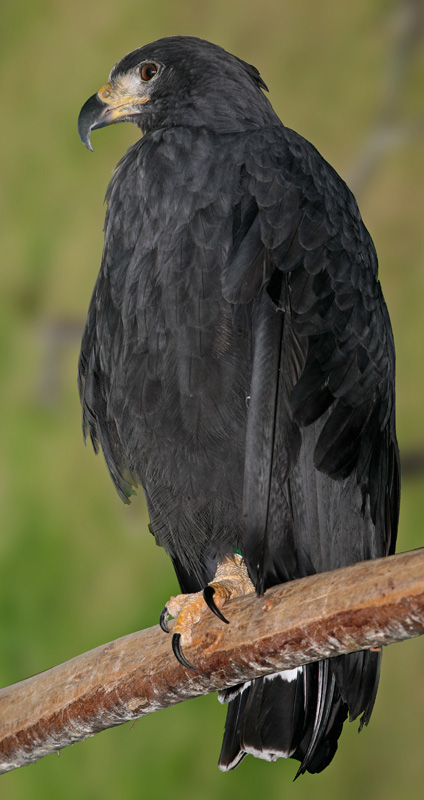
Buteogallus anthracinus inhabits mangrove swamps, estuaries, nearby dry open woodland, and other coastal habitats, with inland populations also occurring. Adults are predominantly black or dark gray, with very broad wings and a short black tail marked by a broad white band and white tip. Full profile
Solitary Eagle
Buteogallus solitarius inhabits mountainous or hilly forests at elevations between 600 and 2,200 m. It has uniformly dark gray adult plumage, exceptionally broad wings and a thickset body. Full profile
Compare something else
Page built on 29 November 2026 from the data on the two species pages, where every source is listed.
Cite this page
ScientificNames.org. (2026). Common Black Hawk vs Solitary Eagle. Retrieved November 29, 2026, from https://scientificnames.org/compare/common-black-hawk-vs-solitary-eagle
“Common Black Hawk vs Solitary Eagle.” ScientificNames.org, 2026, scientificnames.org/compare/common-black-hawk-vs-solitary-eagle. Accessed 29 Nov. 2026.
ScientificNames.org. “Common Black Hawk vs Solitary Eagle.” Accessed November 29, 2026. https://scientificnames.org/compare/common-black-hawk-vs-solitary-eagle.
@misc{scientificnames_common_black_hawk_vs_solitary_eagle,
  author = {{ScientificNames.org}},
  title = {Common Black Hawk vs Solitary Eagle},
  year = {2026},
  url = {https://scientificnames.org/compare/common-black-hawk-vs-solitary-eagle},
  note = {Accessed 2026-11-29}
}