Species · Birds
Solitary Eagle Buteogallus solitarius
The scientific name of the Solitary Eagle is Buteogallus solitarius. It is a species of bird in the family Accipitridae (hawks), order Accipitriformes. The name dates from 1844.
- Scientific name
- Buteogallus solitarius (Tschudi, 1844)
- Common name
- Solitary Eagle
- Genus
- Buteogallus
- Family
- Accipitridae (Hawks)
- Order
- Accipitriformes
- Class
- Aves
- Red List category
- NT Near Threatened
- Environment
- terrestrial
- Recorded in
- 14 countries
- Name status
- accepted in the Catalogue of Life
Overview
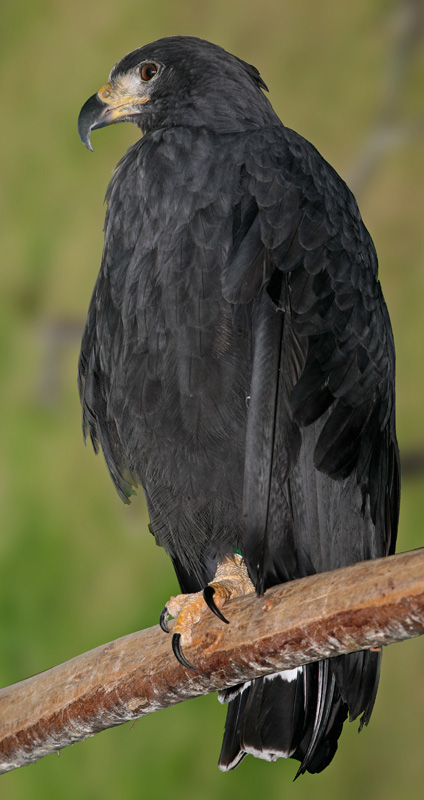
Buteogallus solitarius inhabits mountainous or hilly forests at elevations between 600 and 2,200 m. It has uniformly dark gray adult plumage, exceptionally broad wings and a thickset body.
Written 26 November 2026 from the sources listed below. Each statement was checked against the passage it cites; statements that could not be supported were removed.
Appearance
Adult individuals have uniformly dark gray plumage that often appears black, with white markings on the tail. Juveniles have mottled brown and tan plumage with markings around the eyes.[1][2]
The species has exceptionally broad wings that extend nearly to the tip of its tail and a thickset body shape.[3][4]
Adults measure between 63 and 79 cm in body length, with a wingspan ranging from 152 to 188 cm. The approximate body mass is 3 kg.[5][6][7]
Habitat
The Solitary Eagle inhabits mountainous or hilly forests at elevations between 600 and 2,200 m.[8][9]
Diet
The species has been reported to prey frequently on large snakes. An adult pair has been observed hunting deer fawns.[10][11]
Chachalaca remains have been recorded in a nest of this species.[12]
Conservation
The Solitary Eagle is rare throughout its geographic range.[13]
Similar species
DNA studies indicate that the Solitary Eagle is closely related to black-hawks.[14]
Classification of the Solitary Eagle
| Kingdom | Animalia |
|---|---|
| Phylum | Chordata |
| Subphylum | Vertebrata |
| Infraphylum | Gnathostomata |
| Parvphylum | Osteichthyes |
| Megaclass | Tetrapoda |
| Class | Aves (Bird) |
| Order | Accipitriformes (Hawks) |
| Family | Accipitridae (Hawks) |
| Genus | Buteogallus (Black-Hawks) |
| Species | Buteogallus solitarius (Tschudi, 1844) |
Where the Solitary Eagle is found
Checklists and occurrence records place Buteogallus solitarius in 14 countries across North America and South America. GBIF holds 2,504 georeferenced records of it.
Countries
- Argentina 86
- Belize 170
- Bolivia 113
- Brazil 5
- Colombia 593
- Costa Rica 17
- Ecuador 210
- French Guiana 3
- Guatemala 4
- Mexico 82
- Nicaragua 6
- Panama 21
- Peru 1,084
- Venezuela 110
Regions and cities with the most records
- Cuzco Department, Peru 885
- Magdalena Department, Colombia 229
- Cayo District, Belize 153
- Napo, Ecuador 102
- Jujuy, Argentina 65
- Risaralda Department, Colombia 57
- Lambayeque, Peru 46
- La Paz Department, Bolivia 45
- Santa Marta, Colombia 45
- Mariara, Venezuela 44
- El Limón, Venezuela 43
- Maracay, Venezuela 42
- Carabobo, Venezuela 40
- Santa Cruz Department, Bolivia 40
- Belén de Umbría, Colombia 38
- Tolima Department, Colombia 38
- Libertador General San Martín, Argentina 37
- Antioquia, Colombia 36
- Cundinamarca, Colombia 34
- Valle del Cauca Department, Colombia 33
- Chongoyape, Peru 32
- Cesar Department, Colombia 29
- Loja, Ecuador 29
- Piura, Peru 28
- San Joaquín, Venezuela 28
- Putumayo Department, Colombia 27
- Zulia, Venezuela 27
- Morona-Santiago Province, Ecuador 26
- Anserma, Colombia 24
- Cajamarca Department, Peru 23
- Mocoa, Colombia 23
- Zamora Chinchipe, Ecuador 23
- La Guajira Department, Colombia 22
- San Ignacio, Belize 22
- Aragua, Venezuela 20
- Cochabamba, Bolivia 20
Range as the checklists state it
Middle America
South America
A number beside a place is its count of GBIF occurrence records. A place without a number comes from a checklist alone. Records show where a species has been observed or collected, which can include escapes and vagrants.
Common names
English
- Solitary Eagle
- Black Solitary Eagle
- Montane Solitary Eagle
Names in 26 other languages
- Arabic
- عقاب جبلي منعزل, عقاب جبلية منعزلة
- Breton
- Baou zigenvez
- Catalan
- Àguila solitària, àguila solitària negra
- Chinese
- 孤冕雕, 孤冕鵰
- Croatian
- škanjac zmijar
- Czech
- harpyjovec černý, káně samotářská
- Danish
- Eremitørn
- Dutch
- Amerikaanse Zwarte Arend
- Esperanto
- Monta solaglo, soleca buteo
- Estonian
- tõmmu-hiidviu
- Finnish
- erakkohaukka
- French
- Buse solitaire
- German
- Einsiedleradler, Einsiedlerbussard
- Italian
- Aquila solitaria
- Japanese
- オグロカンムリノスリ
- Lithuanian
- juodasis erelis atsiskyrėlis
- Norwegian
- tåkevåk
- Polish
- Harpijnik ciemny, urubitinga górska
- Portuguese
- Bútios-solitários, bútio-solitário, águia-solitária
- Russian
- Горная агуйя-отшельник, Чёрный орёл-отшельник
- Slovak
- myšiak harpyovec
- Spanish
- Aguila Solitaria, Águila solitaria
- Swedish
- eremitörn
- Turkish
- Dağlı Kartal Şahini
- Ukrainian
- орел-самітник чорний
- Vietnamese
- Đại bàng ẩn sĩ núi
Synonyms
4 other scientific names have been used for this species and are now treated as synonyms of Buteogallus solitarius.
- Circaetus solitarius Tschudi, 1844
- Harpyhaliaetus solitarius (Tschudi, 1844)
- Urubitinga solitaria Tschudi, JJ, 1844
- Urubitornis solitaria Tschudi, JJ, 1844
Subspecies and varieties
- Buteogallus solitarius sheffleri subspecies
- Buteogallus solitarius solitarius (Montane Solitary Eagle) subspecies
Related species
-
 Common Black HawkButeogallus anthracinus
-
 Great Black HawkButeogallus urubitinga
-
 Chaco EagleButeogallus coronatus
-
 Savanna HawkButeogallus meridionalis
-
 Buteogallus borrasi
-
 Slate-colored HawkButeogallus schistaceus
-
 Rufous Crab HawkButeogallus aequinoctialis
-
 Cuban Black HawkButeogallus gundlachii
Compare
Questions and answers
What is the scientific name of the Solitary Eagle?
The scientific name of the Solitary Eagle is Buteogallus solitarius. Written with its author, the full name is Buteogallus solitarius (Tschudi, 1844).
Which family does the Solitary Eagle belong to?
Buteogallus solitarius belongs to the family Accipitridae, in the order Accipitriformes and the class Aves.
Where is the Solitary Eagle found?
Checklists and occurrence records place Buteogallus solitarius in 14 countries, including Peru, Colombia, Ecuador, Belize, Bolivia and Venezuela.
What is the conservation status of the Solitary Eagle?
The IUCN Red List category recorded for Buteogallus solitarius is Near Threatened (NT).
What other names does the Solitary Eagle have?
Buteogallus solitarius is also known in English as Black Solitary Eagle and Montane Solitary Eagle.
Sources
Passages the profile rests on
- Adult individuals have uniformly dark gray plumage that often appears black, with white markings on the tail. Source passage: “The adult solitary eagle is uniformly dark gray, often appearing black, with white markings on the tail.” — English Wikipedia
- Juveniles have mottled brown and tan plumage with markings around the eyes. Source passage: “The juvenile is mottled brown and tan, with markings around the eyes.” — English Wikipedia
- The species has exceptionally broad wings that extend nearly to the tip of its tail. Source passage: “It appears very similar to the common black hawk and great black hawk, but is much larger and has significantly broader wings, extending nearly to the tip of the tail.” — English Wikipedia
- The species has a thickset body shape. Source passage: “Its body also has quite a thickset appearance.” — English Wikipedia
- Adults measure between 63 and 79 cm in body length. Source passage: “It is 63 to 79 cm (25 to 31 in)” — English Wikipedia
- The wingspan ranges from 152 to 188 cm. Source passage: “has a 152 to 188 cm (5 ft 0 in to 6 ft 2 in) wingspan.” — English Wikipedia
- The species has an approximate body mass of 3 kg. Source passage: “With a body mass of approximately 3 kg (6.6 lb)” — English Wikipedia
- The species inhabits mountainous or hilly forests. Source passage: “It is found in mountainous or hilly forests” — English Wikipedia
- The species occurs at elevations between 600 and 2,200 m. Source passage: “at elevations between 600 m and 2,200 m.” — English Wikipedia
- The species has been reported to prey frequently on large snakes. Source passage: “it appears to have often been predating large snakes” — English Wikipedia
- An adult pair has been observed hunting deer fawns. Source passage: “one adult pair was seen hunting deer fawns.” — English Wikipedia
- Chachalaca remains have been recorded in a nest of this species. Source passage: “The remains of a chachalaca were noted in one nest.” — English Wikipedia
- The species is rare throughout its geographic range. Source passage: “It is rare in all areas of its range” — English Wikipedia
- The species is closely related to black-hawks according to DNA studies. Source passage: “Recent DNA studies have shown that the solitary eagle is closely related to the black-hawks.” — English Wikipedia
Data
- Catalogue of Life, 2026-10-16 XR cc by
- Global Biodiversity Information Facility CC BY 4.0
- Wikidata CC0
- GeoNames CC BY 4.0
- Wikimedia Commons per image; credit shown with each image
- iNaturalist per image; credit shown with each image
- Within the Catalogue of Life, this name comes from The Integrated Taxonomic Information System cc0
References
- Arch. Naturgesch., 10: 264. 1844 where the name was published
This species in other databases
Page built on 26 November 2026. See how the catalog is made and all sources and licences.
Cite this page
ScientificNames.org. (2026). Buteogallus solitarius (Solitary Eagle). Retrieved November 26, 2026, from https://scientificnames.org/species/buteogallus-solitarius
“Buteogallus solitarius (Solitary Eagle).” ScientificNames.org, 2026, scientificnames.org/species/buteogallus-solitarius. Accessed 26 Nov. 2026.
ScientificNames.org. “Buteogallus solitarius (Solitary Eagle).” Accessed November 26, 2026. https://scientificnames.org/species/buteogallus-solitarius.
@misc{scientificnames_buteogallus_solitarius_solitary_eagle,
  author = {{ScientificNames.org}},
  title = {Buteogallus solitarius (Solitary Eagle)},
  year = {2026},
  url = {https://scientificnames.org/species/buteogallus-solitarius},
  note = {Accessed 2026-11-26}
}