Species · Birds
Common Black Hawk Buteogallus anthracinus
The scientific name of the Common Black Hawk is Buteogallus anthracinus. It is a species of bird in the family Accipitridae (hawks), order Accipitriformes. The name dates from 1830.
- Scientific name
- Buteogallus anthracinus (Deppe, 1830)
- Common name
- Common Black Hawk
- Genus
- Buteogallus
- Family
- Accipitridae (Hawks)
- Order
- Accipitriformes
- Class
- Aves
- Red List category
- LC Least Concern
- Environment
- terrestrial
- Recorded in
- 20 countries
- Name status
- accepted in the Catalogue of Life

Overview
Buteogallus anthracinus inhabits mangrove swamps, estuaries, nearby dry open woodland, and other coastal habitats, with inland populations also occurring. Adults are predominantly black or dark gray, with very broad wings and a short black tail marked by a broad white band and white tip.
Written 26 November 2026 from the sources listed below. Each statement was checked against the passage it cites; statements that could not be supported were removed.
Appearance
Adult birds are predominantly black or dark gray and have very broad wings. Their short black tails have one broad white band and a white tip. The bill is black, and the legs and cere are yellow.[1][2][3]
Immature birds have dark brown upperparts with spotting and streaking, and buff to whitish underparts with dark blotches. Their tails have multiple black and white bars. The flight feathers are slightly paler than the rest of the plumage.[4][5][6][7]
Adult common black hawks measure between 43 and 53 cm in length. The average adult body weight is 930 g.[8][9]
Habitat
The Common Black Hawk inhabits mangrove swamps, estuaries, and nearby dry open woodland. It is primarily associated with coastal habitats, although inland populations also occur.[10][11][12][13]
Diet
Crabs, particularly land crabs, are the main food of the Common Black Hawk. It also eats fish, frogs, turtle hatchlings, lizards, and snakes.[14][15]
The species consumes small, young, or injured birds and mammals. It supplements its diet with carrion, including dead fish, and insects such as grasshoppers, caterpillars, and wasp larvae.[16][17][18]
Behaviour
The Common Black Hawk is often observed soaring with occasional slow wing flaps. Its aerial courtship display involves talon touching, and it has a distinctive piping call.[19][20][21]
Reproduction and life cycle
The species constructs platform nests from sticks in trees, between 15 and 100 feet above the ground. Mangrove trees are frequently used as nesting sites.[22][23][24]
The Common Black Hawk frequently reuses its nests, which tend to increase in size with reuse. It lays between one and three eggs, usually just one; the eggs are whitish and marked with brown.[25][26][27][28]
Natural hybridization with the red-shouldered hawk has been recorded in Sonoma County, California.[29]
Similar species
Adult Common Black Hawks resemble zone-tailed hawks but have fewer white tail bars and larger body size. The mangrove black hawk is generally treated as a subspecies of the Common Black Hawk.[30][31]
Conservation
The Common Black Hawk is protected in the northernmost part of its United States range under the Migratory Bird Treaty Act of 1918.[32]
Uses
The species breeds in the warmer regions of the Americas, with a range extending from the southwestern United States through Central America. It also occurs in Trinidad and the Lesser Antilles. A migratory population occurs in northwestern Mexico and Arizona.[33][34][35][36]
The Cuban black-hawk was formerly classified as a subspecies of the Common Black Hawk. The species has been recorded in New Mexico observations spanning 1933 to 2012.[37][38]
Classification of the Common Black Hawk
| Kingdom | Animalia |
|---|---|
| Phylum | Chordata |
| Subphylum | Vertebrata |
| Infraphylum | Gnathostomata |
| Parvphylum | Osteichthyes |
| Megaclass | Tetrapoda |
| Class | Aves (Bird) |
| Order | Accipitriformes (Hawks) |
| Family | Accipitridae (Hawks) |
| Genus | Buteogallus (Black-Hawks) |
| Species | Buteogallus anthracinus (Deppe, 1830) |
Where the Common Black Hawk is found
Checklists and occurrence records place Buteogallus anthracinus in 20 countries across North America and South America. GBIF holds 156,927 georeferenced records of it.
Countries
- Belize 9,318
- Colombia 5,600
- Costa Rica 44,027
- Cuba 13
- Ecuador 512
- El Salvador 1,876
- French Guiana 4
- Guatemala 1,938
- Guyana 17
- Honduras 5,755
- Mexico 30,876
- Nicaragua 1,413
- Panama 13,104
- Peru 82
- Saint Lucia 4
- Saint Vincent and the Grenadines 706
- Suriname 3
- Trinidad and Tobago 5,106
- United States 34,444
- Venezuela 2,129
Regions and cities with the most records
- Puntarenas Province, Costa Rica 25,999
- Arizona, United States 22,459
- Limón Province, Costa Rica 8,103
- Guanacaste Province, Costa Rica 7,255
- New Mexico, United States 6,060
- Nayarit, Mexico 5,564
- Veracruz, Mexico 5,321
- Rio Rico, United States 4,992
- Texas, United States 4,174
- Paradise, Trinidad and Tobago 3,873
- Toledo District, Belize 3,835
- Arima, Trinidad and Tobago 3,825
- Tunapuna, Trinidad and Tobago 3,814
- Jalisco, Mexico 3,198
- Tunapuna/Piarco, Trinidad and Tobago 3,071
- Bocas del Toro Province, Panama 3,066
- Belize District, Belize 3,021
- Panamá, Panama 2,148
- Alcalde Díaz, Panama 2,128
- Quintana Roo, Mexico 1,988
- Belize City, Belize 1,838
- Colón, Panama 1,807
- Yucatán, Mexico 1,785
- Panama City, Panama 1,765
- Bucerías, Mexico 1,764
- Curundú, Panama 1,733
- Magdalena Department, Colombia 1,732
- Ancón, Panama 1,722
- Chiapas, Mexico 1,708
- San Miguelito, Panama 1,676
- Oaxaca, Mexico 1,573
- Darién, Panama 1,511
- Stann Creek, Belize 1,495
- Juan Díaz, Panama 1,486
- Chiriquí Province, Panama 1,309
- Puerto Vallarta, Mexico 1,289
Range as the checklists state it
Middle America
North America
South America
Caribbean
A number beside a place is its count of GBIF occurrence records. A place without a number comes from a checklist alone. Records show where a species has been observed or collected, which can include escapes and vagrants.
Common names
English
- Common Black Hawk
- Common Black-Hawk
- Cuban Black-hawk
Names in 28 other languages
- Arabic
- باز أسود شائع
- Catalan
- aligot negre comú
- Chinese
- 黑雞鵟, 黑鸡鵟
- Croatian
- mrki škanjac
- Czech
- káně tmavá
- Danish
- Sortvåge
- Dutch
- zwarte buizerd
- Esperanto
- nigra buteo
- Estonian
- kaldaviu
- Finnish
- mustahaukka
- French
- Buse noire
- German
- Krabbenbussard
- Hungarian
- kormos rákászölyv
- Italian
- Poiana nera comune
- Japanese
- クロノスリ
- Latvian
- melnais klijāns
- Lithuanian
- juodasis krabinis suopis
- Norwegian
- kullvåk
- Polish
- czarnostrząb leśny
- Portuguese
- Gavião-caranquejeiro-negro, bútio-preto-pequeno, gavião-caranguejeiro-negro
- Russian
- Чёрный крабовый канюк, Чёрный крабоед
- Serbian
- Mali crni mišar
- Slovak
- myšiak antracitový
- Spanish
- Aguililla Negra Menor, Aguililla-negra menor, Busardo negro, Cangrejero negro, Gavilán cangrejero, Guaraguao negro, gavilán batista
- Swedish
- mindre svartvråk
- Turkish
- Kara Yengeç Şahini
- Ukrainian
- канюк-крабоїд чорний
- Welsh
- gwalch du
Synonyms
One other scientific name has been used for this species and is now treated as a synonym of Buteogallus anthracinus.
- Falco anthracinus Deppe, 1830
Subspecies and varieties
- Buteogallus anthracinus anthracinus (Common Black Hawk) subspecies
- Buteogallus anthracinus bangsi subspecies
- Buteogallus anthracinus rhizophorae subspecies
- Buteogallus anthracinus subtilis (Mangrove Black-Hawk) subspecies
Related species
-
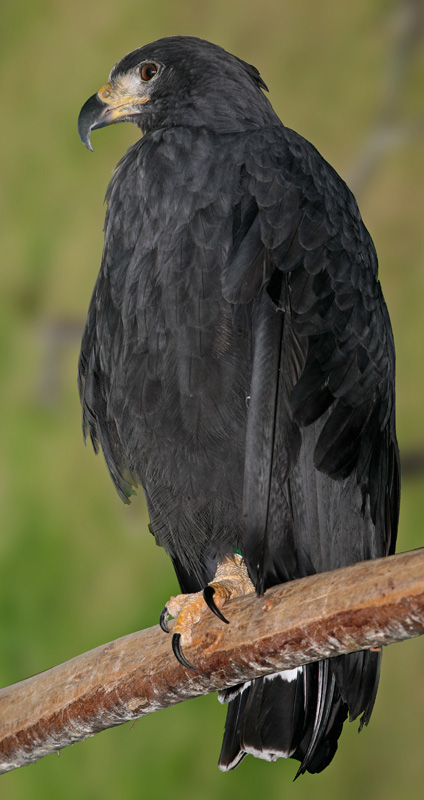 Solitary EagleButeogallus solitarius
-
 Great Black HawkButeogallus urubitinga
-
 Chaco EagleButeogallus coronatus
-
 Savanna HawkButeogallus meridionalis
-
 Buteogallus borrasi
-
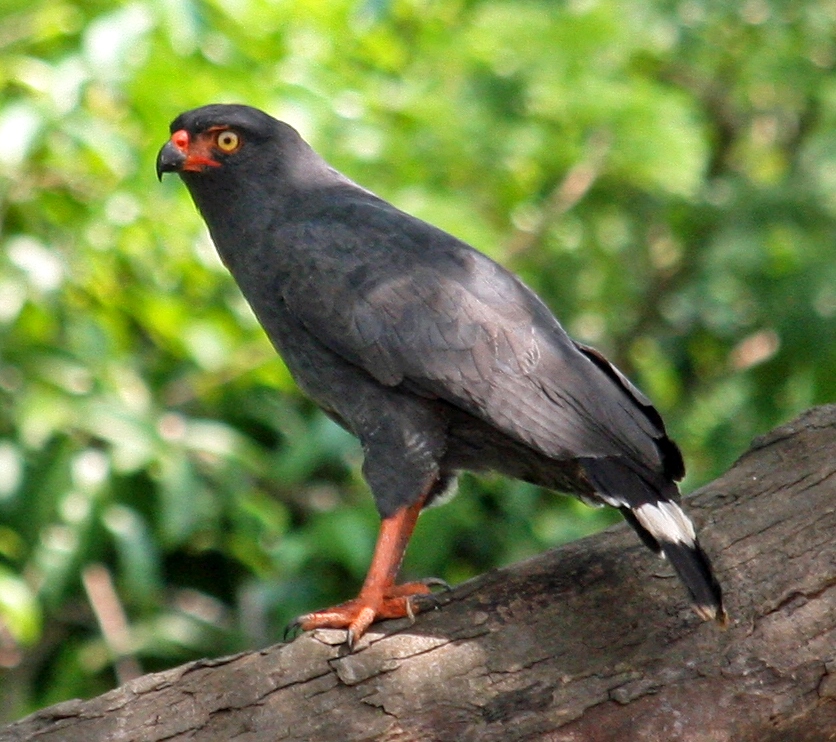 Slate-colored HawkButeogallus schistaceus
-
 Rufous Crab HawkButeogallus aequinoctialis
-
 Cuban Black HawkButeogallus gundlachii
Compare
Questions and answers
What is the scientific name of the Common Black Hawk?
The scientific name of the Common Black Hawk is Buteogallus anthracinus. Written with its author, the full name is Buteogallus anthracinus (Deppe, 1830).
Which family does the Common Black Hawk belong to?
Buteogallus anthracinus belongs to the family Accipitridae, in the order Accipitriformes and the class Aves.
Where is the Common Black Hawk found?
Checklists and occurrence records place Buteogallus anthracinus in 20 countries, including Costa Rica, United States, Mexico, Panama, Belize and Honduras.
What is the conservation status of the Common Black Hawk?
The IUCN Red List category recorded for Buteogallus anthracinus is Least Concern (LC).
What other names does the Common Black Hawk have?
Buteogallus anthracinus is also known in English as Common Black-Hawk and Cuban Black-hawk.
What do Black Hawks eat?
Crabs, particularly land crabs, are their main food. They also eat fish, frogs, turtle hatchlings, lizards, snakes, small, young, or injured birds and mammals, carrion, and insects including grasshoppers, caterpillars, and wasp larvae.[14][15][16][17][18]
What does a hawk's diet consist of?
The Common Black Hawk's diet consists mainly of crabs, particularly land crabs. Other foods include fish, frogs, turtle hatchlings, lizards, snakes, birds, mammals, carrion, and insects.[14][15][16][17][18]
Where does the Common Black Hawk live?
It inhabits mangrove swamps, estuaries, and nearby dry open woodland, primarily in coastal habitats, although inland populations also occur. Its range extends from the southwestern United States through Central America and includes Trinidad and the Lesser Antilles.[10][11][12][13][34][35]
Sources
Passages the profile rests on
- Adult birds are predominantly black or dark gray and have very broad wings. Source passage: “It has very broad wings, and is mainly black or dark gray.” — English Wikipedia
- Adults have a short black tail with one broad white band and a white tip. Source passage: “The short tail is black with a single broad white band and a white tip.” — English Wikipedia
- The species has a black bill and yellow legs and cere. Source passage: “The bill is black and the legs and cere are yellow.” — English Wikipedia
- Immature birds have dark brown upperparts with spotting and streaking. Source passage: “immature birds are dark brown above with spotting and streaks.” — English Wikipedia
- Immature birds have buff to whitish underparts with dark blotches. Source passage: “Their underparts are buff to whitish with dark blotches” — English Wikipedia
- Immature birds have tails marked with multiple black and white bars. Source passage: “the tail has a number of black and white bars.” — English Wikipedia
- The flight feathers are slightly paler than the rest of the plumage. Source passage: “Flight feathers are slightly paler” — ebird.org
- Adult common black hawks measure between 43 and 53 cm in length. Source passage: “The adult common black-hawk is 43–53 cm (17–21 in) long” — English Wikipedia
- The average adult body weight is 930 g. Source passage: “weighs 930 g (33 oz) on average.” — English Wikipedia
- The species inhabits mangrove swamps. Source passage: “resident bird of mangrove swamps” — English Wikipedia
- The species occurs in estuaries and nearby dry open woodland. Source passage: “estuaries and adjacent dry open woodland” — English Wikipedia
- The species is primarily associated with coastal habitats. Source passage: “It is a mainly coastal, resident bird” — English Wikipedia
- The species also occurs in inland populations. Source passage: “though there are inland populations” — English Wikipedia
- Crabs, particularly land crabs, are the main food of the species. Source passage: “It feeds mainly on crabs (especially land crabs)” — English Wikipedia
- The species also eats fish, frogs, turtle hatchlings, lizards, and snakes. Source passage: “such as fish, frogs, turtle hatchlings, lizards, snakes” — English Wikipedia
- The species consumes small, young, or injured birds and mammals. Source passage: “small, young or injured birds and mammals” — English Wikipedia
- The species supplements its diet with carrion, including dead fish. Source passage: “carrion (in form of dead fish)” — English Wikipedia
- Insects eaten by the species include grasshoppers, caterpillars, and wasp larvae. Source passage: “including grasshoppers, caterpillars and wasp larvae.” — English Wikipedia
- The species is often observed soaring with occasional slow wing flaps. Source passage: “This species is often seen soaring, with occasional lazy flaps” — English Wikipedia
- The species performs an aerial courtship display involving talon touching. Source passage: “has a talon-touching aerial courtship display.” — English Wikipedia
- The species has a distinctive piping call. Source passage: “The call is a distinctive piping spink-speenk-speenk-spink-spink-spink.” — English Wikipedia
- The species constructs platform nests from sticks. Source passage: “The bird builds a platform nest of sticks” — English Wikipedia
- Nests are constructed between 15 and 100 feet above the ground in trees. Source passage: “fifteen to one hundred feet above the ground in a tree” — English Wikipedia
- Mangrove trees are frequently used as nesting sites. Source passage: “in a tree, often a mangrove.” — English Wikipedia
- The species frequently reuses its nests. Source passage: “Nests are often reused” — English Wikipedia
- Reused nests tend to increase in size. Source passage: “and tend to grow bigger.” — English Wikipedia
- The species lays between one and three eggs, usually just one. Source passage: “It lays one to three eggs (usually one)” — English Wikipedia
- The eggs are whitish and marked with brown. Source passage: “which are whitish with brown markings.” — English Wikipedia
- Natural hybridization with the red-shouldered hawk has been recorded in Sonoma County, California. Source passage: “It has hybridized naturally with the red-shouldered hawk (Buteo lineatus) in Sonoma County, California, USA.” — English Wikipedia
- Adult common black hawks resemble zone-tailed hawks but have fewer white tail bars and larger body size. Source passage: “The adults resemble zone-tailed hawks, but have fewer white bars on their tail and are larger in size.” — English Wikipedia
- The mangrove black hawk is generally treated as a subspecies of the common black hawk. Source passage: “The mangrove black hawk, traditionally considered a distinct species, is now generally considered a subspecies, B. a. subtilis, of the common black-hawk.” — English Wikipedia
- The species is protected in the northernmost part of its United States range under the Migratory Bird Treaty Act of 1918. Source passage: “The common black hawk is protected in the far north of its range (in the USA) under the Migratory Bird Treaty Act of 1918.” — English Wikipedia
- The species breeds in the warmer regions of the Americas. Source passage: “The common black-hawk is a breeding bird in the warmer parts of the Americas” — English Wikipedia
- Its range extends from the southwestern United States through Central America. Source passage: “from the Southwestern United States through Central America” — English Wikipedia
- The species occurs in Trinidad and the Lesser Antilles. Source passage: “Trinidad, and the Lesser Antilles.” — English Wikipedia
- A migratory population occurs in northwestern Mexico and Arizona. Source passage: “including a migratory population in north-western Mexico and Arizona.” — English Wikipedia
- The Cuban black-hawk was formerly classified as a subspecies of the common black hawk. Source passage: “It formerly included the Cuban black-hawk (Buteogallus gundlachii) as a subspecies.” — English Wikipedia
- The species has been recorded in New Mexico observations spanning 1933 to 2012. Source passage: “Observation date range: 05-04-1933 to 08-03-2012” — nhnm.unm.edu
Data
- Catalogue of Life, 2026-10-16 XR cc by
- Global Biodiversity Information Facility CC BY 4.0
- Wikidata CC0
- GeoNames CC BY 4.0
- Wikimedia Commons per image; credit shown with each image
- Within the Catalogue of Life, this name comes from The Integrated Taxonomic Information System cc0
References
- Preis.-Verz. Säugeth. Vögel, etc., Mex.: 3. 1830 where the name was published
- Banks, R. C., R. W. McDiarmid, and A. L. Gardner. (1987). Checklist of Vertebrates of the United States, the U.S. Territories, and Canada. Resource Publication, No. 166.
- Gill, Frank, & and Minturn Wright. (2006). Birds of the World: Recommended English Names.
This species in other databases
- Catalogue of Life NYVX
- Wikidata Q1267120
- iNaturalist 5233
- WoRMS urn:lsid:marinespecies.org:taxname:422588
- Avibase comblh1
Page built on 26 November 2026. See how the catalog is made and all sources and licences.
Cite this page
ScientificNames.org. (2026). Buteogallus anthracinus (Common Black Hawk). Retrieved November 26, 2026, from https://scientificnames.org/species/buteogallus-anthracinus
“Buteogallus anthracinus (Common Black Hawk).” ScientificNames.org, 2026, scientificnames.org/species/buteogallus-anthracinus. Accessed 26 Nov. 2026.
ScientificNames.org. “Buteogallus anthracinus (Common Black Hawk).” Accessed November 26, 2026. https://scientificnames.org/species/buteogallus-anthracinus.
@misc{scientificnames_buteogallus_anthracinus_common_black_hawk,
  author = {{ScientificNames.org}},
  title = {Buteogallus anthracinus (Common Black Hawk)},
  year = {2026},
  url = {https://scientificnames.org/species/buteogallus-anthracinus},
  note = {Accessed 2026-11-26}
}