Comparison
Wolf vs Coyote
Wolf (Canis lupus) and Coyote (Canis latrans) both belong to the genus Canis (dogs) and part ways below it. Both are recorded in 3 countries.



How they differ
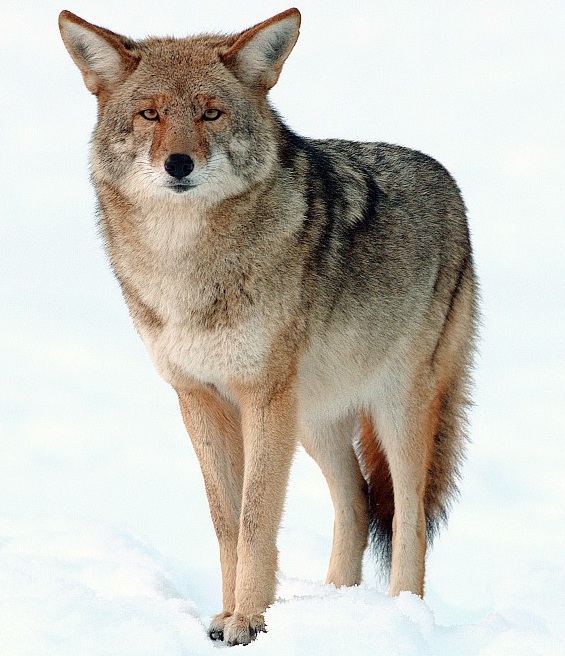
The Wolf (Canis lupus) has small, pointed ears and small eyes positioned relatively far apart, while the Coyote (Canis latrans) has longer ears, a narrow muzzle, and a bushy tail with a black tip. The Wolf generally lives in social packs, while the Coyote can live in family units or loosely organized packs of unrelated individuals and can also hunt individually. The Wolf generally maintains territories used almost exclusively by pack members, while the Coyote may defend territories or survive as a nonterritorial transient individual.
| Wolf | Coyote | |
|---|---|---|
| Appearance | The Wolf has a coat ranging from white and gray to brown and black. | The Coyote typically has a coat combining light gray, reddish or fulvous, black, and white coloration. |
| Winter coat | The Wolf develops a thick, fluffy winter coat with longer guard hairs and a dense undercoat. | The Coyote generally has a grey-brown coat with black-tipped hairs along its back. |
| Social groups | A typical Wolf pack in the northern United States Rocky Mountains contains five to ten animals. | Coyotes may form groups of five to six adults under favorable conditions. |
| Vocalization | The Wolf uses howling to communicate and maintain contact with pack members. | The Coyote characteristically produces howls that rapidly change in tone and pitch. |
| Conservation | The gray Wolf has been assessed as Least Concern by the IUCN. | The Coyote is classified as Least Concern by the International Union for Conservation of Nature. |
Written from the checked facts listed further down. Statements that the sources did not support were removed.
Side by side
| Wolf | Coyote | |
|---|---|---|
| Scientific name | Canis lupus Linnaeus, 1758 | Canis latrans Say, 1823 |
| English name | Wolf | Coyote |
| Group | Mammals | Mammals |
| Class | Mammalia Mammal | Mammalia Mammal |
| Order | Carnivora Carnivores | Carnivora Carnivores |
| Family | Canidae Dogs | Canidae Dogs |
| Genus | Canis Dogs | Canis Dogs |
| Named in | 1758 | 1823 |
| Red List category | Least Concern | Least Concern |
| Environment | terrestrial | terrestrial |
| Countries on record | 73 countries | 10 countries |
| GBIF occurrence records | 119,810 records | 120,320 records |
Rows where the two agree are shown in grey.
Where each is found
Both recorded in 3 countries
Only Wolf (70)
- Afghanistan
- Albania
- Armenia
- Australia
- Austria
- Azerbaijan
- Belarus
- Belgium
- Bosnia and Herzegovina
- Bulgaria
- China
- Croatia
- Czechia
- Denmark
- Egypt
- Estonia
- Finland
- France
- Georgia
- Germany
- Greece
- Greenland
- Hungary
- India
- Indonesia
- Iran
- Iraq
- Israel
- Italy
- Japan
- Jordan
- Kazakhstan
- Kosovo
- Latvia
- Lebanon
- Liechtenstein
- Lithuania
- Luxembourg
- Malaysia
- Moldova
- Mongolia
- Montenegro
- Nepal
- New Zealand
- Nigeria
- North Macedonia
- Norway
- Oman
- Pakistan
- Palestinian Territory
- Poland
- Portugal
- Reunion
- Romania
- Russia
- Saudi Arabia
- Serbia
- Slovakia
- Slovenia
- Spain
- Sweden
- Switzerland
- Syria
- Tajikistan
- The Netherlands
- Trinidad and Tobago
- Turkey
- Ukraine
- United Kingdom
- Uzbekistan
Only Coyote (7)
From Catalogue of Life checklists and GBIF occurrence records. A country missing from a list means no record is held, which is not proof of absence.
Checked facts
| Wolf | Coyote | |
|---|---|---|
| Appearance |
|
|
| Size |
|
|
| Habitat |
|
|
| Diet |
|
|
| Behaviour |
|
|
| Reproduction |
|
|
| Lifespan |
| No checked fact yet |
| Distribution |
|
|
| Conservation |
|
|
| Name origin |
|
|
In brief
Wolf
The Gray Wolf occurs naturally across Eurasia and North America. The Gray Wolf has a coat ranging from white and gray to brown and black and generally lives in social packs. Full profile
Coyote
Coyotes are native to North America and inhabit environments ranging from dry tropical deciduous forests and prairies to woodlands, mountains, and urban areas. The Coyote has pointed ears, a narrow muzzle, a bushy black-tipped tail, and a coat combining gray, reddish, black, and white coloration. Full profile
Compare something else
Page built on 24 November 2026 from the data on the two species pages, where every source is listed.
Cite this page
ScientificNames.org. (2026). Wolf vs Coyote. Retrieved November 24, 2026, from https://scientificnames.org/compare/wolf-vs-coyote
“Wolf vs Coyote.” ScientificNames.org, 2026, scientificnames.org/compare/wolf-vs-coyote. Accessed 24 Nov. 2026.
ScientificNames.org. “Wolf vs Coyote.” Accessed November 24, 2026. https://scientificnames.org/compare/wolf-vs-coyote.
@misc{scientificnames_wolf_vs_coyote,
  author = {{ScientificNames.org}},
  title = {Wolf vs Coyote},
  year = {2026},
  url = {https://scientificnames.org/compare/wolf-vs-coyote},
  note = {Accessed 2026-11-24}
}