Comparison
Two-Clawed Hunting Spider vs European Yellow Sac Spider
Two-Clawed Hunting Spider (Cheiracanthium erraticum) and European Yellow Sac Spider (Cheiracanthium punctorium) both belong to the genus Cheiracanthium (longlegged sac spiders) and part ways below it. Both are recorded in 21 countries.


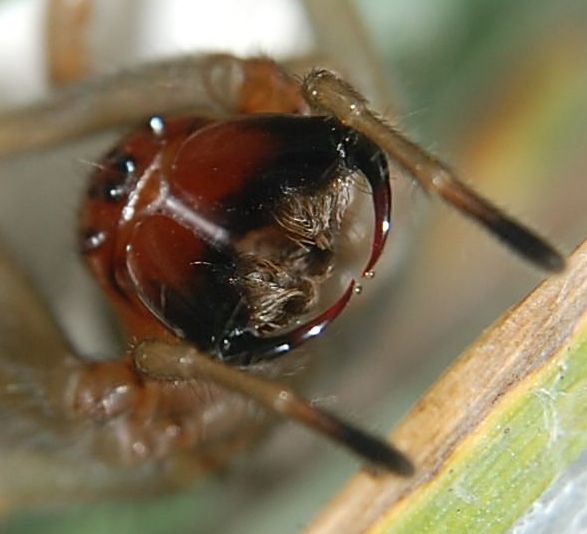
European Yellow Sac Spider
Cheiracanthium punctorium
Rainer Altenkamp, Berlin, CC BY-SA 3.0, via Wikimedia Commons

Side by side
| Two-Clawed Hunting Spider | European Yellow Sac Spider | |
|---|---|---|
| Scientific name | Cheiracanthium erraticum (Walckenaer, 1802) | Cheiracanthium punctorium (Villers, 1789) |
| English name | Two-Clawed Hunting Spider | European Yellow Sac Spider |
| Group | Spiders and other arachnids | Spiders and other arachnids |
| Class | Arachnida Arachnid | Arachnida Arachnid |
| Order | Araneae Spider | Araneae Spider |
| Family | Cheiracanthiidae Long-legged Sac Spiders | Cheiracanthiidae Long-legged Sac Spiders |
| Genus | Cheiracanthium Longlegged Sac Spiders | Cheiracanthium Longlegged Sac Spiders |
| Named in | 1802 | 1789 |
| Countries on record | 29 countries | 29 countries |
| GBIF occurrence records | 3,649 records | 2,862 records |
Rows where the two agree are shown in grey.
Where each is found
Both recorded in 21 countries
- Austria
- Belgium
- Denmark
- Estonia
- Finland
- France
- Germany
- Greece
- Hungary
- Iran
- Kazakhstan
- Luxembourg
- Poland
- Portugal
- Russia
- Slovenia
- Spain
- Sweden
- Switzerland
- Turkey
- Ukraine
Only Two-Clawed Hunting Spider (8)
Only European Yellow Sac Spider (8)
From Catalogue of Life checklists and GBIF occurrence records. A country missing from a list means no record is held, which is not proof of absence.
Checked facts
| Two-Clawed Hunting Spider | European Yellow Sac Spider | |
|---|---|---|
| Appearance |
| No checked fact yet |
| Size |
|
|
| Habitat |
|
|
| Behaviour |
|
|
| Reproduction |
|
|
| Distribution |
|
|
| Conservation | No checked fact yet |
|
| Other | No checked fact yet |
|
In brief
Two-Clawed Hunting Spider
Cheiracanthium erraticum has a Palearctic distribution extending from Ireland to eastern Asia and favours the herbaceous and low bush layers of open habitats. It is marked by a wide, dark red stripe running down the centre of its abdomen, surrounded by a creamy-yellow area. Full profile
European Yellow Sac Spider
The European Yellow Sac Spider is an arachnid in the family Cheiracanthiidae, order Araneae and class Arachnida. It occurs across Eurasia, from Europe through Turkey, the Caucasus and Iran to Central Asia and southern Siberia. It is a nocturnal hunter that lives freely rather than remaining in a fixed web. Full profile
Compare something else
Page built on 27 November 2026 from the data on the two species pages, where every source is listed.
Cite this page
ScientificNames.org. (2026). Two-Clawed Hunting Spider vs European Yellow Sac Spider. Retrieved November 27, 2026, from https://scientificnames.org/compare/two-clawed-hunting-spider-vs-european-yellow-sac-spider
“Two-Clawed Hunting Spider vs European Yellow Sac Spider.” ScientificNames.org, 2026, scientificnames.org/compare/two-clawed-hunting-spider-vs-european-yellow-sac-spider. Accessed 27 Nov. 2026.
ScientificNames.org. “Two-Clawed Hunting Spider vs European Yellow Sac Spider.” Accessed November 27, 2026. https://scientificnames.org/compare/two-clawed-hunting-spider-vs-european-yellow-sac-spider.
@misc{scientificnames_two_clawed_hunting_spider_vs_european_yellow_sac_spider,
  author = {{ScientificNames.org}},
  title = {Two-Clawed Hunting Spider vs European Yellow Sac Spider},
  year = {2026},
  url = {https://scientificnames.org/compare/two-clawed-hunting-spider-vs-european-yellow-sac-spider},
  note = {Accessed 2026-11-27}
}