Species · Spiders and other arachnids
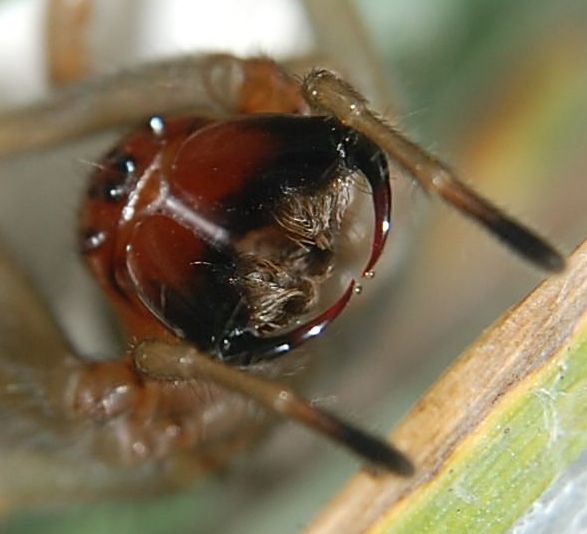
Two-Clawed Hunting Spider Cheiracanthium erraticum
The scientific name of the Two-Clawed Hunting Spider is Cheiracanthium erraticum. It is a species of arachnid in the family Cheiracanthiidae (long-legged sac spiders), order Araneae. The name dates from 1802.
- Scientific name
- Cheiracanthium erraticum (Walckenaer, 1802)
- Common name
- Two-Clawed Hunting Spider
- Genus
- Cheiracanthium
- Family
- Cheiracanthiidae (Long-legged Sac Spiders)
- Order
- Araneae
- Class
- Arachnida
- Recorded in
- 29 countries
- Name status
- accepted in the Catalogue of Life

Overview
Cheiracanthium erraticum, the two-clawed hunting spider, is a species of Palearctic spider of the family Cheiracanthiidae.
Classification of the Two-Clawed Hunting Spider
| Kingdom | Animalia |
|---|---|
| Phylum | Arthropoda |
| Subphylum | Chelicerata |
| Class | Arachnida (Arachnid) |
| Order | Araneae (Spider) |
| Family | Cheiracanthiidae (Long-legged Sac Spiders) |
| Genus | Cheiracanthium (Longlegged Sac Spiders) |
| Species | Cheiracanthium erraticum (Walckenaer, 1802) |
Where the Two-Clawed Hunting Spider is found
Checklists and occurrence records place Cheiracanthium erraticum in 29 countries across Asia and Europe. GBIF holds 3,649 georeferenced records of it.
Countries
- Austria 12
- Belarus 4
- Belgium 358
- China
- Denmark 154
- Estonia 21
- Finland 28
- France 773
- Georgia 5
- Germany 131
- Greece 15
- Hungary 17
- Iran
- Japan 14
- Kazakhstan 11
- Lithuania 12
- Luxembourg 9
- Norway 52
- Poland 61
- Portugal 983
- Russia 206
- Slovenia 6
- Spain 5
- Sweden 323
- Switzerland 6
- The Netherlands 46
- Turkey 1
- Ukraine 36
- United Kingdom 360
Regions and cities with the most records
- Azores, Portugal 966
- England, United Kingdom 258
- Occitanie, France 246
- Nîmes, France 83
- Île-de-France, France 80
- Hauts-de-France, France 78
- Skåne, Sweden 78
- Wales, United Kingdom 69
- Genk, Belgium 61
- Merksem, Belgium 54
- Woluwe-Saint-Lambert, Belgium 54
- Brussels, Belgium 53
- Deurne, Belgium 53
- Hasselt, Belgium 53
- Jette, Belgium 53
- Schaerbeek, Belgium 53
- Molenbeek-Saint-Jean, Belgium 52
- Anderlecht, Belgium 48
- Etterbeek, Belgium 48
- Forest, Belgium 48
- Ixelles, Belgium 48
- Pays de la Loire, France 48
- Saint-Gilles, Belgium 48
- Västra Götaland, Sweden 48
- Värmland, Sweden 45
- Halland, Sweden 42
- Uccle, Belgium 41
- South Denmark, Denmark 38
- Antwerp, Belgium 36
- Borgerhout, Belgium 36
- Beveren, Belgium 35
- Udmurtiya Republic, Russia 33
- Centre-Val de Loire, France 32
- Meaux, France 31
- Sint-Niklaas, Belgium 31
- Grand Est, France 29
Range as the checklists state it
Azores, Europe, Turkey, Caucasus, Russia (Europe to Far East), Iran, Central Asia, China, Korea, Japan
Russia (Kamchatka)
A number beside a place is its count of GBIF occurrence records. A place without a number comes from a checklist alone. Records show where a species has been observed or collected, which can include escapes and vagrants.
Common names
English
- Two-Clawed Hunting Spider
Names in 13 other languages
- Czech
- zápřednice mokřadní
- Danish
- Almindelig pighånd
- Dutch
- Heidespoorspin
- Finnish
- nauhapihdikki
- German
- Heidedornfinger
- Japanese
- アカスジコマチグモ
- Korean
- 북방어리염낭거미
- Lithuanian
- Klajoklinis diegliavoris
- Norwegian Bokmål
- langstripet sabeledderkopp
- Polish
- Kolczak trawny
- Russian
- Хейракантиум бродячий
- Slovak
- pradiar močiarny
- Swedish
- bandsporrspindel
Synonyms
10 other scientific names have been used for this species and are now treated as synonyms of Cheiracanthium erraticum.
- Anyphaena erratica Simon, 1864
- Aranea erratica Walckenaer, 1802
- Bolyphantes equestris C. L. Koch, 1837b
- Cheiracanthium carnifex C.L.Koch, 1839
- Cheiracanthium erroneum O.Pickard-Cambridge, 1873
- Cheiracanthium orientale Kulczyński, 1885
- Chiracanthium erraticum (Walckenaer)
- Clubiona dumetorum Hahn, 1833b
- Clubiona erratica Walckenaer, 1805
- Clubiona nutrix Hahn, 1833a
Related species
-
 Agrarian Sac SpiderCheiracanthium inclusum
-
 Northern Yellow Sac SpiderCheiracanthium mildei
-
 European Yellow Sac SpiderCheiracanthium punctorium
-
 Yellow Sac SpiderCheiracanthium furculatum
- Cheiracanthium taiwanicum
- Cheiracanthium annulipes
- African Long-legged Sac SpiderCheiracanthium africanum
- Cheiracanthium eutittha
Compare
Questions and answers
What is the scientific name of the Two-Clawed Hunting Spider?
The scientific name of the Two-Clawed Hunting Spider is Cheiracanthium erraticum. Written with its author, the full name is Cheiracanthium erraticum (Walckenaer, 1802).
Which family does the Two-Clawed Hunting Spider belong to?
Cheiracanthium erraticum belongs to the family Cheiracanthiidae, in the order Araneae and the class Arachnida.
Where is the Two-Clawed Hunting Spider found?
Checklists and occurrence records place Cheiracanthium erraticum in 29 countries, including Portugal, France, United Kingdom, Belgium, Sweden and Russia.
Sources
Data
- Catalogue of Life, 2026-10-16 XR cc by
- Global Biodiversity Information Facility CC BY 4.0
- Wikidata CC0
- English Wikipedia CC BY-SA 4.0
- GeoNames CC BY 4.0
- Wikimedia Commons per image; credit shown with each image
- Within the Catalogue of Life, this name comes from The World Spider Catalog cc by
References
- Walckenaer, C. A. (1802). Faune parisienne. Insectes. Ou histoire abrégée des insectes de environs de Paris, classés d'après le système de Fabricius. Tome seconde. Dentu, Paris, pp. 187-250, 428-430. doi: <a href="https://doi.org/10.5962/bhl.title.8151" target="_blank">10.5962/bhl.title.8151 Link where the name was published
This species in other databases
Page built on 25 November 2026. See how the catalog is made and all sources and licences.
Cite this page
ScientificNames.org. (2026). Cheiracanthium erraticum (Two-Clawed Hunting Spider). Retrieved November 25, 2026, from https://scientificnames.org/species/cheiracanthium-erraticum
“Cheiracanthium erraticum (Two-Clawed Hunting Spider).” ScientificNames.org, 2026, scientificnames.org/species/cheiracanthium-erraticum. Accessed 25 Nov. 2026.
ScientificNames.org. “Cheiracanthium erraticum (Two-Clawed Hunting Spider).” Accessed November 25, 2026. https://scientificnames.org/species/cheiracanthium-erraticum.
@misc{scientificnames_cheiracanthium_erraticum_two_clawed_hunting_spider,
  author = {{ScientificNames.org}},
  title = {Cheiracanthium erraticum (Two-Clawed Hunting Spider)},
  year = {2026},
  url = {https://scientificnames.org/species/cheiracanthium-erraticum},
  note = {Accessed 2026-11-25}
}