Species · Spiders and other arachnids
European Yellow Sac Spider Cheiracanthium punctorium
The scientific name of the European Yellow Sac Spider is Cheiracanthium punctorium. It is a species of arachnid in the family Cheiracanthiidae (long-legged sac spiders), order Araneae. The name dates from 1789.
- Scientific name
- Cheiracanthium punctorium (Villers, 1789)
- Common name
- European Yellow Sac Spider
- Genus
- Cheiracanthium
- Family
- Cheiracanthiidae (Long-legged Sac Spiders)
- Order
- Araneae
- Class
- Arachnida
- Recorded in
- 29 countries
- Name status
- accepted in the Catalogue of Life
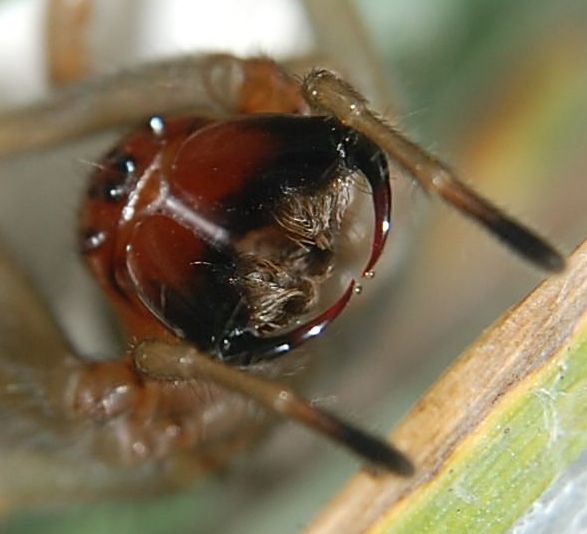
Overview
The European Yellow Sac Spider is an arachnid in the family Cheiracanthiidae, order Araneae and class Arachnida. It occurs across Eurasia, from Europe through Turkey, the Caucasus and Iran to Central Asia and southern Siberia. It is a nocturnal hunter that lives freely rather than remaining in a fixed web.
Written 26 November 2026 from the sources listed below. Each statement was checked against the passage it cites; statements that could not be supported were removed.
Appearance
Adults reach approximately 15 mm in length.[1]
Habitat
The species inhabits fallow land and meadows. Females place their egg sacs in tall grass.[2][3]
Behaviour
The European Yellow Sac Spider is a nocturnal hunter that lives freely rather than remaining in a fixed web. Young spiders leave their nests after reaching maturity.[4][5]
Juveniles disperse using silk balloons propelled by static electricity rather than wind.[6]
Females aggressively defend their egg sacs for approximately 17 days after their offspring are born.[7]
Reproduction and life cycle
The mating season begins in early summer, when males actively seek females. Both sexes can mate and reproduce multiple times.[8][9]
Females produce egg sacs approximately 14 days after mating. They construct egg sacs approximately 4 cm in size in tall grass.[10][11]
Conservation
Increasing areas of fallow and uncultivated land are identified as a major factor contributing to the species' spread in northeastern Germany. Changing weather patterns involving greater aridity and reduced precipitation may also contribute to its expansion there.[12][13]
Classification of the European Yellow Sac Spider
| Kingdom | Animalia |
|---|---|
| Phylum | Arthropoda |
| Subphylum | Chelicerata |
| Class | Arachnida (Arachnid) |
| Order | Araneae (Spider) |
| Family | Cheiracanthiidae (Long-legged Sac Spiders) |
| Genus | Cheiracanthium (Longlegged Sac Spiders) |
| Species | Cheiracanthium punctorium (Villers, 1789) |
Where the European Yellow Sac Spider is found
Checklists and occurrence records place Cheiracanthium punctorium in 29 countries across Asia and Europe. GBIF holds 2,862 georeferenced records of it.
Countries
- Armenia 3
- Austria 88
- Belgium 36
- Bulgaria 7
- Croatia 14
- Czechia 31
- Denmark 12
- Estonia 7
- Finland 7
- France 1,018
- Germany 697
- Greece 4
- Hungary 75
- Iran
- Italy 35
- Kazakhstan 23
- Latvia 6
- Luxembourg 18
- Poland 193
- Portugal 12
- Romania 9
- Russia 107
- Slovakia 4
- Slovenia 9
- Spain 62
- Sweden 260
- Switzerland 38
- Turkey 4
- Ukraine 83
Regions and cities with the most records
- Occitanie, France 363
- Kalmar, Sweden 206
- Brandenburg, Germany 164
- Pays de la Loire, France 149
- Kalmar, Sweden 139
- Rheinland-Pfalz, Germany 80
- Saxony, Germany 79
- State of Berlin, Germany 78
- Baden-Wurttemberg, Germany 72
- Berlin, Germany 71
- Provence-Alpes-Côte d'Azur, France 70
- Île-de-France, France 68
- Neuenhagen, Germany 62
- Mecklenburg-Vorpommern, Germany 55
- Auvergne-Rhône-Alpes, France 54
- Chelles, France 48
- Clichy-sous-Bois, France 48
- Grand Est, France 48
- Livry-Gargan, France 48
- Montfermeil, France 48
- Bondy, France 47
- Hennigsdorf, Germany 47
- Les Pavillons-sous-Bois, France 47
- Montreuil, France 47
- Noisy-le-Sec, France 47
- Villemomble, France 47
- Champs-sur-Marne, France 46
- Créteil, France 46
- Fontenay-sous-Bois, France 46
- Gagny, France 46
- Le Perreux-sur-Marne, France 46
- Neuilly-Plaisance, France 46
- Neuilly-sur-Marne, France 46
- Noisy-le-Grand, France 46
- Rosny-sous-Bois, France 46
- Vincennes, France 46
Range as the checklists state it
Europe, Turkey, Caucasus, Russia (Europe to South Siberia), Iran, Central Asia
A number beside a place is its count of GBIF occurrence records. A place without a number comes from a checklist alone. Records show where a species has been observed or collected, which can include escapes and vagrants.
Common names
English
- European Yellow Sac Spider
Names in 12 other languages
- Czech
- zápřednice jedovatá
- Danish
- Kæmpepighånd
- Dutch
- Grote spoorspin
- Finnish
- piikkipihdikki
- French
- Chiracanthe nourrice
- German
- Ammen-Dornfinger, Ammendornfinger, Dornfingerspinne
- Hungarian
- mérges dajkapók
- Polish
- Kolczak zbrojny
- Russian
- Желтосумный колющий паук, Хейракантиум колющий
- Slovak
- pradiarka pestrá
- Swedish
- större sporrspindel
- Ukrainian
- Павук жовтий
Synonyms
2 other scientific names have been used for this species and are now treated as synonyms of Cheiracanthium punctorium.
- Aranea punctoria Villers, 1789
- Chiracanthium punctorium (Villiers)
Related species
-
 Agrarian Sac SpiderCheiracanthium inclusum
-
 Northern Yellow Sac SpiderCheiracanthium mildei
-
 Common House Sac SpiderCheiracanthium furculatum
-
 Two-Clawed Hunting SpiderCheiracanthium erraticum
-
 Cheiracanthium taiwanicum
- Cheiracanthium annulipes
- African Long-legged Sac SpiderCheiracanthium africanum
-
 Cheiracanthium eutittha
Compare
Questions and answers
What is the scientific name of the European Yellow Sac Spider?
The scientific name of the European Yellow Sac Spider is Cheiracanthium punctorium. Written with its author, the full name is Cheiracanthium punctorium (Villers, 1789).
Which family does the European Yellow Sac Spider belong to?
Cheiracanthium punctorium belongs to the family Cheiracanthiidae, in the order Araneae and the class Arachnida.
Where is the European Yellow Sac Spider found?
Checklists and occurrence records place Cheiracanthium punctorium in 29 countries, including France, Germany, Sweden, Poland, Russia and Austria.
How poisonous is a yellow sac spider?
The European Yellow Sac Spider is considered medically important in Central Europe, and its bite can penetrate human skin. The bite has been compared to a wasp sting and may cause stronger reactions, including nausea, in susceptible individuals. It has been regarded as Germany's only seriously venomous spider.[14][15][16][17]
Sources
Passages the profile rests on
- Adults reach approximately 15 mm in length. Source passage: “They reach a length of about 15 mm” — English Wikipedia
- The species inhabits fallow land and meadows. Source passage: “It is a comparably large, free ranging, and nocturnal hunter, living on fallows and meadows.” — pmc.ncbi.nlm.nih.gov
- Females place their egg sacs in tall grass. Source passage: “About 14 days after mating, females produce egg sacs of about 4 cm in high grass.” — English Wikipedia
- Young spiders leave their nests after reaching maturity. Source passage: “Once mature, spiderlings are emancipated from their nests.” — English Wikipedia
- The species is a nocturnal hunter that lives freely rather than remaining in a fixed web. Source passage: “It is a comparably large, free ranging, and nocturnal hunter, living on fallows and meadows.” — pmc.ncbi.nlm.nih.gov
- Juveniles disperse using silk balloons propelled by static electricity rather than wind. Source passage: “Relying not on the power of the wind but on static electricity, the juveniles deploy silk 'balloons' and venture off to begin adult life.” — English Wikipedia
- Females aggressively defend their egg sacs for approximately 17 days after their offspring are born. Source passage: “The sac opens from the bottom and is aggressively defended for approximately 17 days after the young are born.” — English Wikipedia
- The mating season begins in early summer, when males actively seek females. Source passage: “The mating season for Cheiracanthium punctorium begins in early summer, when males deliberately seek out desired females.” — English Wikipedia
- Both sexes can mate and reproduce multiple times. Source passage: “Both genders possess the ability to reproduce and mate numerous times.” — English Wikipedia
- Females produce egg sacs approximately 14 days after mating. Source passage: “About 14 days after mating, females produce egg sacs of about 4 cm in high grass.” — English Wikipedia
- Females construct egg sacs approximately 4 cm in size in tall grass. Source passage: “About 14 days after mating, females produce egg sacs of about 4 cm in high grass.” — English Wikipedia
- Increasing areas of fallow and uncultivated land are identified as a major factor contributing to the species' spread in northeastern Germany. Source passage: “The main reason is an increase in fallow, uncultivated land in these areas” — English Wikipedia
- Changing weather patterns involving greater aridity and reduced precipitation may contribute to the species' expansion in northeastern Germany. Source passage: “though changing weather patterns leading to increased aridity and less precipitation may also play a role.” — English Wikipedia
- The species is considered medically important in Central Europe. Source passage: “a medically important species in Central Europe.” — pmc.ncbi.nlm.nih.gov
- The species' bite can penetrate human skin. Source passage: “their bite can penetrate human skin;” — English Wikipedia
- The bite has been compared to a wasp sting and may cause stronger reactions, including nausea, in susceptible individuals. Source passage: “the bite has been compared to a wasp sting, perhaps a bit more severe, although susceptible persons can have stronger reactions, like nausea.” — English Wikipedia
- The species has been regarded as Germany's only seriously venomous spider. Source passage: “it is considered the only "seriously" venomous spider in Germany” — English Wikipedia
- The species occurs across Eurasia, extending from Europe through Turkey, the Caucasus and Iran to Central Asia and southern Siberia. Source passage: “The species is native over a wide area of Eurasia, from Europe through Turkey, the Caucasus and Iran to Central Asia and southern Siberia.” — English Wikipedia
- The species is particularly abundant in the steppes of Central Asia. Source passage: “C. punctorium is most numerous in the steppes of Central Asia.” — English Wikipedia
Data
- Catalogue of Life, 2026-10-16 XR cc by
- Global Biodiversity Information Facility CC BY 4.0
- Wikidata CC0
- GeoNames CC BY 4.0
- Wikimedia Commons per image; credit shown with each image
- Within the Catalogue of Life, this name comes from The World Spider Catalog cc by
References
- Villers, C. de (1789). Caroli Linnaei entomologia, faunae Suecicae descriptionibus aucta; DD. Scopoli, Geoffroy, de Geer, Fabricii, Schrank, etc., speciebus vel in systemate non enumeratis, vel nuperrime detectis, vel speciebus Galliae australis locupletata, generum specierumque rariorum iconibus ornata. Tomus Quartus. Piestre et Delamolliere, Lugdunum (= Lyon), 556 pp., pl. 11. doi: <a href="https://doi.org/10.5962/bhl.title.12476" target="_blank">10.5962/bhl.title.12476 Link where the name was published
This species in other databases
Page built on 27 November 2026. See how the catalog is made and all sources and licences.
Cite this page
ScientificNames.org. (2026). Cheiracanthium punctorium (European Yellow Sac Spider). Retrieved November 27, 2026, from https://scientificnames.org/species/cheiracanthium-punctorium
“Cheiracanthium punctorium (European Yellow Sac Spider).” ScientificNames.org, 2026, scientificnames.org/species/cheiracanthium-punctorium. Accessed 27 Nov. 2026.
ScientificNames.org. “Cheiracanthium punctorium (European Yellow Sac Spider).” Accessed November 27, 2026. https://scientificnames.org/species/cheiracanthium-punctorium.
@misc{scientificnames_cheiracanthium_punctorium_european_yellow_sac_spider,
  author = {{ScientificNames.org}},
  title = {Cheiracanthium punctorium (European Yellow Sac Spider)},
  year = {2026},
  url = {https://scientificnames.org/species/cheiracanthium-punctorium},
  note = {Accessed 2026-11-27}
}