| Appearance | - The Asian Houbara has brown upperparts, white underparts, and black stripes along the sides of its neck. English Wikipedia
- The feathers on the top of the head include long, curved feathers that are white or black with white bases. English Wikipedia
- The female is smaller and paler above than the male. English Wikipedia
- The neck of the Asian Houbara is white with a vertical black stripe that is most prominent in adult males. ebird.org
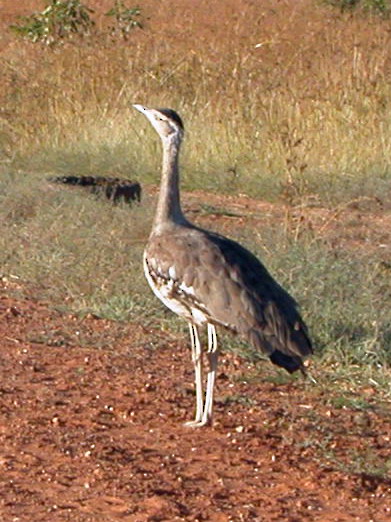
| - The Australian bustard has a black crown and nape, a pale grey front to its long neck, and brown plumage on its wings and upper body. English Wikipedia
- The species has a white abdomen separated from its grey neck by a black feather band. English Wikipedia
- Its wing coverts have irregular black-and-white markings visible both at rest and in flight. English Wikipedia
- The Australian bustard has a white iris and a bill ranging from whitish to brown. English Wikipedia
- Its long legs are yellow to cream in colour. English Wikipedia
- Females resemble males in coloration but are smaller in stature, wingspan and weight. English Wikipedia
- The Australian bustard is a large terrestrial bird with a form resembling an American turkey. English Wikipedia
|
|---|
| Size | - The Asian Houbara measures approximately 65 cm in length. English Wikipedia
- The Asian Houbara has a wingspan of approximately 140 cm. English Wikipedia
- Male Asian Houbaras are 9–15% larger than females on most measured morphological characteristics in a Pakistani study. English Wikipedia
| - Male Australian bustards can reach 1.2 metres in height and have wingspans of up to 2.3 metres. English Wikipedia
- Male body mass averages 6.3 kilograms, with a recorded range of 4.3 to 12.76 kilograms. English Wikipedia
- Females reach approximately 80 centimetres in height and have wingspans of about 1.8 metres. English Wikipedia
- Female body mass averages 3.2 kilograms, with a recorded range of 2.4 to 6.35 kilograms. English Wikipedia
- The largest recorded male Australian bustard weighed 14.5 kilograms and was obtained in Victoria. English Wikipedia
- The Australian bustard is the largest extant flying land bird in Australia. English Wikipedia
|
|---|
| Habitat | - The Asian Houbara breeds in deserts and very arid sandy areas. English Wikipedia
- The species inhabits arid and semi-desert regions of the Middle East and Central Asia. pmc.ncbi.nlm.nih.gov
| - The species inhabits open grasslands, including areas with scattered trees. English Wikipedia
- Spinifex plains and low shrublands are favoured habitats of the Australian bustard. English Wikipedia
- Australian bustards enter denser vegetation following fires. English Wikipedia
- The species also uses artificial clearings such as golf courses and farmland. English Wikipedia
- The species avoids forests and densely vegetated areas. English Wikipedia
- The species occurs in savanna, shrubland, grassland, inland wetlands and artificial terrestrial habitats. iucnredlist.org
|
|---|
| Diet | - The Asian Houbara is omnivorous and consumes seeds, berries, insects, and other invertebrates. English Wikipedia
- Tenebrionid beetles can constitute a particularly abundant food resource for the Asian Houbara. English Wikipedia
- Plant material represents a greater proportion of the Asian Houbara's diet during the non-breeding season. English Wikipedia
- The Asian Houbara obtains the moisture it needs from its food rather than drinking water. English Wikipedia
| - The Australian bustard is omnivorous and primarily consumes plant fruits and seeds. English Wikipedia
- Its plant diet includes shoots, roots, leaves, flowerheads, seeds and fruits. English Wikipedia
- Grasshoppers, beetles and caterpillars are among the insects eaten by the species. English Wikipedia
- The Australian bustard eats lizards, young birds and small rodents. English Wikipedia
- The species is strongly attracted to the fruits of Capparis nummularia, known as myandee or moonflower in northwestern Australia. English Wikipedia
|
|---|
| Behaviour | - The Asian Houbara is a partial latitudinal migrant. English Wikipedia
- Male Asian Houbaras perform displays that begin with an upright neck and erected feathers at the base of the neck. English Wikipedia
- During courtship displays, males run in lines or circles around bushes with their necks tucked into an S shape. English Wikipedia
- Male Asian Houbaras mate with multiple females. English Wikipedia
- The species is highly sensitive to disturbance from humans and livestock during nesting. English Wikipedia
- Sheep grazing does not disturb the Asian Houbara in its non-breeding habitat. English Wikipedia
| - Australian bustards are predominantly terrestrial and usually walk slowly alone or in pairs. English Wikipedia
- When disturbed, Australian bustards may hold their necks erect and point their bills skywards as camouflage. English Wikipedia
- When alarmed, the species may walk away gradually or run, generally taking flight only as a last resort. English Wikipedia
- Australian bustards can travel long distances despite the apparent effort required for flight. English Wikipedia
- The species is nomadic and moves to locations where food becomes plentiful. English Wikipedia
- Australian bustards roost at elevated locations on open plains or in trees when available. English Wikipedia
- Male Australian bustards perform conspicuous breeding displays accompanied by loud booming calls. English Wikipedia
- Displaying males expand a neck sac and spread their feathers into a swaying skirt while holding their wings downward and arching their tails over their backs. English Wikipedia
- Courting males produce a call transliterated as 'who-o-o-o'. English Wikipedia
|
|---|
| Reproduction | - Female Asian Houbaras independently build nests and incubate eggs after mating. English Wikipedia
- The female lays between two and four eggs in a bare scrape on the ground. English Wikipedia
- Asian Houbara eggs hatch after approximately 23 days of incubation. English Wikipedia
- Asian Houbara chicks leave the nest immediately after hatching and follow their mother. English Wikipedia
- Young Asian Houbaras fledge at approximately 30 days of age. English Wikipedia
- Young birds remain close to their mother for several months after fledging. English Wikipedia
- Breeding in the Asian Houbara is strongly seasonal. pmc.ncbi.nlm.nih.gov
- Reproductive performance in both male and female Asian Houbaras is limited even during the breeding season. pmc.ncbi.nlm.nih.gov
| - The Australian bustard does not construct a nest. English Wikipedia
- Females usually lay one egg per clutch, although clutches of two eggs sometimes occur. English Wikipedia
- Eggs are laid on bare ground near a small shrub or bush. English Wikipedia
- Australian bustard eggs measure approximately 75 by 55 millimetres. English Wikipedia
- Female Australian bustards are responsible for incubating the eggs. English Wikipedia
- Newly hatched chicks leave the hatching site to reduce their risk of predation. English Wikipedia
|
|---|
| Distribution | No checked fact yet | - The Australian bustard occurs across a wide area of the Australian continent. English Wikipedia
- Its distribution occasionally extends into southern Papua New Guinea and Indonesia. English Wikipedia
- The species remains relatively common and widespread across most of northern Australia. English Wikipedia
- The species' range has contracted in southeastern Australia. English Wikipedia
- Local populations in wetter regions are more permanent and geographically restricted than populations in more arid regions. English Wikipedia
|
|---|
| Conservation | - The Asian Houbara is classified as Vulnerable on the IUCN Red List. pmc.ncbi.nlm.nih.gov
- Asian Houbara populations have declined because of overhunting, habitat loss, and commercial development. pmc.ncbi.nlm.nih.gov
- The Asian Houbara population declined by approximately 20–50% between 1984 and 2004. English Wikipedia
- Habitat degradation caused by agricultural expansion and infrastructure development is a major threat to the Asian Houbara. English Wikipedia
- Captive breeding programs for the Asian Houbara have been established particularly in Saudi Arabia and the United Arab Emirates. pmc.ncbi.nlm.nih.gov
- The United Arab Emirates initiated a captive breeding program for the species at Al Ain Zoo in 1977. pmc.ncbi.nlm.nih.gov
- The International Fund for Houbara Conservation was established in the United Arab Emirates in 2006. pmc.ncbi.nlm.nih.gov
- A captive breeding facility for the Asian Houbara was established in Saudi Arabia in 1986. English Wikipedia
- Captive-bred Asian Houbaras may have reduced survival and altered migration and predator-avoidance behaviours. pmc.ncbi.nlm.nih.gov
| - The IUCN assessed the Australian bustard as Least Concern in 2024. English Wikipedia
- The IUCN assessment recorded a declining population trajectory for the species in 2024. English Wikipedia
- The global population of Australian bustards is estimated to exceed 10,000 individuals but not to exceed 100,000. English Wikipedia
- The species is classified as near threatened in Western Australia and the Northern Territory. English Wikipedia
- The Australian bustard is classified as endangered in South Australia and New South Wales. English Wikipedia
- The species is classified as critically endangered on Victoria's 2007 advisory list of threatened vertebrate fauna, with the same advice retained in 2016. English Wikipedia
- The Australian bustard is classified as Least Concern in Queensland. English Wikipedia
- The species is not listed as threatened under Australia's Environment Protection and Biodiversity Conservation Act 1999. English Wikipedia
- The IUCN assessment identifies invasive non-native species and diseases among the threats relevant to the species. iucnredlist.org
- The IUCN assessment records continuing decline in the extent or quality of the species' habitat. iucnredlist.org
|
|---|
| Uses | No checked fact yet | - Aboriginal people in Central Australia use the Australian bustard as an important food source. English Wikipedia
- The species' white feathers are used for ceremonial purposes. English Wikipedia
- Australian bustards have historically been hunted and shot for food. australian.museum
|
|---|
| Similar species | - The Asian Houbara is larger and much paler than the African Houbara. English Wikipedia
| No checked fact yet |
|---|
| Other | No checked fact yet | - The Australian bustard is also known as the plains turkey and bush turkey. English Wikipedia
|
|---|