Species · Birds
Asian Houbara Chlamydotis macqueenii
The scientific name of the Asian Houbara is Chlamydotis macqueenii. It is a species of bird in the family Otididae (bustard), order Otidiformes. The name dates from 1832.
- Scientific name
- Chlamydotis macqueenii (J. E. Gray, 1832)
- Common name
- Asian Houbara
- Genus
- Chlamydotis
- Family
- Otididae (Bustard)
- Order
- Otidiformes
- Class
- Aves
- Red List category
- VU Vulnerable
- Recorded in
- 24 countries
- Name status
- accepted in the Catalogue of Life

Overview
Chlamydotis macqueenii inhabits arid and semi-desert regions of the Middle East and Central Asia. It has brown upperparts, white underparts and distinctive long, curved feathers on the top of its head.
Written 26 November 2026 from the sources listed below. Each statement was checked against the passage it cites; statements that could not be supported were removed.
Appearance
The Asian Houbara has brown upperparts, white underparts and black stripes along the sides of its neck. Its neck is white with a vertical black stripe that is most prominent in adult males.[1][2]
The feathers on the top of its head include long, curved feathers that are white or black with white bases. Females are smaller and paler above than males.[3][4]
The Asian Houbara measures approximately 65 cm in length and has a wingspan of approximately 140 cm. Male Asian Houbaras are 9–15% larger than females on most measured morphological characteristics in a Pakistani study.[5][6][7]
Habitat
The Asian Houbara inhabits arid and semi-desert regions of the Middle East and Central Asia. It breeds in deserts and very arid sandy areas.[8][9]
Diet
The Asian Houbara is omnivorous and consumes seeds, berries, insects and other invertebrates. Tenebrionid beetles can constitute a particularly abundant food resource.[10][11]
Plant material represents a greater proportion of its diet during the non-breeding season. The Asian Houbara obtains the moisture it needs from its food rather than drinking water.[12][13]
Behaviour
The Asian Houbara is a partial latitudinal migrant. Male Asian Houbaras mate with multiple females.[14][15]
Male displays begin with an upright neck and erected feathers at the base of the neck. During courtship displays, males run in lines or circles around bushes with their necks tucked into an S shape.[16][17]
The species is highly sensitive to disturbance from humans and livestock during nesting. Sheep grazing does not disturb the Asian Houbara in its non-breeding habitat.[18][19]
Reproduction and life cycle
Breeding in the Asian Houbara is strongly seasonal. Reproductive performance in both males and females is limited even during the breeding season.[20][21]
After mating, females independently build nests and incubate eggs. Each female lays between two and four eggs in a bare scrape on the ground.[22][23]
Eggs hatch after approximately 23 days of incubation. Chicks leave the nest immediately after hatching and follow their mother.[24][25]
Young Asian Houbaras fledge at approximately 30 days of age. They remain close to their mother for several months after fledging.[26][27]
Conservation
The Asian Houbara is classified as Vulnerable on the IUCN Red List. Its population declined by approximately 20–50% between 1984 and 2004.[28][29]
Populations have declined because of overhunting, habitat loss and commercial development. Habitat degradation caused by agricultural expansion and infrastructure development is a major threat.[30][31]
Captive breeding programs have been established particularly in Saudi Arabia and the United Arab Emirates. The United Arab Emirates initiated a captive breeding program at Al Ain Zoo in 1977, and a captive breeding facility was established in Saudi Arabia in 1986.[32][33][34]
The International Fund for Houbara Conservation was established in the United Arab Emirates in 2006. Captive-bred Asian Houbaras may have reduced survival and altered migration and predator-avoidance behaviours.[35][36]
Similar species
The Asian Houbara is larger and much paler than the African Houbara.[37]
Classification of the Asian Houbara
| Kingdom | Animalia |
|---|---|
| Phylum | Chordata |
| Subphylum | Vertebrata |
| Infraphylum | Gnathostomata |
| Parvphylum | Osteichthyes |
| Megaclass | Tetrapoda |
| Class | Aves (Bird) |
| Order | Otidiformes (Bustards) |
| Family | Otididae (Bustard) |
| Genus | Chlamydotis (Houbaras) |
| Species | Chlamydotis macqueenii (J. E. Gray, 1832) |
Where the Asian Houbara is found
Checklists and occurrence records place Chlamydotis macqueenii in 24 countries across Asia. GBIF holds 4,060 georeferenced records of it.
Countries
- Azerbaijan 4
- Bahrain 3
- Belgium 4
- China 33
- India 63
- Iran 151
- Iraq 4
- Israel 2,394
- Jordan 20
- Kazakhstan 468
- Kuwait 18
- Kyrgyzstan 3
- Mongolia 6
- Oman 8
- Pakistan 3
- Palestinian Territory 38
- Qatar 4
- Saudi Arabia 25
- Sweden 19
- Syria 4
- Turkey 10
- Ukraine 7
- United Arab Emirates 496
- Uzbekistan 275
Regions and cities with the most records
- Southern District, Israel 2,344
- Ofaqim, Israel 874
- Beersheba, Israel 780
- Dubai, United Arab Emirates 319
- Segev Shalom, Israel 290
- Bukhara, Uzbekistan 232
- ‘Abasān al Kabīrah, Palestinian Territory 199
- Almaty Region, Kazakhstan 189
- Tel Sheva‘, Israel 186
- Abu Dhabi, United Arab Emirates 166
- Netivot, Israel 158
- Banī Suhaylā, Palestinian Territory 97
- Rafaḩ, Palestinian Territory 96
- Khān Yūnis, Palestinian Territory 94
- Rahat, Israel 84
- Al Qarārah, Palestinian Territory 77
- Laqiyya, Israel 65
- West Bank, Palestinian Territory 58
- Jericho, Palestinian Territory 44
- Semnan, Iran 44
- Isfahan, Iran 39
- H̱ura, Israel 30
- Gujarat, India 28
- Az̧ Z̧āhirīyah, Palestinian Territory 26
- Al Shamkhah City, United Arab Emirates 22
- Bani Yas City, United Arab Emirates 22
- Mohammed Bin Zayed City, United Arab Emirates 22
- Navoiy Region, Uzbekistan 22
- Aqaba, Jordan 20
- Eilat, Israel 20
- Aqaba, Jordan 19
- Dimona, Israel 19
- ‘Ar‘ara BaNegev, Israel 17
- Ar Ruways, United Arab Emirates 16
- Kalmar, Sweden 16
- Tehran, Iran 15
1 more country has a few records outside this range
These countries hold a few records of Chlamydotis macqueenii but lie outside the range the checklists give for it. Such records are often zoo or garden specimens, museum material or vagrants, so the species is not counted as occurring there.
Range as the checklists state it
Europe & Northern Asia (excluding China)
Southern Asia
A number beside a place is its count of GBIF occurrence records. A place without a number comes from a checklist alone. Records show where a species has been observed or collected, which can include escapes and vagrants.
Common names
English
- Asian Houbara
- Asian Houbara Bustard
- Macqueen's Bustard
- Macqueen’s Bustard
Names in 42 other languages
- Arabic
- حبارى آسيوي, حبارى شرقية, حبارى ماكوين
- Breton
- Otiz Mac Queen
- Bulgarian
- Азиатска хубара
- Catalan
- hubara asiàtica
- Chinese
- 波斑鴇, 波斑鸨, 麥昆氏波斑鴇
- Croatian
- azijska droplja
- Czech
- drop hřívnatý, drop obojkový
- Danish
- Østlig Kravetrappe
- Dutch
- Oostelijke Kraagtrap
- Esperanto
- Makkvina otido, orienta otido
- Estonian
- aasia kraetrapp
- Finnish
- Kaulustrappi, idänkaulustrappi
- French
- Outarde de Macqueen
- German
- Asiatische Kragentrappe, Kragentrappe, Steppenkragentrappe
- Greek
- Ασιατική Χλαμυδωτίδα, Ερημόγαλος
- Hebrew
- חובארה מדברית, חוברה מדברית, חוברת מקווין
- Hungarian
- pettyes túzok
- Icelandic
- Macqueendoðra
- Irish
- Bústard mhic shuibhne
- Italian
- Ubara asiatica
- Japanese
- サバクフサエリショウノガン
- Kazakh
- Жек дуадақ, или Джек
- Latvian
- apkakles sīga
- Lithuanian
- Azijinis puošnusis einis, Makvenio einis
- Malayalam
- മരുക്കൊക്ക്
- Northern Sami
- Sitnuábetráhppe
- Norwegian
- steppetrappe
- Norwegian Bokmål
- Kragetrappe
- Persian
- هوبره, هوبره آسیایی
- Polish
- hubara arabska
- Portuguese
- Abetarda de MacQueen, abetarda-de-macqueen, hubara-ocidental, hubara-oriental
- Romanian
- Dropie gulerată asiatică
- Russian
- Вихляй, Джек, Дрофа-красотка
- Serbian
- Mekvinova droplja
- Slovak
- drop hrivnatý
- Slovenian
- ovratničarska droplja
- Spanish
- Avutarda hubara asiática, Hubara de MacQueen
- Swedish
- kragtrapp
- Turkish
- Asya Yakalı Toyu, Yakalı Toy
- Ukrainian
- джек східний
- Vietnamese
- Ô tác Macqueen
- roh
- Droppa asiatica
Synonyms
2 other scientific names have been used for this species and are now treated as synonyms of Chlamydotis macqueenii.
- Chlamydotis undulata macqueenii Gray, JE, 1832
- Otis macqueenii J. E. Gray, 1832
Related species
-
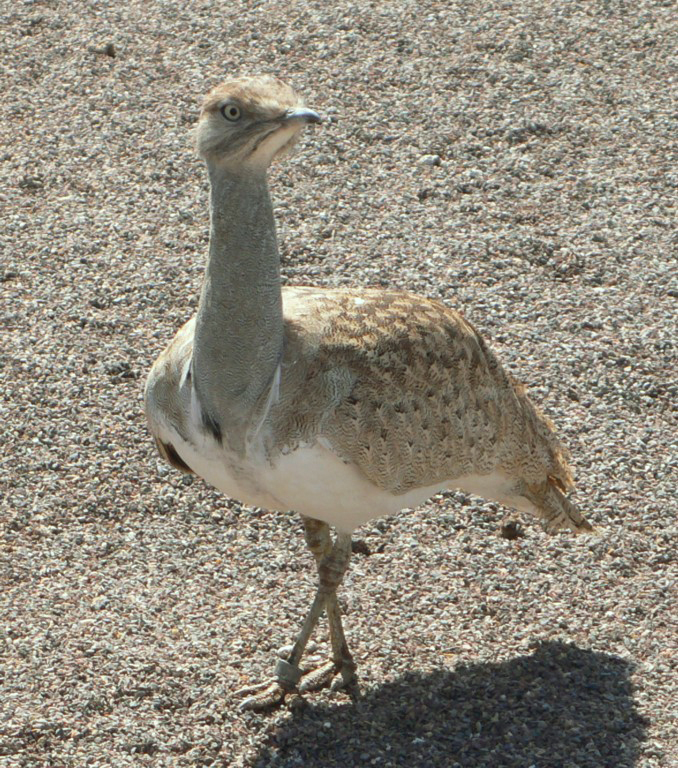 African HoubaraChlamydotis undulata
-
 Great Indian BustardArdeotis nigriceps
-
 Kori BustardArdeotis kori
-
 Great BustardOtis tarda
-
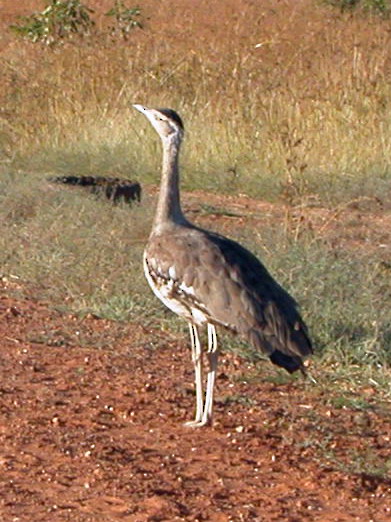 Australian BustardArdeotis australis
-
 Little BustardTetrax tetrax
-
 Bengal FloricanHoubaropsis bengalensis
-
 Lesser FloricanSypheotides indicus
Compare
Questions and answers
What is the scientific name of the Asian Houbara?
The scientific name of the Asian Houbara is Chlamydotis macqueenii. Written with its author, the full name is Chlamydotis macqueenii (J. E. Gray, 1832).
Which family does the Asian Houbara belong to?
Chlamydotis macqueenii belongs to the family Otididae, in the order Otidiformes and the class Aves.
Where is the Asian Houbara found?
Checklists and occurrence records place Chlamydotis macqueenii in 24 countries, including Israel, United Arab Emirates, Kazakhstan, Uzbekistan, Iran and India.
What is the conservation status of the Asian Houbara?
The IUCN Red List category recorded for Chlamydotis macqueenii is Vulnerable (VU).
What other names does the Asian Houbara have?
Chlamydotis macqueenii is also known in English as Asian Houbara Bustard, Macqueen's Bustard and Macqueen’s Bustard.
What do houbara bustards eat?
Asian Houbaras are omnivorous and consume seeds, berries, insects and other invertebrates. Tenebrionid beetles can be a particularly abundant food resource.[10][11]
What is the diet of birds?
The Asian Houbara is omnivorous, eating seeds, berries, insects and other invertebrates. Plant material represents a greater proportion of its diet during the non-breeding season.[10][12]
What is a houbara bustard?
The Asian Houbara (Chlamydotis macqueenii) is a bird in the family Otididae. It inhabits arid and semi-desert regions of the Middle East and Central Asia.[9]
Sources
Passages the profile rests on
- The Asian Houbara has brown upperparts, white underparts, and black stripes along the sides of its neck. Source passage: “It is brown above and white below, with black stripes down the sides of the neck.” — English Wikipedia
- The neck of the Asian Houbara is white with a vertical black stripe that is most prominent in adult males. Source passage: “The neck is white with a vertical black stripe, most prominent in adult males.” — ebird.org
- The feathers on the top of the head include long, curved feathers that are white or black with white bases. Source passage: “The feathers on the top of the head include some long and curved feathers which are white or black with white bases.” — English Wikipedia
- The female is smaller and paler above than the male. Source passage: “Sexes are similar, but the female is smaller and paler above.” — English Wikipedia
- The Asian Houbara measures approximately 65 cm in length. Source passage: “This medium-sized bustard is about 65 cm (26 in) long” — English Wikipedia
- The Asian Houbara has a wingspan of approximately 140 cm. Source passage: “with a 140 cm (55 in) wingspan.” — English Wikipedia
- Male Asian Houbaras are 9–15% larger than females on most measured morphological characteristics in a Pakistani study. Source passage: “showed that the males were 9–15% larger than females on most measurements.” — English Wikipedia
- The Asian Houbara breeds in deserts and very arid sandy areas. Source passage: “The Asian houbara breeds in deserts and other very arid sandy areas.” — English Wikipedia
- The species inhabits arid and semi-desert regions of the Middle East and Central Asia. Source passage: “The Houbara Bustard (Chlamydotis macqueenii) is a vulnerable species found in arid and semi-desert regions of the Middle East and Central Asia.” — pmc.ncbi.nlm.nih.gov
- The Asian Houbara is omnivorous and consumes seeds, berries, insects, and other invertebrates. Source passage: “This species is omnivorous taking seeds, berries, insects and other invertebrates.” — English Wikipedia
- Tenebrionid beetles can constitute a particularly abundant food resource for the Asian Houbara. Source passage: “Tenebrionid beetles were found to be especially numerous in one study.” — English Wikipedia
- Plant material represents a greater proportion of the Asian Houbara's diet during the non-breeding season. Source passage: “Plant material makes up more of their diet during the non-breeding season.” — English Wikipedia
- The Asian Houbara obtains the moisture it needs from its food rather than drinking water. Source passage: “They do not drink water and obtain all the moisture they need from their diet.” — English Wikipedia
- The Asian Houbara is a partial latitudinal migrant. Source passage: “The Asian houbara is a partial latitudinal migrant” — English Wikipedia
- Male Asian Houbaras mate with multiple females. Source passage: “The males mate with multiple females” — English Wikipedia
- Male Asian Houbaras perform displays that begin with an upright neck and erected feathers at the base of the neck. Source passage: “The male houbara displays initially with the neck upright and the feathers on the base of the neck erected.” — English Wikipedia
- During courtship displays, males run in lines or circles around bushes with their necks tucked into an S shape. Source passage: “This is followed by a more vigorous phase of running either in a line or in a circle around a few bushes while the neck is tucked back into an "S".” — English Wikipedia
- The species is highly sensitive to disturbance from humans and livestock during nesting. Source passage: “It is very sensitive to disturbance by humans and livestock when nesting.” — English Wikipedia
- Sheep grazing does not disturb the Asian Houbara in its non-breeding habitat. Source passage: “However, sheep grazing does not disturb the Asian Houbara's non-breeding habitats.” — English Wikipedia
- Breeding in the Asian Houbara is strongly seasonal. Source passage: “Breeding is strongly seasonal” — pmc.ncbi.nlm.nih.gov
- Reproductive performance in both male and female Asian Houbaras is limited even during the breeding season. Source passage: “even within the breeding season the reproductive performance of both males and females is limited.” — pmc.ncbi.nlm.nih.gov
- Female Asian Houbaras independently build nests and incubate eggs after mating. Source passage: “after mating, the female alone builds the nest and incubates.” — English Wikipedia
- The female lays between two and four eggs in a bare scrape on the ground. Source passage: “The clutch consists of 2–4 eggs laid in a bare scrape on the ground.” — English Wikipedia
- Asian Houbara eggs hatch after approximately 23 days of incubation. Source passage: “The eggs hatch after about 23 days” — English Wikipedia
- Asian Houbara chicks leave the nest immediately after hatching and follow their mother. Source passage: “the nidifugous chicks leave the nest immediately after hatching and follow the mother” — English Wikipedia
- Young Asian Houbaras fledge at approximately 30 days of age. Source passage: “The young fledge in about 30 days” — English Wikipedia
- Young birds remain close to their mother for several months after fledging. Source passage: “but remain close to their mother for several months.” — English Wikipedia
- The Asian Houbara is classified as Vulnerable on the IUCN Red List. Source passage: “As a result, the International Union for Conservation of Nature (IUCN) has classified this species as Vulnerable.” — pmc.ncbi.nlm.nih.gov
- The Asian Houbara population declined by approximately 20–50% between 1984 and 2004. Source passage: “Populations have decreased by 20–50% between 1984 and 2004 mainly due to hunting and changes in land-use.” — English Wikipedia
- Asian Houbara populations have declined because of overhunting, habitat loss, and commercial development. Source passage: “In recent decades, Houbara populations have significantly declined due to overhunting, habitat loss, and commercial development.” — pmc.ncbi.nlm.nih.gov
- Habitat degradation caused by agricultural expansion and infrastructure development is a major threat to the Asian Houbara. Source passage: “The main threat to the Asian houbara is degradation of semi-desert habitat by the introduction of agriculture and by infrastructure development such as roads and electricity” — English Wikipedia
- Captive breeding programs for the Asian Houbara have been established particularly in Saudi Arabia and the United Arab Emirates. Source passage: “several captive breeding and conservation programs have been established in the Middle East, particularly in Saudi Arabia and the United Arab Emirates (UAE)” — pmc.ncbi.nlm.nih.gov
- The United Arab Emirates initiated a captive breeding program for the species at Al Ain Zoo in 1977. Source passage: “The UAE initiated one of the earliest captive breeding programs in 1977 at Al Ain Zoo” — pmc.ncbi.nlm.nih.gov
- A captive breeding facility for the Asian Houbara was established in Saudi Arabia in 1986. Source passage: “one in Saudi Arabia in 1986” — English Wikipedia
- The International Fund for Houbara Conservation was established in the United Arab Emirates in 2006. Source passage: “the International Fund for Houbara Conservation (IFHC) was established in 2006 in the UAE” — pmc.ncbi.nlm.nih.gov
- Captive-bred Asian Houbaras may have reduced survival and altered migration and predator-avoidance behaviours. Source passage: “Captive-bred birds often show reduced survival and altered behaviors such as weakened migration and predator avoidance” — pmc.ncbi.nlm.nih.gov
- The Asian Houbara is larger and much paler than the African Houbara. Source passage: “The Asian houbara is larger than the African houbara and much paler.” — English Wikipedia
Data
- Catalogue of Life, 2026-10-16 XR cc by
- Global Biodiversity Information Facility CC BY 4.0
- Wikidata CC0
- GeoNames CC BY 4.0
- Wikimedia Commons per image; credit shown with each image
- Within the Catalogue of Life, this name comes from The Integrated Taxonomic Information System cc0
References
- Gill, Frank, & and Minturn Wright. (2006). Birds of the World: Recommended English Names.
- Dickinson, E. C., and J. V. Remsen Jr., eds. (2013). The Howard and Moore Complete Checklist of the Birds of the World, 4th Edition, Vol. 1 Non-Passerines.
This species in other databases
Page built on 27 November 2026. See how the catalog is made and all sources and licences.
Cite this page
ScientificNames.org. (2026). Chlamydotis macqueenii (Asian Houbara). Retrieved November 27, 2026, from https://scientificnames.org/species/chlamydotis-macqueenii
“Chlamydotis macqueenii (Asian Houbara).” ScientificNames.org, 2026, scientificnames.org/species/chlamydotis-macqueenii. Accessed 27 Nov. 2026.
ScientificNames.org. “Chlamydotis macqueenii (Asian Houbara).” Accessed November 27, 2026. https://scientificnames.org/species/chlamydotis-macqueenii.
@misc{scientificnames_chlamydotis_macqueenii_asian_houbara,
  author = {{ScientificNames.org}},
  title = {Chlamydotis macqueenii (Asian Houbara)},
  year = {2026},
  url = {https://scientificnames.org/species/chlamydotis-macqueenii},
  note = {Accessed 2026-11-27}
}