Species · Insects
Hercules Beetle Dynastes (Dynastes) hercules
The scientific name of the Hercules Beetle is Dynastes (Dynastes) hercules. It is a species of insect in the family Scarabaeidae (dung beetles), order Coleoptera. The name dates from 1758.
- Scientific name
- Dynastes (Dynastes) hercules (Linnaeus, 1758)
- Common name
- Hercules Beetle
- Genus
- Dynastes
- Family
- Scarabaeidae (Dung Beetles)
- Order
- Coleoptera
- Class
- Insecta
- Recorded in
- 18 countries
- Name status
- accepted in the Catalogue of Life

Overview
The species inhabits mountainous and lowland rain forests. Male Hercules beetles are distinguished by two horns, one on the head and a larger one on the pronotum.
Written 24 November 2026 from the sources listed below. Each statement was checked against the passage it cites; statements that could not be supported were removed.
Appearance
Male Hercules beetles have black bodies and olive-green elytra that vary in coloration. Their elytra become darker as environmental humidity increases.[1][2]
Female Hercules beetles usually have entirely black elytra with a punctured surface.[3]
Adult body length, excluding the thoracic horn, ranges from 50 to 85 mm. Adult body width ranges from 29 to 42 mm.[4][5]
Male Hercules beetles can reach 173 mm in length when their horn is included. Horn size varies more than the dimensions of the legs, wings, or overall body.[6][7]
Habitat
The Hercules beetle inhabits mountainous and lowland rain forests.[8]
Diet
Hercules beetle larvae feed on rotting wood. Adult beetles consume fresh and decaying fruit as well as tree sap.[9][10]
In captivity, adult beetles have been observed eating peaches, pears, apples, grapes, bananas, and mangoes.[11]
Behaviour
Adult Hercules beetles are nocturnal and forage for fruit at night. During the daytime, they hide or burrow in leaf litter.[12][13]
Adults produce warning sounds by stridulating their abdomen against their elytra.[14]
Male beetles orient towards and seek out nearby females, indicating chemical communication. Males fight to obtain possession of females and mating rights.[15][16]
During mating disputes, males use their horns to grab, pin, lift, and throw rivals. Hercules beetles exhibit polygynandrous mating behaviour.[17][18]
Reproduction and life cycle
Adult mating typically takes place during the rainy season, from July to December. Females have an average period of 30 days between copulation and egg-laying.[19][20]
Females can lay as many as 100 eggs on the ground or on dead wood. Eggs take approximately 27.7 days to hatch.[21][22]
The larval stage can last up to two years and includes three instars. Larvae can grow to 11 cm long and weigh more than 100 grams.[23][24]
The pupal stage lasts approximately 32 days.[25]
Uses
Hercules beetles can be kept as pets.[26]
An enzyme extracted from larval fecal matter may be suitable for enzyme-based cleaning products.[27]
Classification of the Hercules Beetle
| Kingdom | Animalia |
|---|---|
| Phylum | Arthropoda |
| Subphylum | Hexapoda |
| Class | Insecta (Insect) |
| Order | Coleoptera (Beetle) |
| Suborder | Polyphaga |
| Series | Staphyliniformia |
| Superfamily | Scarabaeoidea |
| Family | Scarabaeidae (Dung Beetles) |
| Subfamily | Dynastinae |
| Tribe | Dynastini |
| Subtribe | Dynastina |
| Genus | Dynastes |
| Subgenus | Dynastes (Dynastes) |
| Species | Dynastes (Dynastes) hercules (Linnaeus, 1758) |
Where the Hercules Beetle is found
Checklists and occurrence records place Dynastes (Dynastes) hercules in 18 countries across North America and South America. GBIF holds 596 georeferenced records of it.
Countries
- Belize
- Bolivia 2
- Brazil 16
- Colombia 84
- Costa Rica 151
- Dominica 15
- Ecuador 33
- El Salvador
- Guadeloupe 178
- Guatemala 7
- Honduras 1
- Martinique 36
- Nicaragua 13
- Panama 18
- Peru 7
- Saint Lucia 9
- Trinidad and Tobago 9
- Venezuela 17
Regions and cities with the most records
- Guanacaste Province, Costa Rica 36
- Puntarenas Province, Costa Rica 34
- Fort-de-France, Martinique 25
- Limón Province, Costa Rica 22
- Les Abymes, Guadeloupe 20
- Alajuela Province, Costa Rica 15
- Cartago Province, Costa Rica 12
- Heredia Province, Costa Rica 11
- Meta Department, Colombia 6
- Boyacá, Colombia 5
- Jinotega Department, Nicaragua 5
- Soufrière, Saint Lucia 5
- Bocas del Toro Province, Panama 4
- Orellana Province, Ecuador 4
- Valle del Cauca Department, Colombia 4
- Cali, Colombia 3
- Pichincha, Ecuador 3
- Tunapuna/Piarco, Trinidad and Tobago 3
- Yumbo, Colombia 3
A number beside a place is its count of GBIF occurrence records. A place without a number comes from a checklist alone. Records show where a species has been observed or collected, which can include escapes and vagrants.
Common names
English
- Hercules Beetle
Names in 14 other languages
- Asturian
- escarabayu hércules
- Chinese
- 赫克力士長戟大兜蟲
- Dutch
- Herculeskever
- French
- Dynaste Hercule, Scieur de long
- German
- Herkuleskäfer
- Italian
- Scarabeo Ercole
- Japanese
- ヘラクレスオオカブト, ヘルクレスオオカブト
- Portuguese
- Besouro hércules
- Romanian
- Gândacul lui Hercule
- Russian
- Жук-геркулес
- Slovak
- herkules antilský
- Slovenian
- herkul
- Swedish
- Herkulesbagge
- Thai
- ด้วงกว่างเฮอร์คิวลิส, ด้วงกว่างเฮอร์คิวลีส
Synonyms
One other scientific name has been used for this species and is now treated as a synonym of Dynastes (Dynastes) hercules.
- Scarabaeus hercules Linnaeus, 1758
Subspecies and varieties
- Dynastes (Dynastes) hercules bleuzeni subspecies
- Dynastes (Dynastes) hercules ecuatorianus subspecies
- Dynastes (Dynastes) hercules hercules subspecies
- Dynastes (Dynastes) hercules lichyi subspecies
- Dynastes (Dynastes) hercules occidentalis subspecies
- Dynastes (Dynastes) hercules paschoali subspecies
- Dynastes (Dynastes) hercules reidi subspecies
- Dynastes (Dynastes) hercules septentrionalis subspecies
- Dynastes (Dynastes) hercules trinidadensis subspecies
Related species
-
 Grant's Hercules BeetleDynastes (Dynastes) grantii
-
 Neptune BeetleDynastes (Theogenes) neptunus
-
 Satanas BeetleDynastes (Theogenes) satanas
-
 Hyllus BeetleDynastes (Dynastes) hyllus
- Dynastes (Dynastes) maya
- Unicorn BeetleDynastes (Dynastes) tityus
-
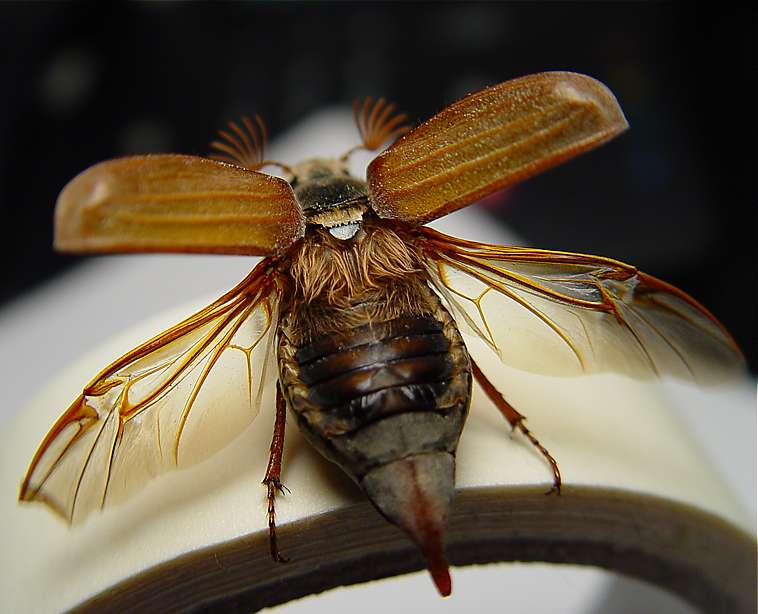 CockchaferMelolontha melolontha
-
 Japanese BeetlePopillia japonica
Compare
Questions and answers
What is the scientific name of the Hercules Beetle?
The scientific name of the Hercules Beetle is Dynastes (Dynastes) hercules. Written with its author, the full name is Dynastes (Dynastes) hercules (Linnaeus, 1758).
Which family does the Hercules Beetle belong to?
Dynastes (Dynastes) hercules belongs to the family Scarabaeidae, in the order Coleoptera and the class Insecta.
Where is the Hercules Beetle found?
Checklists and occurrence records place Dynastes (Dynastes) hercules in 18 countries, including Guadeloupe, Costa Rica, Colombia, Martinique, Ecuador and Panama.
Where do Hercules beetles get their name?
The species is named after the mythological hero Hercules because of its exceptional strength.[28]
What habitat do Hercules beetles live in?
They inhabit mountainous and lowland rain forests.[8]
What do Hercules beetles eat?
Larvae feed on rotting wood. Adults consume fresh and decaying fruit as well as tree sap.[9][10]
Can I keep a Hercules beetle as a pet?
Hercules beetles can be kept as pets.[26]
Sources
Passages the profile rests on
- Male beetles have black bodies and olive-green elytra that can vary in coloration. Source passage: “The body of males is black with the exception of the elytra, which can have shades of olive-green.” — English Wikipedia
- Male elytra become darker as environmental humidity increases. Source passage: “At low humidity the elytra are olive-green or yellow in color, but darken to black at higher humidity due to its hygrochromic properties.” — English Wikipedia
- Female beetles usually have entirely black elytra with a punctured surface. Source passage: “Females of D. hercules have punctured elytra which are usually entirely black” — English Wikipedia
- Adult body length excluding the thoracic horn ranges from 50 to 85 mm. Source passage: “Adult body sizes (not including the thoracic horn) vary between 50 and 85 mm (2.0 and 3.3 in) in length” — English Wikipedia
- Adult body width ranges from 29 to 42 mm. Source passage: “29 and 42 mm (1.1 and 1.7 in) in width.” — English Wikipedia
- Male Hercules beetles can reach 173 mm in length when their horn is included. Source passage: “Male Hercules beetles may reach up to 173 mm (7 in) in length (including the horn)” — English Wikipedia
- Horn size varies more than the dimensions of the legs, wings, or overall body. Source passage: “The size of the horn is naturally variable, more so than any variation of the size of legs, wings, or overall body size in the species.” — English Wikipedia
- The species inhabits mountainous and lowland rain forests. Source passage: “in mountainous and lowland rain forests.” — English Wikipedia
- Hercules beetle larvae feed on rotting wood. Source passage: “The larvae of the Hercules beetle are saproxylophagous, meaning that they feed on rotting wood” — English Wikipedia
- Adult Hercules beetles consume fresh and decaying fruit as well as tree sap. Source passage: “The adult Hercules beetle feeds on fresh and rotting fruit, along with tree sap.” — English Wikipedia
- Adult beetles have been observed eating peaches, pears, apples, grapes, bananas, and mangoes in captivity. Source passage: “They have been observed feeding on peaches, pears, apples, grapes, bananas, and mangoes in captivity.” — English Wikipedia
- Adult Hercules beetles are nocturnal and forage for fruit at night. Source passage: “the adult beetles, which are nocturnal, forage for fruit at night” — English Wikipedia
- During the daytime, adults hide or burrow in leaf litter. Source passage: “hide or burrow within the leaf litter during the day.” — English Wikipedia
- Adults produce warning sounds by stridulating their abdomen against their elytra. Source passage: “generated by stridulating their abdomen against their elytra to serve as a warning to predators.” — English Wikipedia
- Male beetles orient towards and seek out nearby females, indicating chemical communication. Source passage: “a male placed in the vicinity of a female will immediately orient towards her and seek her out, suggesting chemical communication through strong sexual pheromones.” — English Wikipedia
- Males fight to obtain possession of females and mating rights. Source passage: “male D. hercules will engage in combat to win possession and mating rights to a female.” — English Wikipedia
- Male beetles use their horns to grab, pin, lift, and throw rivals during mating disputes. Source passage: “During fights, the males attempt to grab and pin their rival between the cephalic and thoracic horns to lift and throw them.” — English Wikipedia
- Hercules beetles exhibit polygynandrous mating behaviour. Source passage: “though the beetles remain polygynandrous.” — English Wikipedia
- Adult mating typically takes place during the rainy season, from July to December. Source passage: “The mating season for adults typically occurs during the rainy season (July to December).” — English Wikipedia
- Females have an average period of 30 days between copulation and egg-laying. Source passage: “Females have an average gestation period of 30 days from copulation to egg-laying” — English Wikipedia
- Females can lay as many as 100 eggs on the ground or on dead wood. Source passage: “may lay up to 100 eggs on the ground or on dead wood.” — English Wikipedia
- Eggs take approximately 27.7 days to hatch. Source passage: “The eggs have an incubation period of approximately 27.7 days before they hatch.” — English Wikipedia
- The larval stage can last up to two years and includes three instars. Source passage: “the larval stage of the Hercules beetle may last up to two years in duration, where it will go through 3 metamorphosis stages, also known as instars.” — English Wikipedia
- Hercules beetle larvae can grow to 11 cm long and weigh more than 100 grams. Source passage: “The larvae can grow up to 11 cm (4.5 in) in length and weigh more than 100 grams.” — English Wikipedia
- The pupal stage lasts approximately 32 days. Source passage: “After the third instar stage, the pupal stage lasts about 32 days” — English Wikipedia
- Hercules beetles can be kept as pets. Source passage: “The beetles can be kept as pets.” — English Wikipedia
- An enzyme extracted from larval fecal matter may be suitable for enzyme-based cleaning products. Source passage: “β-mannanase has been successfully extracted and cloned from larvae fecal matter, suggesting that production of bio additive cleaning products may be feasible.” — English Wikipedia
- The species is named after the mythological hero Hercules because of its exceptional strength. Source passage: “Dynastes hercules is known for its tremendous strength and is named after Hercules, a hero of classical mythology who is famed for his great strength.” — English Wikipedia
Data
- Catalogue of Life, 2026-10-16 XR cc by
- Global Biodiversity Information Facility CC BY 4.0
- Wikidata CC0
- GeoNames CC BY 4.0
- Wikimedia Commons per image; credit shown with each image
- Within the Catalogue of Life, this name comes from World Scarabaeidae Database cc by
References
- Linnaeus, C. (1758). Systema naturae per regna tria naturae, secundum classes, ordines, genera, species cum characteribus, differentiis, synonymis, locis. Tomus I. Editio X. Laurentii Salvi, Holmiae :1-824. https://doi.org/10.5962/bhl.title.542 Link where the name was published
This species in other databases
Page built on 24 November 2026. See how the catalog is made and all sources and licences.
Cite this page
ScientificNames.org. (2026). Dynastes (Dynastes) hercules (Hercules Beetle). Retrieved November 24, 2026, from https://scientificnames.org/species/dynastes-dynastes-hercules
“Dynastes (Dynastes) hercules (Hercules Beetle).” ScientificNames.org, 2026, scientificnames.org/species/dynastes-dynastes-hercules. Accessed 24 Nov. 2026.
ScientificNames.org. “Dynastes (Dynastes) hercules (Hercules Beetle).” Accessed November 24, 2026. https://scientificnames.org/species/dynastes-dynastes-hercules.
@misc{scientificnames_dynastes_dynastes_hercules_hercules_beetle,
  author = {{ScientificNames.org}},
  title = {Dynastes (Dynastes) hercules (Hercules Beetle)},
  year = {2026},
  url = {https://scientificnames.org/species/dynastes-dynastes-hercules},
  note = {Accessed 2026-11-24}
}