Comparison
Common Haircap Moss vs Bristly Haircap Moss
Common Haircap Moss (Polytrichum commune) and Bristly Haircap Moss (Polytrichum piliferum) both belong to the genus Polytrichum (hair moss) and part ways below it. Both are recorded in 38 countries.
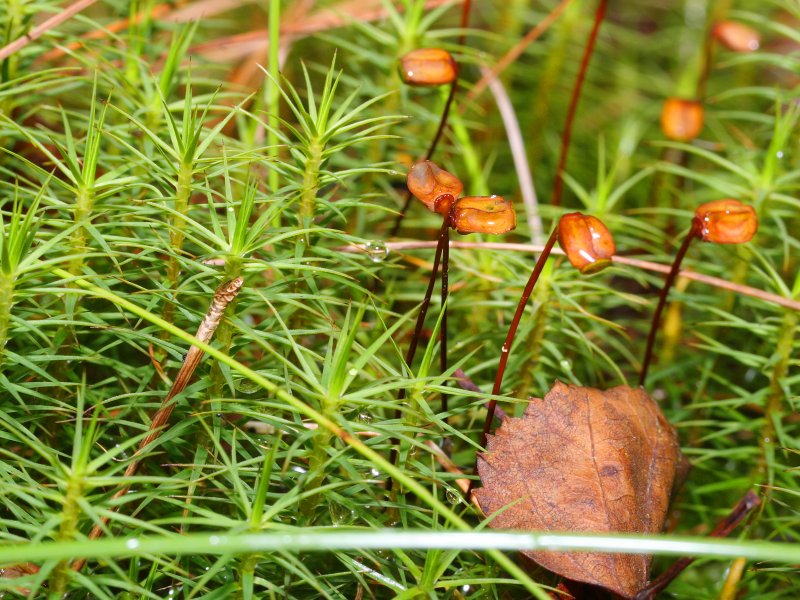
Common Haircap Moss
Polytrichum commune
Kristian Peters -- Fabelfroh 14:35, 21 October 2007 (UTC), CC BY-SA 3.0, via Wikimedia Commons


How they differ
Common Haircap has stems most commonly 5 to 10 cm long, while Bristly Haircap grows to approximately 4 cm or less in height. Common Haircap typically grows in bogs, wet heathland and along forest streams, while Bristly Haircap favors open, exposed and relatively dry habitats. Common Haircap has shiny, golden-yellow leaf sheaths and lamellae five to nine cells high, while Bristly Haircap has hairy, whitish-brown calyptrae and lamellae five to seven cells high that appear one cell wide in cross-section.
| Common Haircap Moss | Bristly Haircap Moss | |
|---|---|---|
| Stem appearance | Common Haircap has stems that are usually unbranched, although they occasionally fork, and grow in loose or dense tufts. | Bristly Haircap has tall, wiry, unbranched, dark-red stems and forms loose tufts. |
| Leaf arrangement | Common Haircap has leaves that are densely or relatively widely spaced along the stems. | Bristly Haircap has shorter leaves clustered near the tips of red stems, producing tapered shoots. |
| Dry leaf behaviour | Common Haircap leaves curl and twist around the stem when conditions become too dry. | Bristly Haircap leaves generally stand erect, with slightly inward-curved blades when dry, and spread outward when moist. |
| Habitat | Common Haircap typically grows in bogs, wet heathland and along forest streams, in regions with high humidity and rainfall. | Bristly Haircap occurs in acidic environments with low nutrient availability, including shallow soil over rock outcrops, exposed sandy soils, gravel-covered ground and disturbed sites. |
| Reproduction | Common Haircap has separate male and female plants, and raindrops transfer sperm from male splash-cups to female plants containing eggs. | Bristly Haircap is dioicous, with male and female reproductive structures on separate plants, and disperses sperm through a splash-cup mechanism involving raindrops. |
Written from the checked facts listed further down. Statements that the sources did not support were removed.
Side by side
| Common Haircap Moss | Bristly Haircap Moss | |
|---|---|---|
| Scientific name | Polytrichum commune Hedw. | Polytrichum piliferum Hedw. |
| English name | Common Haircap Moss | Bristly Haircap Moss |
| Group | Mosses and liverworts | Mosses and liverworts |
| Class | Polytrichopsida | Polytrichopsida |
| Order | Polytrichales | Polytrichales |
| Family | Polytrichaceae Aloe-mosses | Polytrichaceae Aloe-mosses |
| Genus | Polytrichum Hair Moss | Polytrichum Hair Moss |
| Countries on record | 44 countries | 41 countries |
| GBIF occurrence records | 122,086 records | 67,468 records |
Rows where the two agree are shown in grey.
Where each is found
Both recorded in 38 countries
- Aland Islands
- Andorra
- Austria
- Belarus
- Belgium
- Canada
- Czechia
- Denmark
- Estonia
- Faroe Islands
- Finland
- France
- Germany
- Greenland
- Hungary
- Iceland
- Ireland
- Isle of Man
- Italy
- Latvia
- Lithuania
- Luxembourg
- Norway
- Poland
- Portugal
- Romania
- Russia
- Saint Pierre and Miquelon
- Slovakia
- Slovenia
- Spain
- Svalbard and Jan Mayen
- Sweden
- Switzerland
- The Netherlands
- Ukraine
- United Kingdom
- United States
Only Common Haircap Moss (6)
Only Bristly Haircap Moss (3)
From Catalogue of Life checklists and GBIF occurrence records. A country missing from a list means no record is held, which is not proof of absence.
Checked facts
| Common Haircap Moss | Bristly Haircap Moss | |
|---|---|---|
| Appearance |
|
|
| Size |
|
|
| Habitat |
|
|
| Behaviour |
|
|
| Reproduction |
|
|
| Lifespan | No checked fact yet |
|
| Distribution |
|
|
| Conservation | No checked fact yet |
|
| Other | No checked fact yet |
|
In brief
Bristly Haircap Moss
Bristly haircap moss (Polytrichum piliferum Hedw.) is a perennial, evergreen moss in the family Polytrichaceae, order Polytrichales and class Polytrichopsida. It grows in open, exposed, relatively dry habitats, including shallow soil over rocks, sandy banks, gravel-covered ground and disturbed areas. Full profile
Compare something else
Page built on 24 November 2026 from the data on the two species pages, where every source is listed.
Cite this page
ScientificNames.org. (2026). Common Haircap Moss vs Bristly Haircap Moss. Retrieved November 24, 2026, from https://scientificnames.org/compare/common-haircap-moss-vs-bristly-haircap-moss
“Common Haircap Moss vs Bristly Haircap Moss.” ScientificNames.org, 2026, scientificnames.org/compare/common-haircap-moss-vs-bristly-haircap-moss. Accessed 24 Nov. 2026.
ScientificNames.org. “Common Haircap Moss vs Bristly Haircap Moss.” Accessed November 24, 2026. https://scientificnames.org/compare/common-haircap-moss-vs-bristly-haircap-moss.
@misc{scientificnames_common_haircap_moss_vs_bristly_haircap_moss,
  author = {{ScientificNames.org}},
  title = {Common Haircap Moss vs Bristly Haircap Moss},
  year = {2026},
  url = {https://scientificnames.org/compare/common-haircap-moss-vs-bristly-haircap-moss},
  note = {Accessed 2026-11-24}
}