Comparison
Common Haircap Moss vs Juniper Haircap
Common Haircap Moss (Polytrichum commune) and Juniper Haircap (Polytrichum juniperinum) both belong to the genus Polytrichum (hair moss) and part ways below it. Both are recorded in 43 countries.
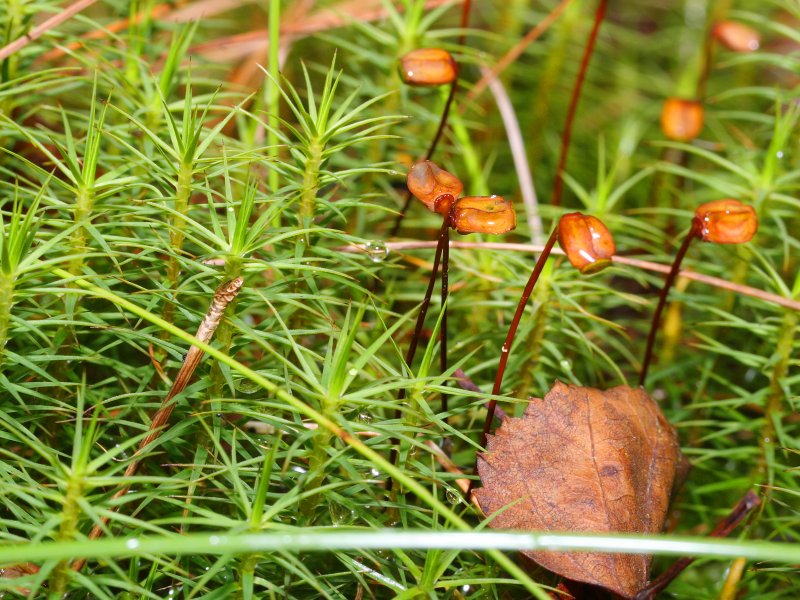
Common Haircap Moss
Polytrichum commune
Kristian Peters -- Fabelfroh 14:35, 21 October 2007 (UTC), CC BY-SA 3.0, via Wikimedia Commons


How they differ
Common Haircap (Polytrichum commune) has dark green stems that become brownish with age and typically grows in loose or dense tufts, while juniper polytrichum moss (Polytrichum juniperinum) has reddish stems, grey-green leaves with red-brown tips, and generally forms thin, interwoven mats. Common Haircap (Polytrichum commune) has parallel photosynthetic ridges with five to nine cells in height, while juniper polytrichum moss (Polytrichum juniperinum) has a capsule mouth surrounded by 64 short, blunt teeth. Common Haircap (Polytrichum commune) typically grows in bogs, wet heathland and along forest streams, while juniper polytrichum moss (Polytrichum juniperinum) most commonly grows in dry, acidic, exposed habitats.
| Common Haircap Moss | Juniper Haircap | |
|---|---|---|
| Growth form | Common Haircap (Polytrichum commune) grows in loose or dense tufts that can form extensive colonies. | Juniper polytrichum moss (Polytrichum juniperinum) generally forms thin, interwoven mats and often grows in loose clumps. |
| Leaves | Common Haircap (Polytrichum commune) has leaf sheaths that are typically shiny and golden yellow, with margins bearing teeth composed of single cells. | Juniper polytrichum moss (Polytrichum juniperinum) has lance-shaped leaves with distinctive red-brown tips that spread upright when dry and more widely when moist. |
| Capsule | Common Haircap (Polytrichum commune) has a brown to dark reddish brown, slightly rectangular to cubic capsule with four prominent wings. | Juniper polytrichum moss (Polytrichum juniperinum) has a capsule with 64 short, blunt teeth surrounding its mouth. |
| Distribution | Common Haircap (Polytrichum commune) occurs across temperate and boreal latitudes of the Northern Hemisphere, Mexico, several Pacific Islands including New Zealand, and Australia. | Juniper polytrichum moss (Polytrichum juniperinum) occurs on every continent, including Antarctica. |
| Habitat | Common Haircap (Polytrichum commune) typically grows in bogs, wet heathland and along forest streams. | Juniper polytrichum moss (Polytrichum juniperinum) most commonly grows in dry, acidic, exposed habitats and dry open woods. |
| Reproduction | Common Haircap (Polytrichum commune) has separate male and female plants, and raindrops transfer sperm from male splash-cups to female plants containing eggs. | Juniper polytrichum moss (Polytrichum juniperinum) has separate male and female gametophytes, and fertilization requires water for sperm to swim to the egg through the archegonium. |
| Size | Common Haircap (Polytrichum commune) stems most commonly measure 5 to 10 cm in length and can range from 2 to 70 cm. | Juniper polytrichum moss (Polytrichum juniperinum) can grow up to 4 inches tall. |
Written from the checked facts listed further down. Statements that the sources did not support were removed.
Side by side
| Common Haircap Moss | Juniper Haircap | |
|---|---|---|
| Scientific name | Polytrichum commune Hedw. | Polytrichum juniperinum Hedw. |
| English name | Common Haircap Moss | Juniper Haircap |
| Group | Mosses and liverworts | Mosses and liverworts |
| Class | Polytrichopsida | Polytrichopsida |
| Order | Polytrichales | Polytrichales |
| Family | Polytrichaceae Aloe-mosses | Polytrichaceae Aloe-mosses |
| Genus | Polytrichum Hair Moss | Polytrichum Hair Moss |
| Countries on record | 44 countries | 66 countries |
| GBIF occurrence records | 122,086 records | 109,541 records |
Rows where the two agree are shown in grey.
Where each is found
Both recorded in 43 countries
- Aland Islands
- Andorra
- Australia
- Austria
- Belarus
- Belgium
- Brazil
- Canada
- Czechia
- Denmark
- Estonia
- Faroe Islands
- Finland
- France
- Germany
- Greenland
- Hungary
- Iceland
- Ireland
- Isle of Man
- Italy
- Japan
- Latvia
- Lithuania
- Luxembourg
- Mexico
- New Zealand
- Norway
- Poland
- Portugal
- Romania
- Russia
- Saint Pierre and Miquelon
- Slovakia
- Slovenia
- Spain
- Svalbard and Jan Mayen
- Sweden
- Switzerland
- The Netherlands
- Ukraine
- United Kingdom
- United States
Only Common Haircap Moss (1)
Only Juniper Haircap (23)
- Antarctica
- Bolivia
- Bosnia and Herzegovina
- Bulgaria
- Colombia
- Costa Rica
- Croatia
- Cuba
- Dominica
- Dominican Republic
- Ecuador
- El Salvador
- Greece
- Guatemala
- Haiti
- Honduras
- Jamaica
- Montenegro
- New Caledonia
- Nicaragua
- Panama
- Papua New Guinea
- Peru
From Catalogue of Life checklists and GBIF occurrence records. A country missing from a list means no record is held, which is not proof of absence.
Checked facts
| Common Haircap Moss | Juniper Haircap | |
|---|---|---|
| Appearance |
|
|
| Size |
|
|
| Habitat |
|
|
| Behaviour |
| No checked fact yet |
| Reproduction |
|
|
| Distribution |
|
|
| Similar species | No checked fact yet |
|
| Other | No checked fact yet |
|
In brief
Juniper Haircap
Polytrichum juniperinum occurs on every continent, including Antarctica, and most commonly grows in dry, acidic, exposed habitats. It has reddish stems and grey-green leaves with distinctive red-brown tips. Full profile
Compare something else
Page built on 24 November 2026 from the data on the two species pages, where every source is listed.
Cite this page
ScientificNames.org. (2026). Common Haircap Moss vs Juniper Haircap. Retrieved November 24, 2026, from https://scientificnames.org/compare/common-haircap-moss-vs-juniper-haircap
“Common Haircap Moss vs Juniper Haircap.” ScientificNames.org, 2026, scientificnames.org/compare/common-haircap-moss-vs-juniper-haircap. Accessed 24 Nov. 2026.
ScientificNames.org. “Common Haircap Moss vs Juniper Haircap.” Accessed November 24, 2026. https://scientificnames.org/compare/common-haircap-moss-vs-juniper-haircap.
@misc{scientificnames_common_haircap_moss_vs_juniper_haircap,
  author = {{ScientificNames.org}},
  title = {Common Haircap Moss vs Juniper Haircap},
  year = {2026},
  url = {https://scientificnames.org/compare/common-haircap-moss-vs-juniper-haircap},
  note = {Accessed 2026-11-24}
}