Comparison
Common Krait vs Indian Cobra
Common Krait (Bungarus caeruleus) and Indian Cobra (Naja naja) both belong to the family Elapidae (cobras) and part ways below it. Both are recorded in 7 countries.


How they differ
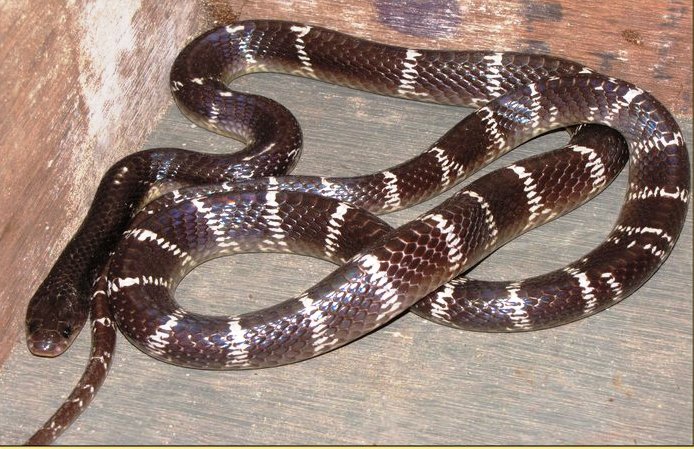
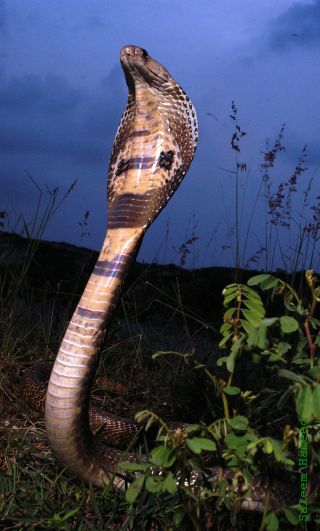
The common krait has a black or bluish-black body with narrow white crossbands, whereas the Indian cobra has a relatively large hood that expands when threatened. The common krait has relatively small eyes with rounded pupils, whereas the Indian cobra has medium-sized eyes with round pupils. The common krait is nocturnal and generally avoids confrontation, whereas the Indian cobra bites its prey quickly and waits for its venom to paralyse or kill it. The common krait feeds primarily on other snakes, whereas the Indian cobra feeds on rodents, plovers, grebes, lizards, and frogs.
| Common Krait | Indian Cobra | |
|---|---|---|
| Appearance | The common krait generally has a black or bluish-black body with narrow white crossbands and highly polished scales arranged in 15–17 rows. | The Indian cobra is a moderately sized, heavy-bodied snake with a relatively large hood and smooth, strongly oblique dorsal scales. |
| Head and eyes | The common krait has a flat head and relatively small eyes with rounded pupils. | The Indian cobra has an elliptical, depressed head, a short and rounded snout, and medium-sized eyes with round pupils. |
| Behaviour | The common krait is nocturnal, remains inactive during daylight hours, and rarely bites unless provoked. | The Indian cobra expands its hood when threatened and bites its prey quickly before waiting for its venom to paralyse or kill it. |
| Diet | The common krait feeds primarily on other snakes, including venomous kraits and vipers, and also consumes small rodents, lizards, birds and frogs. | The Indian cobra feeds on rodents, plovers, grebes, lizards, and frogs. |
| Distribution | The common krait occurs in India, Pakistan, Bangladesh, Sri Lanka and Nepal, with a reported western extent including Afghanistan and potentially parts of Iran. | The Indian cobra's documented distribution includes India, Pakistan, Sri Lanka, Bangladesh, and southern Nepal. |
| Habitat | The common krait inhabits scrub jungles, grasslands, agricultural fields, semi-desert environments and rocky terrain, and is particularly associated with habitats near streams, canals and ponds. | The Indian cobra inhabits dense and open forests, plains, agricultural lands, rocky terrain, and wetlands, and is frequently found near water. |
| Shelter | The common krait takes refuge in termite mounds, rat burrows and locations beneath debris. | The Indian cobra's preferred hiding places include embankment holes, tree hollows, termite mounds, rock piles, and small mammal dens. |
| Human-modified environments | The common krait occurs in suburban gardens, plantations and cultivated lands, and may enter houses during the monsoon season in search of shelter or prey. | The Indian cobra occurs in populated villages and city outskirts and sometimes enters buildings while searching for rodents. |
Written from the checked facts listed further down. Statements that the sources did not support were removed.
Side by side
| Common Krait | Indian Cobra | |
|---|---|---|
| Scientific name | Bungarus caeruleus (Schneider, 1801) | Naja naja (Linnaeus, 1758) |
| English name | Common Krait | Indian Cobra |
| Group | Reptiles | Reptiles |
| Class | Reptilia Reptile | Reptilia Reptile |
| Order | Squamata Snakes | Squamata Snakes |
| Family | Elapidae Cobras | Elapidae Cobras |
| Genus | Bungarus Deathpickers | Naja Cobras |
| Named in | 1801 | 1758 |
| Red List category | Least Concern | Least Concern |
| Environment | Not recorded | terrestrial |
| Countries on record | 8 countries | 15 countries |
| GBIF occurrence records | 1,003 records | 2,471 records |
Rows where the two agree are shown in grey.
Where each is found
Both recorded in 7 countries
Only Common Krait (1)
Only Indian Cobra (8)
From Catalogue of Life checklists and GBIF occurrence records. A country missing from a list means no record is held, which is not proof of absence.
Checked facts
| Common Krait | Indian Cobra | |
|---|---|---|
| Appearance |
|
|
| Size |
| No checked fact yet |
| Habitat |
|
|
| Diet |
|
|
| Behaviour |
|
|
| Reproduction |
|
|
| Distribution |
|
|
| Conservation |
|
|
| Uses | No checked fact yet |
|
| Similar species | No checked fact yet |
|
| Other |
|
|
In brief
Common Krait
The Common Krait (Bungarus caeruleus) is a highly venomous snake in the family Elapidae, order Squamata and class Reptilia. It occurs in India, Pakistan, Bangladesh, Sri Lanka and Nepal, with a reported western extent including Afghanistan and potentially parts of Iran. It is predominantly nocturnal and feeds primarily on other snakes, including venomous kraits and vipers. Full profile
Indian Cobra
The Indian Cobra (Naja naja) is a reptile in the family Elapidae, order Squamata, and genus Naja. It is native to the Indian subcontinent, with a documented distribution in India, Pakistan, Sri Lanka, Bangladesh, and southern Nepal. It is a moderately sized, heavy-bodied snake with a relatively large hood that expands when threatened. Full profile
Compare something else
Page built on 24 November 2026 from the data on the two species pages, where every source is listed.
Cite this page
ScientificNames.org. (2026). Common Krait vs Indian Cobra. Retrieved November 24, 2026, from https://scientificnames.org/compare/common-krait-vs-indian-cobra
“Common Krait vs Indian Cobra.” ScientificNames.org, 2026, scientificnames.org/compare/common-krait-vs-indian-cobra. Accessed 24 Nov. 2026.
ScientificNames.org. “Common Krait vs Indian Cobra.” Accessed November 24, 2026. https://scientificnames.org/compare/common-krait-vs-indian-cobra.
@misc{scientificnames_common_krait_vs_indian_cobra,
  author = {{ScientificNames.org}},
  title = {Common Krait vs Indian Cobra},
  year = {2026},
  url = {https://scientificnames.org/compare/common-krait-vs-indian-cobra},
  note = {Accessed 2026-11-24}
}