Comparison

Basilisk Rattlesnake vs Mojave Rattlesnake

Basilisk Rattlesnake (Crotalus basiliscus) and Mojave Rattlesnake (Crotalus scutulatus) both belong to the genus Crotalus (rattlesnakes) and part ways below it. Both are recorded in 1 country.

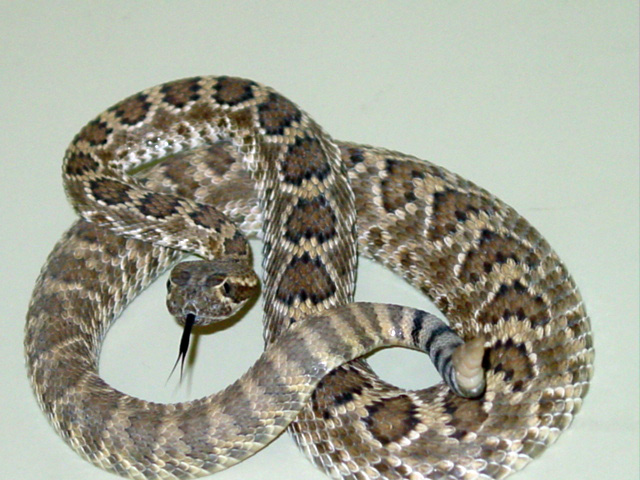
Basilisk Rattlesnake

Basilisk Rattlesnake

Crotalus basiliscus

snakecollector, CC BY 2.0, via Wikimedia Commons

Mojave Rattlesnake

Mojave Rattlesnake

Crotalus scutulatus

Lvthn13 at English Wikipedia (Original text: Self-Created), Public domain, via Wikimedia Commons

Side by side

Basilisk RattlesnakeMojave Rattlesnake
Scientific nameCrotalus basiliscus (Cope, 1864)Crotalus scutulatus (Kennicott, 1861)
English nameBasilisk RattlesnakeMojave Rattlesnake
GroupReptilesReptiles
ClassReptilia ReptileReptilia Reptile
OrderSquamata SnakesSquamata Snakes
FamilyViperidae ViperViperidae Viper
GenusCrotalus RattlesnakesCrotalus Rattlesnakes
Named in18641861
Red List categoryLeast ConcernLeast Concern
Countries on record1 country2 countries
GBIF occurrence records1,269 records10,048 records

Rows where the two agree are shown in grey.

Where each is found

Both recorded in 1 country

Only Mojave Rattlesnake (1)

From Catalogue of Life checklists and GBIF occurrence records. A country missing from a list means no record is held, which is not proof of absence.

Checked facts

Basilisk RattlesnakeMojave Rattlesnake
Appearance
  • The species has a moderately stout body with a rather rectangular cross section. English Wikipedia
  • Its dorsal scales have 25–29 strongly keeled rows at midbody. English Wikipedia
  • Its ventral scales number between 174 and 206. English Wikipedia
  • Its subcaudal scales number between 18 and 36. English Wikipedia
  • Its ground color is brown or grayish, with 26–41 dark diamond-shaped blotches edged in lighter color. English Wikipedia
  • Its head is uniformly grayish-brown apart from lighter labial scales and a dark postorbital bar. English Wikipedia
  • Its crown and neck lack distinct patterns. English Wikipedia
  • Its tail may be gray with darker bands or nearly uniform in color without distinct markings. English Wikipedia
  • Its belly is white or cream-colored. English Wikipedia
  • Young individuals are mostly red, while adults eventually develop an olive-green coloration. English Wikipedia
  • It is the only rattlesnake within its range with diamond-shaped dorsal markings. English Wikipedia
  • The species exhibits dorsal coloration ranging from green and brown to gray and yellowish shades. English Wikipedia
  • Its back has large, diamond-shaped blotches resembling those of the western diamond-backed rattlesnake. English Wikipedia
  • Its dorsal diamond markings lack the abundant dark speckling characteristic of the western diamond-backed rattlesnake. English Wikipedia
  • Its crown scales are relatively large and extend behind the supraocular scales in a fan-shaped arrangement. English Wikipedia
Size
Habitat
  • Its primary habitat is tropical thorn forest, with some occurrence in tropical deciduous forest. English Wikipedia
  • The species primarily inhabits broad desert valleys and lower mountain slopes. English Wikipedia
  • It commonly occurs in sparsely vegetated areas containing creosote, sage, mesquite, cacti, and Joshua trees. English Wikipedia
  • In some locations, the species also inhabits juniper woodland and grassland. English Wikipedia
  • It generally favors relatively flat, open, dry habitats over densely vegetated or extremely rocky areas. English Wikipedia
  • Its habitats extend from near sea level to approximately 2,500 m elevation. English Wikipedia
Diet
  • Examination of seven specimens revealed mammal hair in their stomachs, probably originating from rodents. English Wikipedia
Behaviour
  • In lowland areas, the species is primarily active during the rainy summer months. English Wikipedia
  • Most observed specimens are found crossing roads at night. English Wikipedia
  • Some individuals have been observed basking early in the morning. English Wikipedia
  • The species has been reported to become tame quickly in captivity. English Wikipedia
  • The species is primarily active between April and September. English Wikipedia
  • It hunts by ambushing its prey. English Wikipedia
  • The species is shy and cryptic and generally avoids confrontations with larger animals, including humans. English Wikipedia
  • It can strike and bite vigorously when disturbed, particularly when surprised or unable to escape into nearby vegetation or a burrow. English Wikipedia
  • The species is preyed upon by coyotes, bobcats, and raptors. English Wikipedia
ReproductionNo checked fact yet
  • Courtship begins in late summer or autumn, pauses during winter, and resumes in spring. English Wikipedia
  • Females give birth to live young between July and September. English Wikipedia
  • A litter contains between two and 17 young, averaging approximately eight. English Wikipedia
Distribution
  • The species occurs in the southwestern United States, including California, Arizona, western Texas, Nevada, Utah, and New Mexico. English Wikipedia
  • In Mexico, the species occurs in Sonora, Chihuahua, and southward across the Mexican Plateau into the states of Mexico, Puebla, and Veracruz. English Wikipedia
  • The species is found in the deserts of the southwestern United States and deep into mainland Mexico. English Wikipedia
Conservation
Similar species
  • Crotalus basiliscus sometimes occurs in the same areas as Crotalus molossus, and the two species appear to hybridize freely. English Wikipedia
  • Identifying hybrid specimens of Crotalus basiliscus and Crotalus molossus is problematic despite the ease of distinguishing the two species. English Wikipedia
No checked fact yet
OtherNo checked fact yet

In brief

Basilisk Rattlesnake

The Basilisk Rattlesnake is a venomous pit viper in the family Viperidae. It is endemic to western Mexico, with a recorded range extending from southern Sonora to Michoacán, mostly along the coastal plain. It is the only rattlesnake within its range with diamond-shaped dorsal markings. Full profile

Mojave Rattlesnake

Crotalus scutulatus occurs in the deserts of the southwestern United States and deep into mainland Mexico. Full profile

Compare something else

Page built on 28 November 2026 from the data on the two species pages, where every source is listed.

Cite this page

ScientificNames.org. (2026). Basilisk Rattlesnake vs Mojave Rattlesnake. Retrieved November 28, 2026, from https://scientificnames.org/compare/basilisk-rattlesnake-vs-mojave-rattlesnake