Species · Reptiles
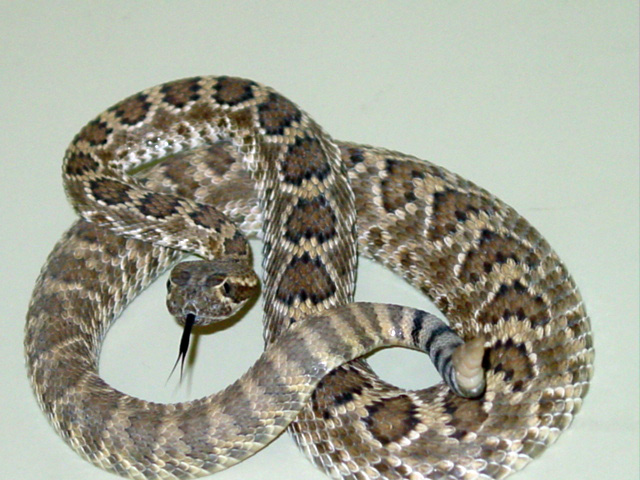
Basilisk Rattlesnake Crotalus basiliscus
The scientific name of the Basilisk Rattlesnake is Crotalus basiliscus. It is a species of reptile in the family Viperidae (viper), order Squamata. The name dates from 1864.

Overview
Crotalus basiliscus, known as the Mexican west coast rattlesnake, Mexican green rattler, and also by other names, is a species of pit viper in the family Viperidae. The species is endemic to western Mexico. Like all other pit vipers, it is venomous. The specific name, basiliscus, is derived from the Greek word for king, βασιλισκος (basiliskos), and alludes to this snake's large size and potent venom.
Classification of the Basilisk Rattlesnake
| Kingdom | Animalia |
|---|---|
| Phylum | Chordata |
| Subphylum | Vertebrata |
| Infraphylum | Gnathostomata |
| Parvphylum | Osteichthyes |
| Megaclass | Tetrapoda |
| Class | Reptilia (Reptile) |
| Order | Squamata (Snakes) |
| Suborder | Serpentes (Snakes) |
| Infraorder | Alethinophidia |
| Family | Viperidae (Viper) |
| Subfamily | Crotalinae |
| Genus | Crotalus (Rattlesnakes) |
| Species | Crotalus basiliscus (Cope, 1864) |
Where the Basilisk Rattlesnake is found
Checklists and occurrence records place Crotalus basiliscus in 1 country across North America. GBIF holds 1,269 georeferenced records of it.
Countries
Regions and cities with the most records
- Sinaloa, Mexico 301
- Jalisco, Mexico 234
- Colima, Mexico 115
- Nayarit, Mexico 90
- Sonora, Mexico 82
- Colima, Mexico 71
- Ciudad de Villa de Álvarez, Mexico 70
- Mazatlán, Mexico 45
- Chihuahua, Mexico 38
- Michoacán, Mexico 30
- Zapopan, Mexico 30
- Guadalajara, Mexico 24
- Hacienda Santa Fe, Mexico 14
- Tecomán, Mexico 13
- Tlaquepaque, Mexico 13
- Culiacán, Mexico 12
- Tepic, Mexico 12
- Oaxaca, Mexico 11
- Puerto Vallarta, Mexico 9
- Tonalá, Mexico 8
- Autlán de Navarro, Mexico 7
- Apatzingán, Mexico 6
- Manzanillo, Mexico 5
- Tepatitlán de Morelos, Mexico 5
- Durango, Mexico 4
- San Luis Potosí, Mexico 4
- Ciudad Nezahualcoyotl, Mexico 3
- Guamúchil, Mexico 3
- Oaxaca, Mexico 3
- Santa Cruz Xoxocotlán, Mexico 3
- Uruapan, Mexico 3
- Zacatecas, Mexico 3
- Aguascalientes, Mexico
Range as the checklists state it
Mexico (Sinaloa, Nayarit, Jalisco, Colima, Michoacan, Sonora, Zacatecas, Aguascalientes, Chihuahua)
A number beside a place is its count of GBIF occurrence records. A place without a number comes from a checklist alone. Records show where a species has been observed or collected, which can include escapes and vagrants.
Common names
English
- Basilisk Rattlesnake
- Mexican West-Coast Rattlesnake
- Mexican West Coast Rattlesnake
Names in 10 other languages
- Chinese
- 西海岸響尾蛇
- Czech
- chřestýš mexický
- Danish
- Vestmexicansk Klapperslange
- German
- Basilisken-Klapperschlange
- Hungarian
- sárkány csörgőkígyó
- Italian
- Crotalo basilisco, Serpente a sonagli basilisco
- Portuguese
- Cascavel-basilisco
- Russian
- Гремучник-василиск, Чудовищный гремучник
- Spanish
- Cascabel del Pacífico, Saye, Víbora-cascabel de Saye
- sei
- sayahuqui
Synonyms
2 other scientific names have been used for this species and are now treated as synonyms of Crotalus basiliscus.
- Caudisona basilisca Cope, 1864
- Crotalus basiliscus basiliscus Gloyd, 1948
Related species
-
 Timber RattlesnakeCrotalus horridus
-
 Western Diamondback RattlesnakeCrotalus atrox
-
 SidewinderCrotalus cerastes
-
 Mojave RattlesnakeCrotalus scutulatus
-
 Hopi RattlesnakeCrotalus viridis
-
 Western RattlesnakeCrotalus oreganus
-
 Tiger RattlesnakeCrotalus tigris
-
 Black-tailed RattlesnakeCrotalus molossus
Compare
Questions and answers
What is the scientific name of the Basilisk Rattlesnake?
The scientific name of the Basilisk Rattlesnake is Crotalus basiliscus. Written with its author, the full name is Crotalus basiliscus (Cope, 1864).
Which family does the Basilisk Rattlesnake belong to?
Crotalus basiliscus belongs to the family Viperidae, in the order Squamata and the class Reptilia.
Where is the Basilisk Rattlesnake found?
Checklists and occurrence records place Crotalus basiliscus in 1 country: Mexico.
What is the conservation status of the Basilisk Rattlesnake?
The IUCN Red List category recorded for Crotalus basiliscus is Least Concern (LC).
What other names does the Basilisk Rattlesnake have?
Crotalus basiliscus is also known in English as Mexican West-Coast Rattlesnake and Mexican West Coast Rattlesnake.
Sources
Data
- Catalogue of Life, 2026-10-16 XR cc by
- Global Biodiversity Information Facility CC BY 4.0
- Wikidata CC0
- English Wikipedia CC BY-SA 4.0
- GeoNames CC BY 4.0
- Wikimedia Commons per image; credit shown with each image
- Within the Catalogue of Life, this name comes from The Reptile Database cc by
References
- Cope, E. D. (1864). Contributions to the herpetology of tropical America. Proc. Acad. Nat. Sci. Philadelphia 16: 166-181.
- Cope, E. D. (1885). Twelfth contribution to the herpetology of tropical America. Proc. Amer. Philos. Soc. 22: 167-194 [1884].
- Cope, E. D. (1900). The crocodilians, lizards and snakes of North America. Ann. Rep. U.S. Natl. Mus. 1898: 153-1270.
- Marcy, D. (1945). Birth of a Brood of Crotalus basiliscus. Copeia 1945 (3): 169-170.
- Schmidt, Karl P.;Shannon, Frederick A. (1947). Notes on amphibians and reptiles of Michoacan, Mexico. Zoological Series of Field Museum of Natural History 31 (9): 63-85.
- Gloyd, Howard K. (1948). Description of a neglected subspecies of rattlesnake from Mexico. Natural History Miscellanea (17): 1-4.
- Smith, Hobart M. & Taylor, Edward H. (1950). Type localities of Mexican reptiles and amphibians. Univ. Kansas Sci. Bull. 33 (8): 313-380.
- Klauber, Laurence M. (1952). Taxonomic studies on rattlesnakes of Mainland Mexico. Bulletins of the Zoological Society of San Diego (26): 1-143.
- Zweifel, Richard G. (1959). Additions to the herpetofauna of Nayarit, Mexico. American Museum Novitates (1953): 1-13.
- Fugler, Charles M.;Dixon, James R. (1961). Notes on the herpetofauna of the El Dorado Area of Sinaloa, Mexico. Publications of the Museum, Michigan State University, Biological Series 2 (1): 1-24.
- Hardy, L.M., & McDiarmid, R.W. (1969). The amphibians and reptiles of Sinaloa, Mexico. Univ. Kansas Publ. Mus. Nat. Hist. 18 (3): 39-252.
- McCranie J R. (1981). Crotalus basiliscus (Cope). Mexican west coast rattlesnake. Catalogue of American Amphibians and Reptiles ( 283: 1-2.
- Webb, R. G. (1984). Herpetogeography in the Mazatlán-Durango Region of the Sierra Madre Occidental, Mexico. Vetrebrate Ecology and Systematics - A Ribute to Henry S. Fitch; Museum of Natural History, University of Kansas, Lawrence, Pp. 217-241.
- Campbell, J. A., & Lamar, W. W. (1989). The Venomous Reptiles of Latin America. Comstock Publishing/Cornell University Press, Ithaca.
- García, A., & Ceballos, G. (1994). GUIA DE CAMPO DE LOS REPTILES Y ANFIBIOS DE LA COSTA DE JALISCO, MEXICO. Fundacion Ecologica de Cuixmala, a.c. Instituto de Biologia, Unam.
- McDiarmid, R.W.; Campbell, J.A. & Touré,T.A. (1999). Snake species of the world. Vol. 1. [type catalogue]. Herpetologists’ League, 511 Pp.
- Palacio-Baena, J. A., Eliana María Muñoz Escobar, Sandra Milena Gallo Delgado, & Mauricio Rivera Correa. (2006). ANFIBIOS Y REPTILES DEL VALLE DE ABURRÁ. Editorial Zuluaga, 92 Pp.
- Goldberg, Stephen R. and Charles R. Bursey. (2006). Crotalus basiliscus Endoparasites. Herpetological Review 37 (1): 94.
- Santos-Barrera, Georgina; Jesus Pacheco, Fernando Mendoza-Quijano, Federico Bolaños,Gerardo Cháves , Gretchen C. Daily, Paul R. Ehrlich & Gerardo Ceballos. (2008). Diversity, natural history and conservation of amphibians and reptiles from the San Vito Region, southwestern Costa Rica. Rev. Biol. Trop. 56 (2): 755-778.
- Meik, & Jesse M and André Pires-daSilva. (2009). Evolutionary morphology of the rattlesnake style. BMC Evolutionary Biology 2009, 9:35.
- Hoser, R. (2009). A reclassification of the rattlesnakes; species formerly exclusively referred to the genera Crotalus and Sistrurus. Australasian J. Herpetol. 3: 1-21 (Dubious Journal).
- Wüster, W., & Bérnils, R. S. (2011). On the generic classification of the rattlesnakes, with special reference to the Neotropical Crotalus durissus complex (Squamata: Viperidae). Zoologia 28 (4): 417–419.
- Cobarrubias, E. F., & Daniel Cruz-Sáenz, a. D. L. (2012). Notes on the Herpetofauna of Western Mexico 6: Amphibians and Reptiles of Hostotipaquillo, Jalisco, Mexico. Bull. Chicago Herp. Soc. 47 (2):21-26.
- Enderson, Erik F.; Thomas R. Van Devender, Robert L. Bezy. (2014). Amphibians and reptiles of Yécora, Sonora and the Madrean Tropical Zone of the Sierra Madre Occidental in northwestern Mexico. Check List 10 (4): 913-926.
- Wallach, Van; Kenneth L. Williams, Jeff Boundy. (2014). Snakes of the World: A Catalogue of Living and Extinct Species. [type catalogue]. Taylor and Francis, CRC Press, 1237 Pp.
This species in other databases
Page built on 25 November 2026. See how the catalog is made and all sources and licences.
Cite this page
ScientificNames.org. (2026). Crotalus basiliscus (Basilisk Rattlesnake). Retrieved November 25, 2026, from https://scientificnames.org/species/crotalus-basiliscus
“Crotalus basiliscus (Basilisk Rattlesnake).” ScientificNames.org, 2026, scientificnames.org/species/crotalus-basiliscus. Accessed 25 Nov. 2026.
ScientificNames.org. “Crotalus basiliscus (Basilisk Rattlesnake).” Accessed November 25, 2026. https://scientificnames.org/species/crotalus-basiliscus.
@misc{scientificnames_crotalus_basiliscus_basilisk_rattlesnake,
  author = {{ScientificNames.org}},
  title = {Crotalus basiliscus (Basilisk Rattlesnake)},
  year = {2026},
  url = {https://scientificnames.org/species/crotalus-basiliscus},
  note = {Accessed 2026-11-25}
}