Comparison

Southern Pacific Rattlesnake vs Mojave Rattlesnake

Southern Pacific Rattlesnake (Crotalus helleri) and Mojave Rattlesnake (Crotalus scutulatus) both belong to the genus Crotalus (rattlesnakes) and part ways below it. Both are recorded in 2 countries.

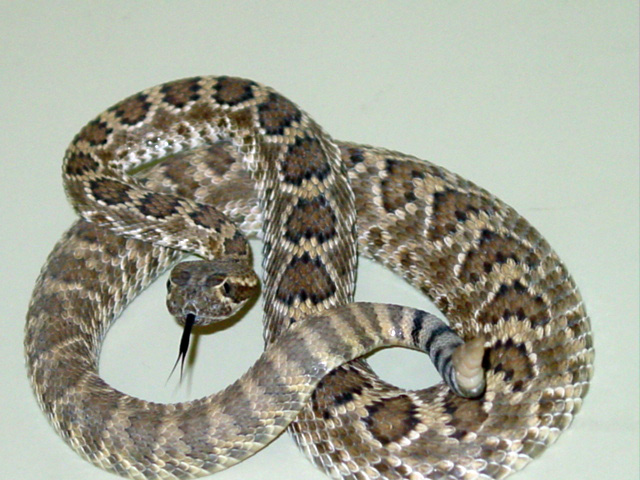
Southern Pacific Rattlesnake

Southern Pacific Rattlesnake

Crotalus helleri

Laura Camp from San Juan Capistrano, CA, CC BY-SA 2.0, via Wikimedia Commons

Mojave Rattlesnake

Mojave Rattlesnake

Crotalus scutulatus

Lvthn13 at English Wikipedia (Original text: Self-Created), Public domain, via Wikimedia Commons

Side by side

Southern Pacific RattlesnakeMojave Rattlesnake
Scientific nameCrotalus helleri Meek, 1905Crotalus scutulatus (Kennicott, 1861)
English nameSouthern Pacific RattlesnakeMojave Rattlesnake
GroupReptilesReptiles
ClassReptilia ReptileReptilia Reptile
OrderSquamata SnakesSquamata Snakes
FamilyViperidae ViperViperidae Viper
GenusCrotalus RattlesnakesCrotalus Rattlesnakes
Named in19051861
Red List categoryNot recordedLeast Concern
Countries on record2 countries2 countries
GBIF occurrence records11,399 records10,048 records

Rows where the two agree are shown in grey.

Where each is found

Both recorded in 2 countries

From Catalogue of Life checklists and GBIF occurrence records. A country missing from a list means no record is held, which is not proof of absence.

Checked facts

Southern Pacific RattlesnakeMojave Rattlesnake
Appearance
  • The species has a pale brown, gray-brown, or yellowish-brown ground color with large dark brown dorsal blotches. English Wikipedia
  • Its dorsal blotches are generally diamond-shaped and bordered by light-colored scales. English Wikipedia
  • Its tail rings are not clearly defined. English Wikipedia
  • Juveniles have a bright orange tail tip that becomes brown as they mature. English Wikipedia
  • Adult individuals have a brown tail base and a brown first rattle segment. English Wikipedia
  • The species has a moderately to very clearly defined postocular stripe. English Wikipedia
  • Juveniles have a pale stripe above the postocular stripe, which becomes drab yellow or brown with maturity. English Wikipedia
  • Some individuals have a conspicuous pale crossbar across the supraoculars followed by a uniformly dark-colored head. English Wikipedia
  • Some older individuals have mostly dark heads with little or no visible supraorbital crossbar. English Wikipedia
  • The species exhibits dorsal coloration ranging from green and brown to gray and yellowish shades. English Wikipedia
  • Its back has large, diamond-shaped blotches resembling those of the western diamond-backed rattlesnake. English Wikipedia
  • Its dorsal diamond markings lack the abundant dark speckling characteristic of the western diamond-backed rattlesnake. English Wikipedia
  • Its crown scales are relatively large and extend behind the supraocular scales in a fan-shaped arrangement. English Wikipedia
Size
HabitatNo checked fact yet
  • The species primarily inhabits broad desert valleys and lower mountain slopes. English Wikipedia
  • It commonly occurs in sparsely vegetated areas containing creosote, sage, mesquite, cacti, and Joshua trees. English Wikipedia
  • In some locations, the species also inhabits juniper woodland and grassland. English Wikipedia
  • It generally favors relatively flat, open, dry habitats over densely vegetated or extremely rocky areas. English Wikipedia
  • Its habitats extend from near sea level to approximately 2,500 m elevation. English Wikipedia
DietNo checked fact yet
Behaviour
  • Santa Catalina Island individuals attempted to bite 4.7 times as often as mainland individuals in a reported study. English Wikipedia
  • Santa Catalina Island individuals delivered 2.1 times as much venom when biting as mainland individuals. English Wikipedia
  • Individuals showed significantly reduced heart rates under acute stress when accompanied by another individual of the same species. English Wikipedia
  • A 2023 study reported evidence of social buffering in this species. English Wikipedia
  • The species is primarily active between April and September. English Wikipedia
  • It hunts by ambushing its prey. English Wikipedia
  • The species is shy and cryptic and generally avoids confrontations with larger animals, including humans. English Wikipedia
  • It can strike and bite vigorously when disturbed, particularly when surprised or unable to escape into nearby vegetation or a burrow. English Wikipedia
  • The species is preyed upon by coyotes, bobcats, and raptors. English Wikipedia
ReproductionNo checked fact yet
  • Courtship begins in late summer or autumn, pauses during winter, and resumes in spring. English Wikipedia
  • Females give birth to live young between July and September. English Wikipedia
  • A litter contains between two and 17 young, averaging approximately eight. English Wikipedia
Distribution
  • The species occurs in southern California in the United States and northern Baja California in Mexico, west of the desert. English Wikipedia
  • Its northern distribution extends from San Luis Obispo and Kern counties southward through several southern California counties. English Wikipedia
  • Its recorded range includes Santa Catalina Island and the foothills of Los Angeles County. English Wikipedia
  • Its distribution extends through Baja California south to approximately 28°30′ north latitude. English Wikipedia
  • The type locality is recorded as San Jose, Lower California, corresponding to San José in Baja California at approximately 31° north latitude. English Wikipedia
  • The species occurs in the southwestern United States, including California, Arizona, western Texas, Nevada, Utah, and New Mexico. English Wikipedia
  • In Mexico, the species occurs in Sonora, Chihuahua, and southward across the Mexican Plateau into the states of Mexico, Puebla, and Veracruz. English Wikipedia
  • The species is found in the deserts of the southwestern United States and deep into mainland Mexico. English Wikipedia
ConservationNo checked fact yet
Similar species
  • The dorsal blotches of this species are more diamond-shaped than the more hexagonal blotches of Crotalus oreganus oreganus. English Wikipedia
No checked fact yet
Other
  • Some populations possess neurotoxic venom that attacks the nervous system in a manner similar to Mojave rattlesnake venom. English Wikipedia
  • Other populations possess hemotoxic and myotoxic venom. English Wikipedia
  • The venom variation within the species has been described by scientists as medically significant. English Wikipedia
No checked fact yet

In brief

Southern Pacific Rattlesnake

Crotalus helleri occurs in southern California in the United States and northern Baja California in Mexico, west of the desert. It has diamond-shaped dark dorsal blotches bordered by light-colored scales and tail rings that are not clearly defined. Full profile

Mojave Rattlesnake

Crotalus scutulatus occurs in the deserts of the southwestern United States and deep into mainland Mexico. Full profile

Compare something else

Page built on 29 November 2026 from the data on the two species pages, where every source is listed.

Cite this page

ScientificNames.org. (2026). Southern Pacific Rattlesnake vs Mojave Rattlesnake. Retrieved November 29, 2026, from https://scientificnames.org/compare/southern-pacific-rattlesnake-vs-mojave-rattlesnake