Species · Reptiles
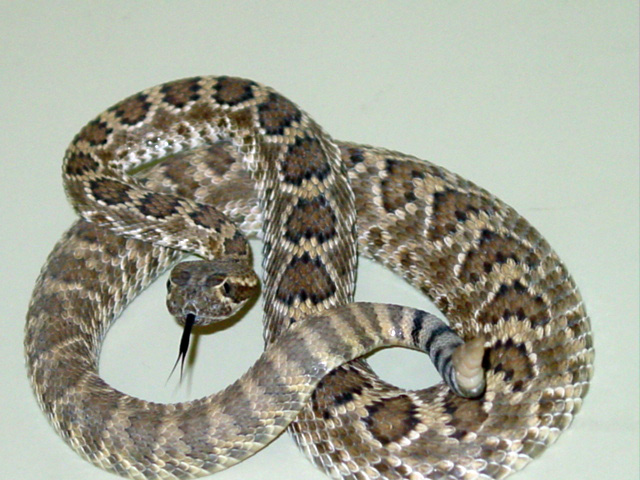
Southern Pacific Rattlesnake Crotalus helleri
The scientific name of the Southern Pacific Rattlesnake is Crotalus helleri. It is a species of reptile in the family Viperidae (viper), order Squamata. The name dates from 1905.
- Scientific name
- Crotalus helleri Meek, 1905
- Common name
- Southern Pacific Rattlesnake
- Genus
- Crotalus
- Family
- Viperidae (Viper)
- Order
- Squamata
- Class
- Reptilia
- Recorded in
- 2 countries
- Name status
- accepted in the Catalogue of Life
Overview
Crotalus helleri or Crotalus oreganus helleri, also known commonly as the Southern Pacific rattlesnake, the black diamond rattlesnake, and by several other common names, is a pit viper species or subspecies found in southwestern California and south into Baja California, Mexico, that is known for its regional variety of dangerous venom types. It is sometimes considered a subspecies of Crotalus oreganus.
Classification of the Southern Pacific Rattlesnake
| Kingdom | Animalia |
|---|---|
| Phylum | Chordata |
| Subphylum | Vertebrata |
| Infraphylum | Gnathostomata |
| Parvphylum | Osteichthyes |
| Megaclass | Tetrapoda |
| Class | Reptilia (Reptile) |
| Order | Squamata (Snakes) |
| Suborder | Serpentes (Snakes) |
| Infraorder | Alethinophidia |
| Family | Viperidae (Viper) |
| Subfamily | Crotalinae |
| Genus | Crotalus (Rattlesnakes) |
| Species | Crotalus helleri Meek, 1905 |
Where the Southern Pacific Rattlesnake is found
Checklists and occurrence records place Crotalus helleri in 2 countries across North America. GBIF holds 11,399 georeferenced records of it.
Countries
Regions and cities with the most records
- California, United States 10,377
- Poway, United States 1,153
- La Mesa, United States 1,144
- El Cajon, United States 1,074
- Santee, United States 1,067
- National City, United States 1,033
- Pasadena, United States 1,011
- Burbank, United States 1,004
- Glendale, United States 985
- San Diego, United States 968
- Encinitas, United States 923
- Alhambra, United States 919
- Thousand Oaks, United States 873
- Arcadia, United States 837
- Monterey Park, United States 818
- Lake Forest, United States 738
- San Marcos, United States 737
- Mission Viejo, United States 700
- Azusa, United States 692
- Los Angeles, United States 687
- Aliso Viejo, United States 682
- Escondido, United States 677
- Chula Vista, United States 675
- Laguna Niguel, United States 664
- Irvine, United States 649
- Simi Valley, United States 642
- Covina, United States 607
- Rosemead, United States 603
- Baldwin Park, United States 598
- Glendora, United States 598
- Rancho Santa Margarita, United States 582
- West Covina, United States 573
- Diamond Bar, United States 569
- Tustin, United States 559
- Pomona, United States 548
- Vista, United States 544
Range as the checklists state it
SW USA (California), Mexico (Baja California)
Middle America
North America
Global
A number beside a place is its count of GBIF occurrence records. A place without a number comes from a checklist alone. Records show where a species has been observed or collected, which can include escapes and vagrants.
Common names
English
- Southern Pacific Rattlesnake
- Coronado Island Rattlesnake
Names in 2 other languages
- Portuguese
- Cascavel-do-Pacífico-Sul
- Spanish
- Cascabel de la isla Coronado, Cascabel del Pacifico Sur, Cascabel del Pacífico
Synonyms
5 other scientific names have been used for this species and are now treated as synonyms of Crotalus helleri.
- Crotalus caliginis Klauber, 1949
- Crotalus oreganus caliginis Klauber, 1949
- Crotalus oreganus helleri Meek, 1905
- Crotalus viridis caliginis Klauber, 1949
- Crotalus viridis helleri Meek, 1905
Related species
-
 Timber RattlesnakeCrotalus horridus
-
 Western Diamondback RattlesnakeCrotalus atrox
-
 SidewinderCrotalus cerastes
-
 Mojave RattlesnakeCrotalus scutulatus
-
 Hopi RattlesnakeCrotalus viridis
-
 Western RattlesnakeCrotalus oreganus
-
 Tiger RattlesnakeCrotalus tigris
-
 Black-tailed RattlesnakeCrotalus molossus
Compare
Questions and answers
What is the scientific name of the Southern Pacific Rattlesnake?
The scientific name of the Southern Pacific Rattlesnake is Crotalus helleri. Written with its author, the full name is Crotalus helleri Meek, 1905.
Which family does the Southern Pacific Rattlesnake belong to?
Crotalus helleri belongs to the family Viperidae, in the order Squamata and the class Reptilia.
Where is the Southern Pacific Rattlesnake found?
Checklists and occurrence records place Crotalus helleri in 2 countries: United States and Mexico.
What other names does the Southern Pacific Rattlesnake have?
Crotalus helleri is also known in English as Coronado Island Rattlesnake.
Sources
Data
- Catalogue of Life, 2026-10-16 XR cc by
- Global Biodiversity Information Facility CC BY 4.0
- Wikidata CC0
- English Wikipedia CC BY-SA 4.0
- GeoNames CC BY 4.0
- Within the Catalogue of Life, this name comes from The Reptile Database cc by
References
- Rafinesque, C. S. (1818). Further accounts of discoveries in natural history in the western states. American Month. Mag. Crit. Rev. 4 (1): 41.
- Holbrook, John E. (1840). North American Herpetology, Vol. 4 (1st ed.). J. Dobson, Philadelphia, 126 Pp.
- Baird, S.F. and Girard,C. (1852). Descriptions of new species of reptiles, collected by the U.S. exploring expedition under the command of Capt. Charles Wilkes, U.S.N. First part. - Including the species from the Western coast of America. Proc. Acad. Nat. Sci. Philadelphia 6: 174-177.
- Meek, S. E. (1905). An annotated list of a collection of reptiles from southern California and northern lower California. Field Columbian Mus. Publ. Zool. 7 (1): 1-19.
- Woodbury, Angus M. (1929). A new rattlesnake from Utah. Bulletin of the University of Utah 20 (6): 2-4.
- Klauber, L. M. (1930). New and renamed subspecies of Crotalus confluentus Say, with remarks on related species. Trans. San Diego Soc. Nat. Hist. 6 (3): 95-144. Link
- Tanner, Vasco M. (1930). The amphibians and reptiles of Bryce Canyon National Park, Utah. Copeia 1930 (2): 41-43.
- Tanner, Vasco M.;Hayward, C. Lynn. (1934). A biological study of the La Sal Mountains, Utah report No. 1 (Ecology). Proceedings of the Utah Academy of Sciences, Arts, and Letters 11: 209-235.
- Eaton, Theodore H., Jr. (1935). Report on amphibians and reptiles of the Navajo country. Bulletin 3. Rainbow Bridge-Monument Valley Expedition : 1-20.
- Fitch, H. S. (1936). Amphibians and reptiles of the Rouge River Basin, Oregon. American Midland Naturalist 17: 634-652.
- Klauber, Laurence M. (1938). Notes from a herpetological diary, I. Copeia 1938 (4): 191-197.
- Klauber, Lawrence M. (1943). The correlation of variability within and between rattlesnake populations. Copeia 1943 (2): 115-118.
- Klauber, Laurence M. (1949). Some new and revived subspecies of rattlesnakes. Transactions of the San Diego Society of Natural History 11 (6): 61-116. Link
- Woodbury, Angus M.;Hansen, Richard M. (1950). A snake den in Tintic Mountains, Utah. Herpetologica 6: 66-70.
- Woodbury, Angus M. & Smith, H.M. (1951). On the correct trivial name of the yellow rattlesnake of the Colorado River Basin: Supplementary Note. Bull. Zool. Nomenclature 6 (4): 101-102.
- Woodbury, Angus M. (1951). On the correct name for the yellow rattle-snake from the Colorado River Basin. Bull. Zool. Nomenclature 6 (4): 99-100.
- Klauber, Laurence M. (1951). On the question of the correct trivial name for the yellow or Midget rattlesnake of the Colorado River Basin. Bull. Zol. Nomenclature 6 (4): 101.
- Zweifel, R. G. (1952). Notes on the lizardsof the Coronados Islands, Baja California, Mexico. Herpetologica 8: 9-11.
- Cliff, Frank S. (1954). Snakes of the islands in the Gulf of California, Mexico. Transactions of the San Diego Society of Natural History 12 (5): 67-98. Link
- Woodbury, A. M. (1958). The Name Crotalus viridis concolor Woodbury. Copeia 1958 (2): 151.
- Hirth, Harold F. (1966). The Ability of Two Species of Snakes to Return to a Hibernaculum after Displacement. Southwestern Naturalist 11 (1): 49-53.
- Loomis, Richard B.;Stephens, Robert C. (1967). Additional notes on snakes taken in or near Joshua Tree National Monument, California. Bulletin of the Southern California Academy of Sciences 66 (1): 1-22.
- Franz, & Richard. (1971). Notes on the distribution and ecology of the herpetofauna of northern Montana. Bull. Maryland Herp. Soc. 7 (1): 1-10.
- Klauber, Laurence M. (1972). Rattlesnakes: Their Habits, Life Histories, and Influence on Mankind. University of California Press, Berkeley, CA, Vol. 1: Xxx + 740; Vol. 2: Xvii + 795 Pp. [First Published 1956].
- Parker, William S.;Brown, William S. (1974). Mortality and weight changes of Great Basin rattlesnakes (Crotalus viridis) at a hibernaculum in northern Utah. Herpetologica 30 (3): 234-239.
This species in other databases
Page built on 25 November 2026. See how the catalog is made and all sources and licences.
Cite this page
ScientificNames.org. (2026). Crotalus helleri (Southern Pacific Rattlesnake). Retrieved November 25, 2026, from https://scientificnames.org/species/crotalus-helleri
“Crotalus helleri (Southern Pacific Rattlesnake).” ScientificNames.org, 2026, scientificnames.org/species/crotalus-helleri. Accessed 25 Nov. 2026.
ScientificNames.org. “Crotalus helleri (Southern Pacific Rattlesnake).” Accessed November 25, 2026. https://scientificnames.org/species/crotalus-helleri.
@misc{scientificnames_crotalus_helleri_southern_pacific_rattlesnake,
  author = {{ScientificNames.org}},
  title = {Crotalus helleri (Southern Pacific Rattlesnake)},
  year = {2026},
  url = {https://scientificnames.org/species/crotalus-helleri},
  note = {Accessed 2026-11-25}
}