| Appearance | - The species exhibits sexual dimorphism, with males tending to have larger heads than females. nationalzoo.si.edu
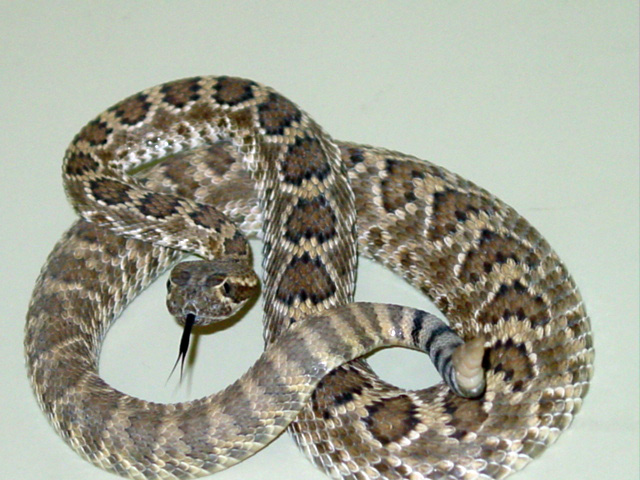
| - The species exhibits dorsal coloration ranging from green and brown to gray and yellowish shades. English Wikipedia
- Its back has large, diamond-shaped blotches resembling those of the western diamond-backed rattlesnake. English Wikipedia
- Its dorsal diamond markings lack the abundant dark speckling characteristic of the western diamond-backed rattlesnake. English Wikipedia
- Its crown scales are relatively large and extend behind the supraocular scales in a fan-shaped arrangement. English Wikipedia
|
|---|
| Size | - Adults usually measure 60–70 cm in total length, although exceptionally large individuals can reach 100 cm. English Wikipedia
- Most individuals grow to approximately 70–80 cm in length. nationalzoo.si.edu
| |
|---|
| Habitat | - The species is terrestrial and inhabits grasslands, scrublands, pine forests, and oak forests. nationalzoo.si.edu
- Its habitat includes rocky outcrops and areas of old lava flows. nationalzoo.si.edu
- The species occupies native and modified grasslands in central Mexico. pmc.ncbi.nlm.nih.gov
| - The species primarily inhabits broad desert valleys and lower mountain slopes. English Wikipedia
- It commonly occurs in sparsely vegetated areas containing creosote, sage, mesquite, cacti, and Joshua trees. English Wikipedia
- In some locations, the species also inhabits juniper woodland and grassland. English Wikipedia
- It generally favors relatively flat, open, dry habitats over densely vegetated or extremely rocky areas. English Wikipedia
- Its habitats extend from near sea level to approximately 2,500 m elevation. English Wikipedia
|
|---|
| Diet | - The species primarily consumes amphibians and other reptiles, with occasional insects and mammals also included in its diet. nationalzoo.si.edu
- Individuals in the studied population consume almost exclusively mammals. pmc.ncbi.nlm.nih.gov
- All age classes in the studied population primarily feed on rodents. pmc.ncbi.nlm.nih.gov
- Neonates are restricted by their gape size to consuming smaller rodent species and individuals. pmc.ncbi.nlm.nih.gov
| |
|---|
| Behaviour | - The species vibrates its tail when alarmed to produce a rattling sound that may deter potential predators. nationalzoo.si.edu
- The species subdues prey through a rapid strike and injection of venom. nationalzoo.si.edu
| - The species is primarily active between April and September. English Wikipedia
- It hunts by ambushing its prey. English Wikipedia
- The species is shy and cryptic and generally avoids confrontations with larger animals, including humans. English Wikipedia
- It can strike and bite vigorously when disturbed, particularly when surprised or unable to escape into nearby vegetation or a burrow. English Wikipedia
- The species is preyed upon by coyotes, bobcats, and raptors. English Wikipedia
|
|---|
| Reproduction | | - Courtship begins in late summer or autumn, pauses during winter, and resumes in spring. English Wikipedia
- Females give birth to live young between July and September. English Wikipedia
- A litter contains between two and 17 young, averaging approximately eight. English Wikipedia
|
|---|
| Distribution | - The species occurs on the central Mexican plateau, extending from southern Zacatecas and northeastern Colima to east-central Veracruz. English Wikipedia
- The species occurs at elevations between 1,450 and 2,600 meters. English Wikipedia
- The species is native to Mexico and inhabits the central portion of the Mexican plateau. nationalzoo.si.edu
| - The species occurs in the southwestern United States, including California, Arizona, western Texas, Nevada, Utah, and New Mexico. English Wikipedia
- In Mexico, the species occurs in Sonora, Chihuahua, and southward across the Mexican Plateau into the states of Mexico, Puebla, and Veracruz. English Wikipedia
- The species is found in the deserts of the southwestern United States and deep into mainland Mexico. English Wikipedia
|
|---|
| Conservation | - The species is classified as Least Concern on the IUCN Red List. English Wikipedia
- The population trend was assessed as decreasing in 2007. English Wikipedia
- Habitat loss caused by conversion of natural habitat into agricultural land is considered the species' greatest threat. nationalzoo.si.edu
- Individuals are frequently killed by people who encounter them because they are considered dangerous. nationalzoo.si.edu
- The species occurs in the national park of Hidalgo. nationalzoo.si.edu
- The species is managed under a Species Survival Plan through the Association of Zoos and Aquariums. nationalzoo.si.edu
- Further research is considered necessary to understand the species and its ecological requirements. nationalzoo.si.edu
| |
|---|
| Other | - The species produces approximately 80–100 milligrams of venom per bite. nationalzoo.si.edu
- The species possesses long fangs. nationalzoo.si.edu
- Adult males and females have broadly similar venom electrophoretic profiles, with only minor differences associated with sex. pmc.ncbi.nlm.nih.gov
- Adult venom contains prominent snake venom metalloproteinases and disintegrins that are absent or greatly reduced in neonate venom. pmc.ncbi.nlm.nih.gov
- Phospholipase A2 activity in neonate venom is approximately 2.5 times greater than in adult venom. pmc.ncbi.nlm.nih.gov
- Neonate venom had an LD50 of 4.5 μg/g in non-Swiss albino mice, compared with 5.5 μg/g for adult venom. pmc.ncbi.nlm.nih.gov
- Adult individuals possess Type I venom, characterized by high snake venom metalloproteinase activity and lower toxicity. pmc.ncbi.nlm.nih.gov
| No checked fact yet |
|---|