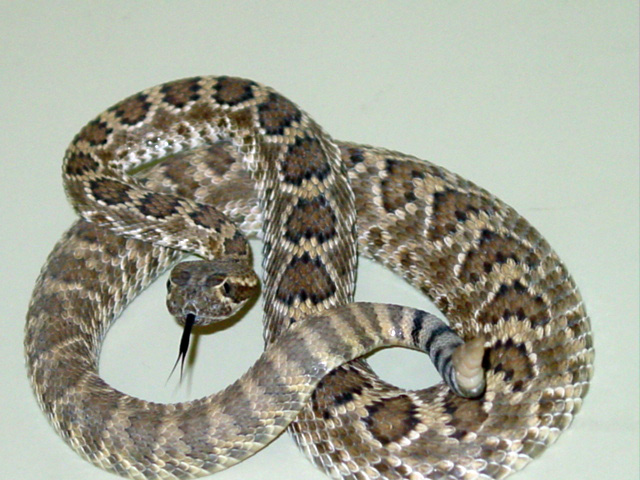
| Appearance | - The dorsal coloration ranges from brick-red, reddish-gray, pinkish-brown, or tan in northern populations to yellowish-brown or olive-brown in southern Baja California populations. animaldiversity.org
- The dorsal body pattern typically consists of 33 to 35 reddish-brown diamonds with light-colored borders. animaldiversity.org
- The head is triangular, reddish, and marked by a dark diagonal stripe running from the lower edge of the eye to the corner of the mouth. animaldiversity.org
- The underside is unmarked and ranges from white to cream in color. animaldiversity.org
- The tail has between two and seven black rings immediately before the rattle. animaldiversity.org
- The most proximal segment of the rattle is black. animaldiversity.org
- The dorsal scales are keeled and pitted, except for the first two lateral rows. animaldiversity.org
- The neck is very thin. animaldiversity.org
- The head possesses heat-sensing pits positioned between the nostrils and eyes on both sides. animaldiversity.org
| - The species exhibits dorsal coloration ranging from green and brown to gray and yellowish shades. English Wikipedia
- Its back has large, diamond-shaped blotches resembling those of the western diamond-backed rattlesnake. English Wikipedia
- Its dorsal diamond markings lack the abundant dark speckling characteristic of the western diamond-backed rattlesnake. English Wikipedia
- Its crown scales are relatively large and extend behind the supraocular scales in a fan-shaped arrangement. English Wikipedia
|
|---|
| Size | No checked fact yet | |
|---|
| Habitat | - The species inhabits desert scrublands, coastal scrublands, chaparral, pine-oak woods, and tropical deciduous forests. animaldiversity.org
- The species occasionally occurs in grasslands and cultivated areas. animaldiversity.org
- Chaparral and sage scrub at low elevations with high winter precipitation are particularly common habitats. animaldiversity.org
- Rocky outcroppings and dense brush are preferred habitat features, particularly in the southern portion of the range. animaldiversity.org
- Rocky outcroppings and dense brush provide important hibernation sites. animaldiversity.org
- The species occurs from sea level to approximately 1,500 m elevation. English Wikipedia
| - The species primarily inhabits broad desert valleys and lower mountain slopes. English Wikipedia
- It commonly occurs in sparsely vegetated areas containing creosote, sage, mesquite, cacti, and Joshua trees. English Wikipedia
- In some locations, the species also inhabits juniper woodland and grassland. English Wikipedia
- It generally favors relatively flat, open, dry habitats over densely vegetated or extremely rocky areas. English Wikipedia
- Its habitats extend from near sea level to approximately 2,500 m elevation. English Wikipedia
|
|---|
| Diet | - Mammals constitute approximately 91.6% of the recorded diet, while lizards account for 7.5% and birds for 0.9%. experts.llu.edu
- Recorded prey includes rabbits, ground squirrels, birds, lizards, and other snakes. English Wikipedia
- Adults consume larger prey than juveniles. experts.llu.edu
- Coastal populations consume a higher proportion of rodents than desert populations. experts.llu.edu
- The species relies heavily on ambushing mammalian prey. experts.llu.edu
- The species may opportunistically scavenge food. experts.llu.edu
| |
|---|
| Behaviour | - The species is generally active at cooler temperatures and avoids severe heat. animaldiversity.org
- Individuals are usually nocturnal from late spring through summer and diurnal during cooler seasons. animaldiversity.org
- Most above-ground activity occurs between April and June. animaldiversity.org
- Coastal populations tend to be more diurnal than desert populations. animaldiversity.org
- The species typically hibernates from October or November until February or March. animaldiversity.org
- Individuals can climb low bushes, cacti, and trees while pursuing arboreal prey. animaldiversity.org
- The species can swim in freshwater lakes, reservoirs, and the Pacific Ocean. animaldiversity.org
- Male individuals engage in ritualized combat displays that can last longer than 15 minutes. animaldiversity.org
- Male combat displays establish dominance rather than facilitate courtship. animaldiversity.org
- The species generally has a peaceful disposition and rarely displays aggression. animaldiversity.org
- When provoked or cornered, individuals may coil, rattle, and strike defensively. animaldiversity.org
- The species tends to avoid developed areas and is reluctant to cross roads. animaldiversity.org
| - The species is primarily active between April and September. English Wikipedia
- It hunts by ambushing its prey. English Wikipedia
- The species is shy and cryptic and generally avoids confrontations with larger animals, including humans. English Wikipedia
- It can strike and bite vigorously when disturbed, particularly when surprised or unable to escape into nearby vegetation or a burrow. English Wikipedia
- The species is preyed upon by coyotes, bobcats, and raptors. English Wikipedia
|
|---|
| Reproduction | | - Courtship begins in late summer or autumn, pauses during winter, and resumes in spring. English Wikipedia
- Females give birth to live young between July and September. English Wikipedia
- A litter contains between two and 17 young, averaging approximately eight. English Wikipedia
|
|---|
| Distribution | - The species occurs in southwestern California in the United States and throughout the Baja California peninsula in Mexico. English Wikipedia
| - The species occurs in the southwestern United States, including California, Arizona, western Texas, Nevada, Utah, and New Mexico. English Wikipedia
- In Mexico, the species occurs in Sonora, Chihuahua, and southward across the Mexican Plateau into the states of Mexico, Puebla, and Veracruz. English Wikipedia
- The species is found in the deserts of the southwestern United States and deep into mainland Mexico. English Wikipedia
|
|---|
| Conservation | - The species is classified as Least Concern on the IUCN Red List. English Wikipedia
- The population trend was recorded as decreasing in the 2007 assessment. English Wikipedia
| |
|---|
| Similar species | - Crotalus ruber has a pattern similar to that of Crotalus atrox but is distinguished by its reddish coloration. English Wikipedia
| No checked fact yet |
|---|
| Other | - The venom of this species is described as among the least potent of rattlesnake venoms. English Wikipedia
- The species has a relatively large venom yield containing high levels of proteolytic enzymes, particularly in adults. English Wikipedia
- The venom contains at least three proteolytic hemorrhagins but no Mojave toxin in the specimens described by one cited study. English Wikipedia
- Three Mexican specimens examined in one study contained Mojave toxin and lacked hemorrhagic activity. English Wikipedia
| No checked fact yet |
|---|