Species · Reptiles
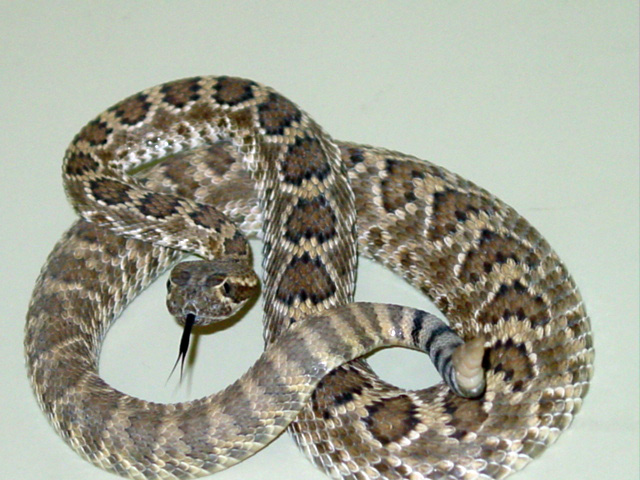
Red Diamond Rattlesnake Crotalus ruber
The scientific name of the Red Diamond Rattlesnake is Crotalus ruber. It is a species of reptile in the family Viperidae (viper), order Squamata. The name dates from 1892.
- Scientific name
- Crotalus ruber Cope, 1892
- Common name
- Red Diamond Rattlesnake
- Genus
- Crotalus
- Family
- Viperidae (Viper)
- Order
- Squamata
- Class
- Reptilia
- Red List category
- LC Least Concern
- Recorded in
- 2 countries
- Name status
- accepted in the Catalogue of Life

Overview
Common names: red diamond rattlesnake, red rattlesnake, red diamond snake, more
Classification of the Red Diamond Rattlesnake
| Kingdom | Animalia |
|---|---|
| Phylum | Chordata |
| Subphylum | Vertebrata |
| Infraphylum | Gnathostomata |
| Parvphylum | Osteichthyes |
| Megaclass | Tetrapoda |
| Class | Reptilia (Reptile) |
| Order | Squamata (Snakes) |
| Suborder | Serpentes (Snakes) |
| Infraorder | Alethinophidia |
| Family | Viperidae (Viper) |
| Subfamily | Crotalinae |
| Genus | Crotalus (Rattlesnakes) |
| Species | Crotalus ruber Cope, 1892 |
Where the Red Diamond Rattlesnake is found
Checklists and occurrence records place Crotalus ruber in 2 countries across North America. GBIF holds 7,756 georeferenced records of it.
Countries
Regions and cities with the most records
- California, United States 4,711
- Baja California Sur, Mexico 1,564
- Poway, United States 1,015
- El Cajon, United States 1,003
- Santee, United States 998
- La Mesa, United States 951
- Baja California, Mexico 794
- National City, United States 682
- Cabo San Lucas, Mexico 669
- Colonia del Sol, Mexico 669
- San Diego, United States 661
- Moreno Valley, United States 587
- Riverside, United States 545
- Escondido, United States 518
- Palm Springs, United States 492
- San Marcos, United States 469
- Colton, United States 413
- Redlands, United States 394
- Perris, United States 391
- Encinitas, United States 387
- Vista, United States 366
- San Bernardino, United States 358
- Rialto, United States 340
- Fontana, United States 315
- Chula Vista, United States 300
- Cathedral City, United States 245
- Carlsbad, United States 239
- Lake Forest, United States 239
- Corona, United States 233
- Rancho Santa Margarita, United States 230
- Palm Desert, United States 229
- Lake Elsinore, United States 226
- Menifee, United States 219
- Tustin, United States 216
- Irvine, United States 210
- Mission Viejo, United States 210
Range as the checklists state it
Mexico (Baja California),
A number beside a place is its count of GBIF occurrence records. A place without a number comes from a checklist alone. Records show where a species has been observed or collected, which can include escapes and vagrants.
Common names
English
- Red Diamond Rattlesnake
- Red Rattlesnake
Names in 15 other languages
- Bulgarian
- червена гърмяща змия
- Chinese
- 紅菱紋響尾蛇
- Czech
- chřestýš červený
- Dutch
- rode diamantratelslang
- French
- Crotale diamantin rouge
- German
- Rote Diamant-Klapperschlange
- Italian
- Crotalo adamantino rosso, Serpente a sonagli rosso
- Japanese
- アカダイヤガラガラヘビ
- Polish
- Grzechotnik kalifornijski
- Portuguese
- Cascavel-vermelha
- Russian
- Красный гремучник
- Spanish
- Cascabel Diamante Rojo, Cascabel de diamantes rojos, Víbora de cascabel de diamantes rojos, Víbora-cascabel colorada, víbora cascabel colorada
- Ukrainian
- Гримучник червоний
- chl
- mesaxa
- pnb
- کروٹالس ربر
Synonyms
6 other scientific names have been used for this species and are now treated as synonyms of Crotalus ruber.
- Crotalus adamanteus ruber Cope, 1892
- Crotalus atrox elegans Schmidt, 1922
- Crotalus exsul Garman, 1884
- Crotalus lucasensis Van Denburgh, 1920
- Crotalus ruber monserratensis Harris & Simmons, 1978
- Crotalus ruber ruber Klauber, 1949 ambiguous synonym
Subspecies and varieties
- Crotalus ruber exsul (Red Diamond Rattlesnake) subspecies
- Crotalus ruber lucasensis (San Lucan Rattlesnake) subspecies
- Crotalus ruber ruber (Red Diamond Rattlesnake) subspecies
Related species
-
 Timber RattlesnakeCrotalus horridus
-
 Western Diamondback RattlesnakeCrotalus atrox
-
 SidewinderCrotalus cerastes
-
 Mojave RattlesnakeCrotalus scutulatus
-
 Hopi RattlesnakeCrotalus viridis
-
 Western RattlesnakeCrotalus oreganus
-
 Tiger RattlesnakeCrotalus tigris
-
 Black-tailed RattlesnakeCrotalus molossus
Compare
Questions and answers
What is the scientific name of the Red Diamond Rattlesnake?
The scientific name of the Red Diamond Rattlesnake is Crotalus ruber. Written with its author, the full name is Crotalus ruber Cope, 1892.
Which family does the Red Diamond Rattlesnake belong to?
Crotalus ruber belongs to the family Viperidae, in the order Squamata and the class Reptilia.
Where is the Red Diamond Rattlesnake found?
Checklists and occurrence records place Crotalus ruber in 2 countries: United States and Mexico.
What is the conservation status of the Red Diamond Rattlesnake?
The IUCN Red List category recorded for Crotalus ruber is Least Concern (LC).
What other names does the Red Diamond Rattlesnake have?
Crotalus ruber is also known in English as Red Rattlesnake.
Sources
Data
- Catalogue of Life, 2026-10-16 XR cc by
- Global Biodiversity Information Facility CC BY 4.0
- Wikidata CC0
- English Wikipedia CC BY-SA 4.0
- GeoNames CC BY 4.0
- Wikimedia Commons per image; credit shown with each image
- Within the Catalogue of Life, this name comes from The Reptile Database cc by
References
- Garman, & Samuel. (1884). The reptiles and batrachians of North America. Mem. Mus. Comp. Zool, Cambridge (Massachusetts), 8 (3): Xxxiv + 185 Pp. [1883] [CNAH Reprint 10].
- Cope, E. D. (1892). A critical review of the characters and variations of the snakes of North America. Proc. US Natl. Mus. 14: 589-694.
- Van Denburgh, & John. (1896). Additional notes on the herpetology of Lower California. Proc. Cal. Acad. Sci. (2) 5: 1004-1008.
- Cope, E. D. (1900). The crocodilians, lizards and snakes of North America. Ann. Rep. U.S. Natl. Mus. 1898: 153-1270.
- Van Denburgh, J. (1920). Description of a new species of rattlesnake (Crotalus lucasensis) from Lower California. Proc. Cal. Acad. Sci. (4) 10: 29-30.
- Amaral, & do, A. (1929). Studies of nearctic ophidia IV. On Crotalus tortugensis VANDENBURGH AND SLEVIN, 1921, Crotalus atrox elegans SCHMIDT, 1922, and Crotalus atrox lucasensis (VANDEBURGH, 1920). Bull. Antivenin Inst. America 2 (4): 85-86.
- Tevis, lloyd, Jr. (1944). Herpetological notes from lower California. Copeia 1944 (1): 6-18.
- Smith, Hobart M. (1944). Additions to the list of Mexican amphibians and reptiles in the Carnegie Museum. Annals of the Carnegie Museum 30: 87-92.
- Klauber, Laurence M. (1949). The relationship of Crotalus ruber and Crotalus lucasensis. Transactions of the San Diego Society of Natural History 11 (5): 57-60.
- Cliff, Frank S. (1954). Snakes of the islands in the Gulf of California, Mexico. Transactions of the San Diego Society of Natural History 12 (5): 67-98. Link
- Loomis, Richard B.;Stephens, Robert C. (1967). Additional notes on snakes taken in or near Joshua Tree National Monument, California. Bulletin of the Southern California Academy of Sciences 66 (1): 1-22.
- Smith, H. M., & Holland, R. L. (1971). Noteworthy snakes and lizards from Baja California. Journal of Herpetology 5 (1-2): 56-59.
- Radcliffe, C. W.; Maslin, T. Paul. (1975). A new subspecies of the red rattlesnake, Crotalus ruber, from San Lorenzo Sur Island, Baja California Norte, Mexico. Copeia 1975 (3): 490-493.
- Harris, Herbert S. & Simmons, Robert S. (1978). A preliminary account of the rattlesnakes with the descriptions of four new subspecies. Bull. Maryland Herp. Soc. 14 (3): 105-211 [1977].
- McCranie, J. R., & Wilson, L. D. (1979). Commentary on taxonomic practice in regional herpetological publications: a review of the rattlesnakes with the description of four new subspecies [by HARRIS & SIMMONS 1978]. Herpetological Review 10 (1): 18-21.
- Patten, R.B. & B.H. Banta. (1980). A Rattlesnake, Crotalus ruber, feeds on a Road-Killed Animal. Journal of Herpetology 14 (1): 111-112.
- Hammerson, G. A. (1981). Opportunistic Scavenging by Crotalus ruber Not Field-Proven. Journal of Herpetology 15 (1): 125.
- Hartmann, P., Jr. & B. Steiner. (1984). Breeding results: Crotalus ruber x atrox. Litteratura Serpentium 4 (2): 81.
- Murphy, R. W., & Ottley, J. R. (1984). Distribution of amphibians and reptiles on islands in the Gulf of California. Annals of the Carnegie Museum 53 (8): 207-230.
- Stebbins, R. C. (1985). A Field Guide to Western Reptiles and Amphibians, 2nd ed. Houghton Mifflin, Boston.
- Campbell, J. A., & Lamar, W. W. (1989). The Venomous Reptiles of Latin America. Comstock Publishing/Cornell University Press, Ithaca.
- Shine, & Richard. (1994). Sexual size dimorphism in snakes revisited. Copeia 1994 (2): 326-346.
- Grismer, L. L., McGuire, J. A., & Hollingsworth, B. D. (1994). A report on the herpetofauna of the Vizcaino Peninsula, Baja California, Mexico, with a discussion of its biogeographic and taxonomic implications. Bull. Southern California Acad. Sci. 93 (2): 45-80.
- Murphy,R.W. et al. (1995). mtDNA gene sequence, allozyme, and morphological uniformity among red diamond rattlesnakes, Crotalus ruber and Crotalus exsul. Can. J. Zool. 73: 270-281.
- Hollingsworth, Bradford, Mellink, & Erik. (1996). Crotalus exsul lorenzoensis: Arboreal behavior. Herpetological Review 27 (3): 143-144.
This species in other databases
Page built on 25 November 2026. See how the catalog is made and all sources and licences.
Cite this page
ScientificNames.org. (2026). Crotalus ruber (Red Diamond Rattlesnake). Retrieved November 25, 2026, from https://scientificnames.org/species/crotalus-ruber
“Crotalus ruber (Red Diamond Rattlesnake).” ScientificNames.org, 2026, scientificnames.org/species/crotalus-ruber. Accessed 25 Nov. 2026.
ScientificNames.org. “Crotalus ruber (Red Diamond Rattlesnake).” Accessed November 25, 2026. https://scientificnames.org/species/crotalus-ruber.
@misc{scientificnames_crotalus_ruber_red_diamond_rattlesnake,
  author = {{ScientificNames.org}},
  title = {Crotalus ruber (Red Diamond Rattlesnake)},
  year = {2026},
  url = {https://scientificnames.org/species/crotalus-ruber},
  note = {Accessed 2026-11-25}
}