Comparison
Panamint Rattlesnake vs Mojave Rattlesnake
Panamint Rattlesnake (Crotalus stephensi) and Mojave Rattlesnake (Crotalus scutulatus) both belong to the genus Crotalus (rattlesnakes) and part ways below it. Both are recorded in 1 country.


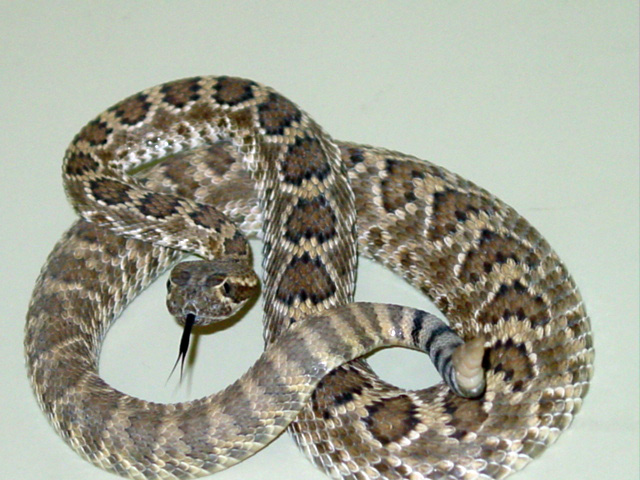
Mojave Rattlesnake
Crotalus scutulatus
Lvthn13 at English Wikipedia (Original text: Self-Created), Public domain, via Wikimedia Commons

Side by side
| Panamint Rattlesnake | Mojave Rattlesnake | |
|---|---|---|
| Scientific name | Crotalus stephensi Klauber, 1930 | Crotalus scutulatus (Kennicott, 1861) |
| English name | Panamint Rattlesnake | Mojave Rattlesnake |
| Group | Reptiles | Reptiles |
| Class | Reptilia Reptile | Reptilia Reptile |
| Order | Squamata Snakes | Squamata Snakes |
| Family | Viperidae Viper | Viperidae Viper |
| Genus | Crotalus Rattlesnakes | Crotalus Rattlesnakes |
| Named in | 1930 | 1861 |
| Red List category | Not recorded | Least Concern |
| Countries on record | 1 country | 2 countries |
| GBIF occurrence records | 935 records | 10,048 records |
Rows where the two agree are shown in grey.
Where each is found
Both recorded in 1 country
Only Mojave Rattlesnake (1)
From Catalogue of Life checklists and GBIF occurrence records. A country missing from a list means no record is held, which is not proof of absence.
Checked facts
| Panamint Rattlesnake | Mojave Rattlesnake | |
|---|---|---|
| Appearance |
|
|
| Size |
|
|
| Habitat |
|
|
| Diet |
|
|
| Behaviour |
|
|
| Reproduction |
|
|
| Distribution |
|
|
| Conservation | No checked fact yet |
|
| Other |
| No checked fact yet |
In brief
Panamint Rattlesnake
The Panamint Rattlesnake (Crotalus stephensi Klauber, 1930) is a venomous pitviper in the family Viperidae, order Squamata, and class Reptilia. It occurs in desert-mountain areas along the eastern slopes of the Sierra Nevada, from Mono County, California, to Nye County, Nevada, and south to Clark County, Nevada, and central San Bernardino County, California. It has a ground color ranging from straw to gray, with contrasting blotches and scattered black-tipped scales. Full profile
Mojave Rattlesnake
Crotalus scutulatus occurs in the deserts of the southwestern United States and deep into mainland Mexico. Full profile
Compare something else
Page built on 29 November 2026 from the data on the two species pages, where every source is listed.
Cite this page
ScientificNames.org. (2026). Panamint Rattlesnake vs Mojave Rattlesnake. Retrieved November 29, 2026, from https://scientificnames.org/compare/panamint-rattlesnake-vs-mojave-rattlesnake
“Panamint Rattlesnake vs Mojave Rattlesnake.” ScientificNames.org, 2026, scientificnames.org/compare/panamint-rattlesnake-vs-mojave-rattlesnake. Accessed 29 Nov. 2026.
ScientificNames.org. “Panamint Rattlesnake vs Mojave Rattlesnake.” Accessed November 29, 2026. https://scientificnames.org/compare/panamint-rattlesnake-vs-mojave-rattlesnake.
@misc{scientificnames_panamint_rattlesnake_vs_mojave_rattlesnake,
  author = {{ScientificNames.org}},
  title = {Panamint Rattlesnake vs Mojave Rattlesnake},
  year = {2026},
  url = {https://scientificnames.org/compare/panamint-rattlesnake-vs-mojave-rattlesnake},
  note = {Accessed 2026-11-29}
}