Species · Reptiles
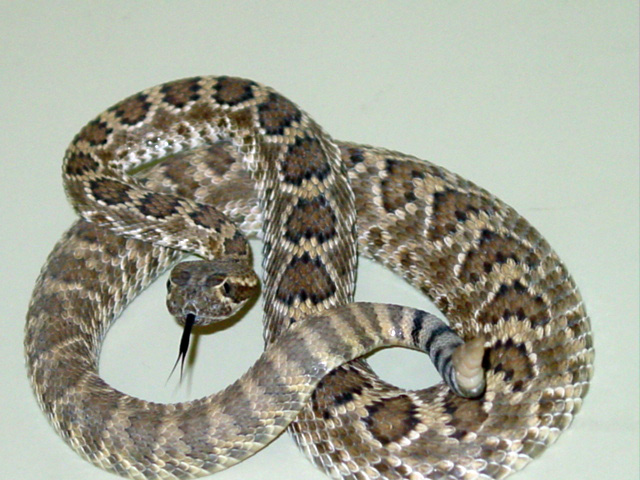
Panamint Rattlesnake Crotalus stephensi
The scientific name of the Panamint Rattlesnake is Crotalus stephensi. It is a species of reptile in the family Viperidae (viper), order Squamata. The name dates from 1930.

Overview
Crotalus stephensi, also known as the Panamint Rattlesnake, is a venomous pitviper species found in central and southern Nevada and adjacent California. Other common names include Owens Valley rattlesnake and tiger rattlesnake (not to be confused with C. tigris).
Classification of the Panamint Rattlesnake
| Kingdom | Animalia |
|---|---|
| Phylum | Chordata |
| Subphylum | Vertebrata |
| Infraphylum | Gnathostomata |
| Parvphylum | Osteichthyes |
| Megaclass | Tetrapoda |
| Class | Reptilia (Reptile) |
| Order | Squamata (Snakes) |
| Suborder | Serpentes (Snakes) |
| Infraorder | Alethinophidia |
| Family | Viperidae (Viper) |
| Subfamily | Crotalinae |
| Genus | Crotalus (Rattlesnakes) |
| Species | Crotalus stephensi Klauber, 1930 |
Where the Panamint Rattlesnake is found
Checklists and occurrence records place Crotalus stephensi in 1 country across North America. GBIF holds 935 georeferenced records of it.
Countries
Regions and cities with the most records
- California, United States 529
- Nevada, United States 353
- Spring Valley, United States 40
- Enterprise, United States 16
- Las Vegas, United States 8
- Henderson, United States 7
- Paradise, United States 7
- North Las Vegas, United States 6
- Sunrise Manor, United States 5
Range as the checklists state it
USA (SW Nevada, EC California), 1900 m elevation
A number beside a place is its count of GBIF occurrence records. A place without a number comes from a checklist alone. Records show where a species has been observed or collected, which can include escapes and vagrants.
Common names
English
- Panamint Rattlesnake
Names in 7 other languages
- Chinese
- 帕納明特響尾蛇
- Danish
- Panamint-klapperslange
- French
- Crotale de Stephen
- German
- Panamint-Klapperschlange
- Italian
- Crotalo di Stephen, Serpente a sonagli di Stephen
- Portuguese
- Cascavel-de-Panamint
- Spanish
- Cascabel tigre
Synonyms
2 other scientific names have been used for this species and are now treated as synonyms of Crotalus stephensi.
- Crotalus confluentus stephensi Klauber, 1930
- Crotalus mitchellii stephensi Klauber, 1930
Related species
-
 Timber RattlesnakeCrotalus horridus
-
 Western Diamondback RattlesnakeCrotalus atrox
-
 SidewinderCrotalus cerastes
-
 Mojave RattlesnakeCrotalus scutulatus
-
 Hopi RattlesnakeCrotalus viridis
-
 Western RattlesnakeCrotalus oreganus
-
 Tiger RattlesnakeCrotalus tigris
-
 Black-tailed RattlesnakeCrotalus molossus
Compare
Questions and answers
What is the scientific name of the Panamint Rattlesnake?
The scientific name of the Panamint Rattlesnake is Crotalus stephensi. Written with its author, the full name is Crotalus stephensi Klauber, 1930.
Which family does the Panamint Rattlesnake belong to?
Crotalus stephensi belongs to the family Viperidae, in the order Squamata and the class Reptilia.
Where is the Panamint Rattlesnake found?
Checklists and occurrence records place Crotalus stephensi in 1 country: United States.
Sources
Data
- Catalogue of Life, 2026-10-16 XR cc by
- Global Biodiversity Information Facility CC BY 4.0
- Wikidata CC0
- English Wikipedia CC BY-SA 4.0
- GeoNames CC BY 4.0
- Wikimedia Commons per image; credit shown with each image
- Within the Catalogue of Life, this name comes from The Reptile Database cc by
References
- Klauber, L. M. (1930). New and renamed subspecies of Crotalus confluentus Say, with remarks on related species. Trans. San Diego Soc. Nat. Hist. 6 (3): 95-144. Link
- Klauber, L. M. (1936). Crotalus mitchellii, the speckled rattlesnake. Transactions of the San Diego Society of Natural History 8 (19): 149-184.
- Bradley, W. Glen and James E. Deacon. (1966). Amphibian and Reptile Records for Southern Nevada. Southwestern Naturalist 11 (1): 132-134.
- Stebbins, R. C. (1985). A Field Guide to Western Reptiles and Amphibians, 2nd ed. Houghton Mifflin, Boston.
- Rodríguez-Robles, Javier A., Good, David A., Wake, David B. (2003). Brief History of Herpetology in the Museum of Vertebrate Zoology, University of California, Berkeley, with a List of Type Specimens of Recent Amphibians and Reptiles. UC Publications in Zoology, 119 Pp.
- Douglas, Michael E.; Marlis R. Douglas, Gordon W. Schuett, Louis W. Porras & Blake L. Thomason. (2007). GENEALOGICAL CONCORDANCE BETWEEN MITOCHONDRIAL AND NUCLEAR DNAS SUPPORTS SPECIES RECOGNITION OF THE PANAMINT RATTLESNAKE (CROTALUS MITCHELLII STEPHENSI). Copeia 2007 (4): 920–932.
- Hoser, R. (2009). A reclassification of the rattlesnakes; species formerly exclusively referred to the genera Crotalus and Sistrurus. Australasian J. Herpetol. 3: 1-21 (Dubious Journal).
- Wüster, W., & Bérnils, R. S. (2011). On the generic classification of the rattlesnakes, with special reference to the Neotropical Crotalus durissus complex (Squamata: Viperidae). Zoologia 28 (4): 417–419.
- Beolens, B., & Michael Watkins, a. M. G. (2011). The Eponym Dictionary of Reptiles. Johns Hopkins University Press, Baltimore, USA.
- Werning, & Heiko. (2012). Die Reptilien und Amphibien des Südwestens. Draco 13 (50): 18-60.
- Crother, B. I. (ed.). (2012). Standard Common and Current Scientific Names for North American Amphibians, Turtles, Reptiles, and Crocodilians, Seventh Edition. Herpetological Circular 39: 1-92.
- Wallach, Van; Kenneth L. Williams, Jeff Boundy. (2014). Snakes of the World: A Catalogue of Living and Extinct Species. [type catalogue]. Taylor and Francis, CRC Press, 1237 Pp.
- Meik JM, Streicher JW, Lawing AM, Flores-Villela O, & Fujita MK. (2015). Limitations of Climatic Data for Inferring Species Boundaries: Insights from Speckled Rattlesnakes. PLoS One 10 (6): E0131435; Doi:10.1371/Journal.Pone.0131435.
- Spinner, L. (2017). Die Klapperschlangen der USA in Natur und Terrarium. Reptilia (Münster) 22 (124): 18-33.
- Zimin, A., Zimin, S. V., Shine, R., Avila, L., Bauer, A., Böhm, M., Brown, R., Barki, G., de Oliveira Caetano, G. H., Castro Herrera, F., Chapple, D. G., Chirio, L., Colli, G. R., Doan, T. M., Glaw, F., Grismer, L. L., Itescu, Y., Kraus, F., LeBreton, M.; [...] Uetz, P.; Wagner, P.; Roll, U. & Meiri, S. (2022). A global analysis of viviparity in squamates highlights its prevalence in cold climates. Global Ecology and Biogeography, 00, 1–16.
- Pilliod, D., Jeffries, M., Arkle, R. and Olson, D. (2024). Climate Futures for Lizards and Snakes in Western North America May Result in New Species Management Issues. Ecol Evol, 14: E70379.
- Hansen, Robert and Jackson D. Shedd. (2025). California Amphibians and Reptiles. Princeton University Press, 528 Pp., ISBN9780691249087 (Ebook).
- Maag, Dylan W.; Ryan J. Hanscom, Craig G. Fischer, Vincent P. Marcantonio, Emma C. McAndrews, Kristin L. Kabat, Jessica L. Hill & Rulon W. Clark. (2025). Spatial Ecology of North American Pitvipers (Viperidae: Crotalinae): A Review and Meta-Analysis. Herpetological Monographs Mar 2025 Vol. 39, No. 1: 35-55.
- Farleigh, K.; D.K. Highland, M.G. Alderman, Y. Francioli, S.R. Hirst, E.M. Faber,B.W. Perry, M.L. Holding, G. Castañeda-Gaytán, M. Borja,H. Franz-Chávez, C.L. Parkinson, J.L. Strickland, M.J. Margres, S.P. Mackessy, J.M. Meik, T.A. Castoe & D.R. Schield. (2026). Evolution of genome-wide barriers to gene flow during complex speciation in rattlesnakes. Proc. Natl. Acad. Sci. U.S.A. 123 (21) E2609058123,.
This species in other databases
Page built on 25 November 2026. See how the catalog is made and all sources and licences.
Cite this page
ScientificNames.org. (2026). Crotalus stephensi (Panamint Rattlesnake). Retrieved November 25, 2026, from https://scientificnames.org/species/crotalus-stephensi
“Crotalus stephensi (Panamint Rattlesnake).” ScientificNames.org, 2026, scientificnames.org/species/crotalus-stephensi. Accessed 25 Nov. 2026.
ScientificNames.org. “Crotalus stephensi (Panamint Rattlesnake).” Accessed November 25, 2026. https://scientificnames.org/species/crotalus-stephensi.
@misc{scientificnames_crotalus_stephensi_panamint_rattlesnake,
  author = {{ScientificNames.org}},
  title = {Crotalus stephensi (Panamint Rattlesnake)},
  year = {2026},
  url = {https://scientificnames.org/species/crotalus-stephensi},
  note = {Accessed 2026-11-25}
}