Comparison
East Indian Leopard Gecko vs Leopard Gecko
East Indian Leopard Gecko (Eublepharis hardwickii) and Leopard Gecko (Eublepharis macularius) both belong to the genus Eublepharis (southwest asian leopard geckos) and part ways below it. Both are recorded in 1 country.
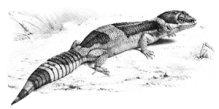
East Indian Leopard Gecko
Eublepharis hardwickii
Unknown author, Public domain, via Wikimedia Commons
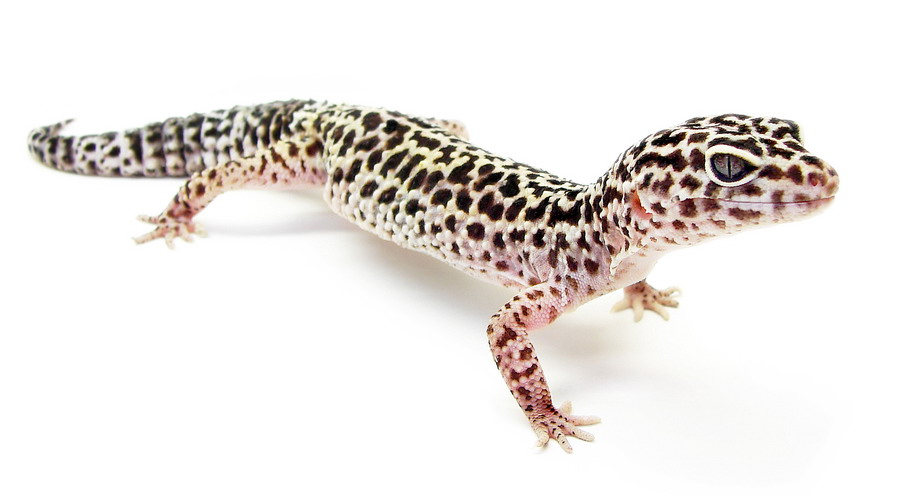


Side by side
| East Indian Leopard Gecko | Leopard Gecko | |
|---|---|---|
| Scientific name | Eublepharis hardwickii Gray, 1827 | Eublepharis macularius (Blyth, 1854) |
| English name | East Indian Leopard Gecko | Leopard Gecko |
| Group | Reptiles | Reptiles |
| Class | Reptilia Reptile | Reptilia Reptile |
| Order | Squamata Snakes | Squamata Snakes |
| Family | Eublepharidae Eublepharid Geckos | Eublepharidae Eublepharid Geckos |
| Genus | Eublepharis Southwest Asian Leopard Geckos | Eublepharis Southwest Asian Leopard Geckos |
| Named in | 1827 | 1854 |
| Red List category | Least Concern | Least Concern |
| Countries on record | 2 countries | 6 countries |
| GBIF occurrence records | 15 records | 224 records |
Rows where the two agree are shown in grey.
Where each is found
Both recorded in 1 country
Only East Indian Leopard Gecko (1)
Only Leopard Gecko (5)
From Catalogue of Life checklists and GBIF occurrence records. A country missing from a list means no record is held, which is not proof of absence.
Checked facts
| East Indian Leopard Gecko | Leopard Gecko | |
|---|---|---|
| Appearance |
|
|
| Size |
| No checked fact yet |
| Habitat |
|
|
| Diet |
|
|
| Behaviour |
|
|
| Reproduction |
|
|
| Distribution |
|
|
| Uses | No checked fact yet |
|
| Other | No checked fact yet |
|
In brief
East Indian Leopard Gecko
Eublepharis hardwickii is endemic to India and Bangladesh, with records from eastern India and Bangladesh. It has a stout body, a swollen ringed tail and reddish brown and cream-coloured upper surfaces marked with broad brown bands. Full profile
Leopard Gecko
The species occurs in Afghanistan, Pakistan, northwestern India, western Nepal and parts of Iran, as well as Iraq. The Leopard Gecko typically has yellow skin with irregular black spots, movable eyelids, clawed toes and a thick, detachable tail. Full profile
Compare something else
Page built on 27 November 2026 from the data on the two species pages, where every source is listed.
Cite this page
ScientificNames.org. (2026). East Indian Leopard Gecko vs Leopard Gecko. Retrieved November 27, 2026, from https://scientificnames.org/compare/east-indian-leopard-gecko-vs-leopard-gecko
“East Indian Leopard Gecko vs Leopard Gecko.” ScientificNames.org, 2026, scientificnames.org/compare/east-indian-leopard-gecko-vs-leopard-gecko. Accessed 27 Nov. 2026.
ScientificNames.org. “East Indian Leopard Gecko vs Leopard Gecko.” Accessed November 27, 2026. https://scientificnames.org/compare/east-indian-leopard-gecko-vs-leopard-gecko.
@misc{scientificnames_east_indian_leopard_gecko_vs_leopard_gecko,
  author = {{ScientificNames.org}},
  title = {East Indian Leopard Gecko vs Leopard Gecko},
  year = {2026},
  url = {https://scientificnames.org/compare/east-indian-leopard-gecko-vs-leopard-gecko},
  note = {Accessed 2026-11-27}
}