Species · Reptiles
Leopard Gecko Eublepharis macularius
The scientific name of the Leopard Gecko is Eublepharis macularius. It is a species of reptile in the family Eublepharidae (eublepharid geckos), order Squamata. The name dates from 1854.
- Scientific name
- Eublepharis macularius (Blyth, 1854)
- Common name
- Leopard Gecko
- Genus
- Eublepharis
- Family
- Eublepharidae (Eublepharid Geckos)
- Order
- Squamata
- Class
- Reptilia
- Red List category
- LC Least Concern
- Recorded in
- 6 countries
- Name status
- accepted in the Catalogue of Life
Overview
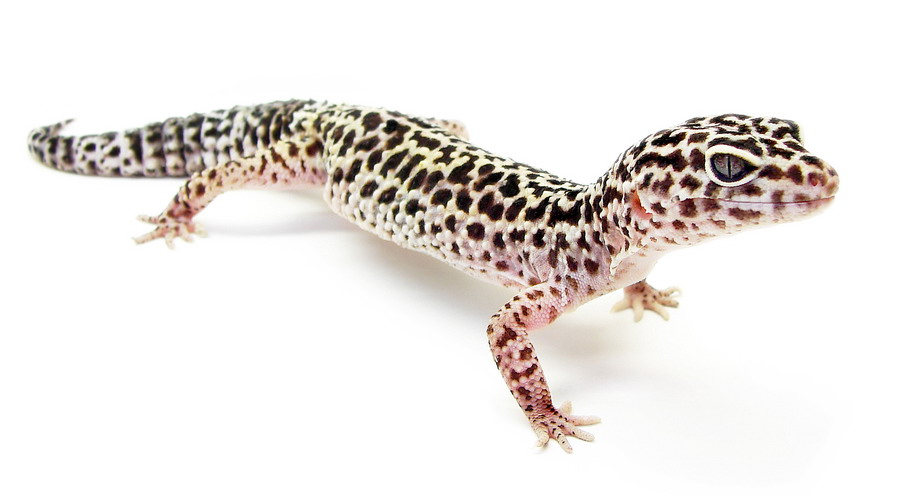
The species occurs in Afghanistan, Pakistan, northwestern India, western Nepal and parts of Iran, as well as Iraq. The Leopard Gecko typically has yellow skin with irregular black spots, movable eyelids, clawed toes and a thick, detachable tail.
Written 26 November 2026 from the sources listed below. Each statement was checked against the passage it cites; statements that could not be supported were removed.
Appearance
The species typically has a yellow ground color with irregular black spots and a white underside. In wild individuals, yellow pigmentation and black spots are produced by xanthophores and melanophores.[1][2]
The Leopard Gecko has movable upper and lower eyelids and a vertical slit pupil. Its toes lack adhesive pads and instead have claws.[3][4][5]
The species has distinctly thick tails that store fat. Its segmented tail can detach as a defensive mechanism.[6][7][8]
Extensive captive breeding has produced multiple color and pattern morphs.[9]
Habitat
The Leopard Gecko inhabits dry and semi-dry desert regions, arid grasslands and arid or semi-arid environments with sparse vegetation and clay or sandy soils.[10][11][12]
The species also inhabits rocky environments where crevices provide shelter. It has been recorded in arid forests in Nepal and Pakistan.[13][14]
The species reportedly avoids habitats where sand is the primary substrate.[15]
Behaviour
The Leopard Gecko is generally nocturnal in the wild. It shelters under rocks, in burrows and in protected hiding places during daylight, becoming active at dusk when temperatures are favorable.[16][17][18][19]
The species can climb rocks and branches using its clawed toes. It consumes its own shed skin.[20][21]
When threatened, the species may vocalize to deter predators. It can also detach its tail as a defensive mechanism.[22][8]
Males display aggressive behavior toward other males.[23]
Diet
The Leopard Gecko is an opportunistic predator that consumes a variety of prey. Invertebrates are believed to constitute most of its wild diet.[24][25]
Wild prey includes scorpions, centipedes, spiders and beetles. The species may also consume mouse pups, smaller reptiles and hatchling leopard geckos.[26][27]
Captive diets commonly include crickets, mealworms, waxworms, mice, locusts, grasshoppers and springtails.[28]
Reproduction and life cycle
The species typically breeds during summer. Females can store sperm throughout the breeding season and may produce up to three clutches following one or two copulations.[29][30][31]
Females can produce approximately six to eight clutches containing two eggs. Eggs are laid approximately 21–28 days after mating, and females bury them in the substrate.[32][33][34]
Eggs measure approximately 28 × 15 mm. Incubation typically lasts approximately 35–89 days, and sex determination depends on incubation temperature.[35][36][37]
Hatchlings measure approximately 85 mm in length. The species generally reaches sexual maturity at approximately 18 months.[38][39]
Uses
The Leopard Gecko is widely kept as a pet. It is also widely used as a model organism in laboratory and experimental research.[40][41]
Classification of the Leopard Gecko
| Kingdom | Animalia |
|---|---|
| Phylum | Chordata |
| Subphylum | Vertebrata |
| Infraphylum | Gnathostomata |
| Parvphylum | Osteichthyes |
| Megaclass | Tetrapoda |
| Class | Reptilia (Reptile) |
| Order | Squamata (Snakes) |
| Suborder | Gekkota |
| Family | Eublepharidae (Eublepharid Geckos) |
| Genus | Eublepharis (Southwest Asian Leopard Geckos) |
| Species | Eublepharis macularius (Blyth, 1854) |
Where the Leopard Gecko is found
Checklists and occurrence records place Eublepharis macularius in 6 countries across Asia. GBIF holds 224 georeferenced records of it.
Countries
Regions and cities with the most records
- Sindh, Pakistan 18
- Balochistan, Pakistan 13
- Karachi, Pakistan 8
- Haryana, India 7
- Punjab, Pakistan 7
- Aya Nagar, India 6
- Gurugram, India 5
- Mach, Pakistan 5
- Rijokri, India 5
- Sultan Pur, India 5
- Bhati, India 4
- Dera Māndi, India 4
- Himachal Pradesh, India 4
- Kāpas Herd, India 4
- Malakpur Kohi Rangpur, India 4
- Samālka, India 4
- Ali, India 3
- Bhundsi, India 3
- Bādshāhpur, India 3
- Chhatarpur, India 3
- Chilla Soroda Bāngar, India 3
- Dalūpura, India 3
- Delhi, India 3
- Delhi Cantonment, India 3
- Deoli, India 3
- Faridabad, India 3
- Gharonda Neemka Bangar, India 3
- Gharroli, India 3
- Jaitpur, India 3
- Kondli, India 3
- Kusum Pur, India 3
- Molārband, India 3
- Mānesar, India 3
- Mīthepur, India 3
- Neb Sarai, India 3
- New Delhi, India 3
1 more country has a few records outside this range
These countries hold a few records of Eublepharis macularius but lie outside the range the checklists give for it. Such records are often zoo or garden specimens, museum material or vagrants, so the species is not counted as occurring there.
Range as the checklists state it
E Afghanistan, Pakistan, NW India (Rajasthan, Ajmer, Madar foot hills, Punhab, Jammu), Nepal, E Iran (fide CARRIÓN et al. 2003).
A number beside a place is its count of GBIF occurrence records. A place without a number comes from a checklist alone. Records show where a species has been observed or collected, which can include escapes and vagrants.
Common names
English
- Leopard Gecko
- Common Leopard Gecko
- Spotted Fat-tailed Gecko
Names in 6 other languages
- Asturian
- saltarrostru lleopardu
- Chinese
- 豹紋守宮
- Dutch
- Luipaardgekko
- German
- Leopardgecko, Pakistanischer Fettschwanzgecko
- Norwegian Bokmål
- leopardgekko
- Slovenian
- leopardji gekon
Synonyms
4 other scientific names have been used for this species and are now treated as synonyms of Eublepharis macularius.
- Cyrtodactylus madarensis Sharma, 1980
- Eublepharis fasciolatus Günther, 1864
- Eublepharis gracilis Börner, 1974
- Cyrtodactylus macularius Blyth, 1854 ambiguous synonym
Subspecies and varieties
- Eublepharis macularius afghanicus subspecies
- Eublepharis macularius fasciolatus subspecies
- Eublepharis macularius macularius subspecies
- Eublepharis macularius montanus subspecies
- Eublepharis macularius smithi subspecies
Related species
-
 Iranian Fat Tailed GeckoEublepharis angramainyu
-
 West Indian Leopard GeckoEublepharis fuscus
-
 Painted Leopard GeckoEublepharis pictus
-
 Satpura Leopard GeckoEublepharis satpuraensis
-
 East Indian Leopard GeckoEublepharis hardwickii
-
 Jhuma’s Leopard GeckoEublepharis jhuma
-
 Turkmenistan Eyelid GeckoEublepharis turcmenicus
-
 African Fat-tailed GeckoHemitheconyx caudicinctus
Compare
Questions and answers
What is the scientific name of the Leopard Gecko?
The scientific name of the Leopard Gecko is Eublepharis macularius. Written with its author, the full name is Eublepharis macularius (Blyth, 1854).
Which family does the Leopard Gecko belong to?
Eublepharis macularius belongs to the family Eublepharidae, in the order Squamata and the class Reptilia.
Where is the Leopard Gecko found?
Checklists and occurrence records place Eublepharis macularius in 6 countries: Pakistan, India, Iran, Afghanistan, Japan and Nepal.
What is the conservation status of the Leopard Gecko?
The IUCN Red List category recorded for Eublepharis macularius is Least Concern (LC).
What other names does the Leopard Gecko have?
Eublepharis macularius is also known in English as Common Leopard Gecko and Spotted Fat-tailed Gecko.
What do leopard geckos eat in their natural habitat?
Wild prey includes scorpions, centipedes, spiders and beetles. Invertebrates are believed to constitute most of the wild diet. The species may also consume mouse pups, smaller reptiles and hatchling leopard geckos.[25][26][27]
What type of habitat do leopard geckos live in?
They inhabit dry and semi-dry desert regions, arid grasslands and arid or semi-arid environments with sparse vegetation and clay or sandy soils. They also inhabit rocky environments with sheltering crevices and have been recorded in arid forests in Nepal and Pakistan.[10][11][12][13][14]
What diet does a leopard gecko need?
Captive diets commonly include crickets, mealworms, waxworms, mice, locusts, grasshoppers and springtails.[28]
Sources
Passages the profile rests on
- The species typically has a yellow ground color with irregular black spots and a white underside. Source passage: “Ground color is usually yellow with irregular black spots and a white ventrum.” — animaldiversity.org
- Wild individuals have yellow skin pigmentation and black spots produced by xanthophores and melanophores. Source passage: “The skin of wild leopard geckos contains xanthophores (yellow) and melanophores (black spots).” — English Wikipedia
- The species has movable upper and lower eyelids. Source passage: “as having mobile upper and lower eyelids is the primary characteristic that distinguishes members of this family from other geckos” — English Wikipedia
- The species has a vertical slit pupil. Source passage: “with a vertical slit pupil (Hunziker 1994)” — animaldiversity.org
- Its toes lack adhesive pads and instead have claws. Source passage: “They also lack toe pads, having clawed toes instead (Hunziker 1994).” — animaldiversity.org
- The species has a segmented tail that can be detached. Source passage: “Leopard geckoes have a segmented tail which may be autotomized” — animaldiversity.org
- The species has distinctly thick tails that store fat. Source passage: “Leopard geckos have distinctly thick tails that store fat;” — English Wikipedia
- The species can detach its tail as a defensive mechanism. Source passage: “Like most geckos, leopard geckos have an ability called autotomy: the ability to "drop" their tail and regrow them.” — English Wikipedia
- Extensive captive breeding has produced multiple color and pattern morphs. Source passage: “Due to extensive captive breeding and artificial selection, captive animals display a range of colors and patterns called morphs.” — English Wikipedia
- The species inhabits dry and semi-dry desert regions. Source passage: “Dry and semi-dry desert regions (Henkel 1995)” — animaldiversity.org
- The species occurs in arid grasslands. Source passage: “arid grasslands (Hunziker 1994).” — animaldiversity.org
- The species inhabits arid and semi-arid environments with sparse vegetation and clay or sandy soils. Source passage: “Leopard geckos inhabit arid and semi-arid areas with sparse vegetation and clay or sandy soils” — English Wikipedia
- The species also inhabits rocky environments where crevices provide shelter. Source passage: “as well as rocky habitat where crevices can be used as shelter.” — English Wikipedia
- The species has also been recorded in arid forests in Nepal and Pakistan. Source passage: “Leopard geckos may also be found in arid forests of Nepal and Pakistan” — English Wikipedia
- The species reportedly avoids habitats where sand is the primary substrate. Source passage: “They reportedly avoid areas where the primary substrate is sand.” — English Wikipedia
- The species is generally nocturnal in the wild. Source passage: “Wild leopard geckos are generally considered to be nocturnal by field biology sources” — English Wikipedia
- The species shelters in burrows and protected hiding places during daylight. Source passage: “During the day they retreat to burrows and sheltered hiding spots” — English Wikipedia
- The species becomes active at dusk when temperatures are favorable. Source passage: “becoming active at dusk when the temperature is favorable.” — English Wikipedia
- The species shelters under rocks or in burrows during daylight. Source passage: “sheltering under rocks or in burrows in daylight” — animaldiversity.org
- The species consumes its own shed skin. Source passage: “This species eats the sloughed skin (Henkel 1995).” — animaldiversity.org
- The species can climb rocks and branches using its clawed toes. Source passage: “the clawed toes of the leopard gecko allow them to climb rocks and branches” — animaldiversity.org
- When threatened, the species may vocalize to deter predators. Source passage: “it may vocalize in an attempt to ward off this predator.” — English Wikipedia
- Males display aggressive behavior toward other males. Source passage: “they respond to other males with aggressive behavior” — English Wikipedia
- The species is an opportunistic predator that consumes a variety of prey. Source passage: “Leopard geckos are opportunistic predators that eat a variety of prey items.” — English Wikipedia
- Invertebrates are believed to constitute most of the wild diet. Source passage: “Invertebrates are presumed to make up the majority of wild geckos' diets” — English Wikipedia
- The species may consume mouse pups, smaller reptiles and hatchling leopard geckos. Source passage: “including mouse pups, smaller reptiles, and even hatchling leopard geckos.” — English Wikipedia
- Wild prey includes scorpions, centipedes, spiders and beetles. Source passage: “known to eat scorpions, centipedes, spiders, and beetles in the wild” — animaldiversity.org
- Captive diets commonly include crickets, mealworms, waxworms, mice, locusts, grasshoppers and springtails. Source passage: “crickets, mealworms, waxworms, pinkie or nestling mice, locusts, grasshoppers, and springtails” — animaldiversity.org
- The species typically breeds during summer. Source passage: “Leopard geckos typically breed in the summer.” — English Wikipedia
- Females can store sperm throughout the breeding season. Source passage: “Females can store sperm over the course of their breeding season” — English Wikipedia
- Females may produce up to three clutches following one or two copulations. Source passage: “produce up to three clutches from one or two copulations.” — English Wikipedia
- Females can produce approximately six to eight clutches containing two eggs. Source passage: “Females can lay about six to eight clutches of two eggs;” — English Wikipedia
- Eggs are laid approximately 21–28 days after mating. Source passage: “eggs are laid approximately 21 to 28 days after mating.” — English Wikipedia
- Females bury their eggs in the substrate. Source passage: “and bury the eggs in the substrate (Henkel 1995).” — animaldiversity.org
- Egg incubation typically lasts approximately 35–89 days. Source passage: “The average incubation time is anywhere between 35 and 89 days” — English Wikipedia
- Eggs measure approximately 28 × 15 mm. Source passage: “The eggs measure approximately 28 x 15 mm” — animaldiversity.org
- Sex determination in the species depends on incubation temperature. Source passage: “Leopard geckos have temperature-dependent sex determination.” — English Wikipedia
- Hatchlings measure approximately 85 mm in length. Source passage: “Hatchlings are about 85 mm in length” — animaldiversity.org
- The species generally reaches sexual maturity at approximately 18 months. Source passage: “Animals reach sexual maturity at around 18 months (Hunziker 1994)” — animaldiversity.org
- The species is widely kept as a pet. Source passage: “Leopard geckos are one of the most popular lizard pets” — English Wikipedia
- The species is widely used as a model organism in laboratory and experimental research. Source passage: “Leopard geckos are widely used as model organisms in laboratory and experimental research.” — English Wikipedia
Data
- Catalogue of Life, 2026-10-16 XR cc by
- Global Biodiversity Information Facility CC BY 4.0
- Wikidata CC0
- GeoNames CC BY 4.0
- Wikimedia Commons per image; credit shown with each image
- Within the Catalogue of Life, this name comes from The Reptile Database cc by
References
- Blyth, E. (1854) Report of the Curator, Zoological Department, for September, 1854. Journal of the Asiatic Society of Bengal 23, 737 - 740. where the name was published
- Blyth, E. (1854). Proceedings of the Society. Report of the Curator, Zoological Department. J. Asiat. Soc. Bengal 23 [1854]: 737-740.
- Günther, A. (1864). Description of a new species of Eublepharis. Ann. Mag. Nat. Hist. (3) 14:429-430.
- Anderson, J. (1871). On some Indian reptiles. Proc. Zool. Soc. London 1871: 149-211.
- Anderson, J. (1872). On some Persian, Himalayan, and other Reptiles. Proc. Zool. Soc. London 1872: 371-404.
- Boulenger, G. A. (1885). Catalogue of the lizards in the British Museum (Nat. Hist.) I. Geckonidae, Eublepharidae, Uroplatidae, Pygopodidae, Agamidae. London: 450 Pp.
- Boulenger, G. A. (1890). On the occurence of Eublepharis macularius in Transcaspia. Ann. Mag. Nat. Hist. (6) 6: 352.
- Procter, J. B. (1923). Lacertilia. Pp. 120-127. In Ingoldby, C. M., and J. B. Proctor. Notes on a collection of Reptilia from Waziristan and the adjoining portion of the N. W. Frontier Province. J. Bombay Nat. Hist. Soc. 29:117-130.
- Smith, M. A. (1935). The fauna of British India, including Ceylon and Burma. Reptiles and Amphibia, Vol. II. Sauria. Taylor and Francis, London, 440 Pp.
- Constable, JOHN D. (1949). Reptiles from the Indian Peninsula in the Museum of Comparative Zoology. Bull. Mus. Comp. Zool. Harvard 103: 59-160.
- Mertens, R. (1959). Über einige seltene Eidechsen aus West Pakistan. Aquar.- Terr., Z. 10: 307-310.
- Leviton, Alan E. (1959). Report on a collection of reptiles from Afghanistan. Proc. Cal. Acad. Sci. 29 (12): 445-463.
- Werner, Y. L., and E. G. Wever. (1972). The function of the middle ear in lizards: Gekko gecko and Eublepharis macularius (Gekkonidæ). Journal of Experimental Zoology, 179(1): 1-16.
- Werner, Y. L. (1972). Observations on eggs of eublepharid lizards, with comments on the evolution of the Gekkonoidea. Zoologische Mededelingen 47: 211-224.
- Börner, A. R. (1974). Ein neuer Lidgecko der Gattung Eublepharis Gray 1827. Miscellaneous Articles in Saurology (4):7-14.
- Borner, A. R. (1976). Second contribution to the systematics of the southwest Asian lizards of the geckonid genus Eublepharis Gray 1827: materials from the Indian subcontinent. Saurologica (2) 1976: 1-15.
- Kluge, Arnold G. (1976). A reinvestigation of the abdominal musulature of gekkonid lizards and its bearing on their phylogenetic relationships. Herpetologica 32 (3): 295-298.
- Marcellini, ; D.L. (1977). Acoustic and Visual Display behavior of Gekkonid Lizards. American Zoologist 17: 251-260.
- Sharma R C. (1980). Discovery of a luminous geckonid lizard from India. BULLETIN OF THE ZOOLOGICAL SURVEY OF INDIA 3(1-2) 1980: 111-112 and Asiatic Herpetol. Res. 4: 55-56.
- Börner, A. R. (1981). Third contribution to the systematics of the southwest Asian lizards of the geckonid genus Eublepharis Gray 1827: Further materials from the Indian subcontinent. Saurologica (3): 1-7.
- Gericke, F. (1981). Lidgeckos der Gattung Eublepharis. Sauria 3 (4): 11-14.
- Abraham, G. (1983). Pflege und Zucht verschiedener Bodengeckoarten unter gleichen Haltungsbedingungen. Sauria 5 (2): 5-11.
- Abraham, G. (1986). Eublepharis macularius (BLYTH, 1854). Sauria 8 (1) Suppl.: 033–034.
- Estes, Richard & Pregill, Gregory, eds. (1988). Phylogenetic relationships of the Lizard Families: Esays Commemorating Charles L. Camp. Stanford University Press, Xvi + 632 Pp.
- Schifter, H. (1988). Bemerkenswerte Lebensdauer eines Eublepharis macularius (BLYTH, 1854) (Sauria: Gekkonidae) in Gefangenschaft. Salamandra 24 (4): 310-311.
This species in other databases
Page built on 27 November 2026. See how the catalog is made and all sources and licences.
Cite this page
ScientificNames.org. (2026). Eublepharis macularius (Leopard Gecko). Retrieved November 27, 2026, from https://scientificnames.org/species/eublepharis-macularius
“Eublepharis macularius (Leopard Gecko).” ScientificNames.org, 2026, scientificnames.org/species/eublepharis-macularius. Accessed 27 Nov. 2026.
ScientificNames.org. “Eublepharis macularius (Leopard Gecko).” Accessed November 27, 2026. https://scientificnames.org/species/eublepharis-macularius.
@misc{scientificnames_eublepharis_macularius_leopard_gecko,
  author = {{ScientificNames.org}},
  title = {Eublepharis macularius (Leopard Gecko)},
  year = {2026},
  url = {https://scientificnames.org/species/eublepharis-macularius},
  note = {Accessed 2026-11-27}
}