Species · Reptiles
East Indian Leopard Gecko Eublepharis hardwickii
The scientific name of the East Indian Leopard Gecko is Eublepharis hardwickii. It is a species of reptile in the family Eublepharidae (eublepharid geckos), order Squamata. The name dates from 1827.
- Scientific name
- Eublepharis hardwickii Gray, 1827
- Common name
- East Indian Leopard Gecko
- Genus
- Eublepharis
- Family
- Eublepharidae (Eublepharid Geckos)
- Order
- Squamata
- Class
- Reptilia
- Red List category
- LC Least Concern
- Recorded in
- 2 countries
- Name status
- accepted in the Catalogue of Life
Overview
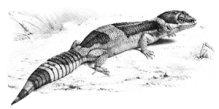
Eublepharis hardwickii is endemic to India and Bangladesh, with records from eastern India and Bangladesh. It has a stout body, a swollen ringed tail and reddish brown and cream-coloured upper surfaces marked with broad brown bands.
Written 26 November 2026 from the sources listed below. Each statement was checked against the passage it cites; statements that could not be supported were removed.
Appearance
The East Indian Leopard Gecko has a stout body, relatively short limbs and short digits. Its head has irregular polygonal scales mixed with enlarged tubercles on the temple and occiput.[1][2]
The body is covered with small, irregular, flat scales interspersed with numerous roundish, subconical tubercles. The tubercles on its back are larger than the spaces between them.[3][4]
Its tail is swollen and rounded, tapers towards the end and has a ringed appearance. The upper surface is reddish brown and cream-coloured, with two broad brown bands across the back and three around the tail.[5][6]
The lower surfaces are white, while the limbs are reddish olive with black dots on the elbows and knees. The middle of the belly has scales arranged in thirty longitudinal series.[7][8][9]
Males have between 14 and 18 preanal pores.[10]
The species reaches a total length of approximately 20–23 cm.[11]
Habitat
The species was recorded at Tikerpada, a village situated at 600 m elevation beside the Mahanadi River in Odisha's Satkoshia Gorge Sanctuary.[12]
During summer and the rainy season, individuals have been found on forest roads and in open areas at night. During the day, they have been found underneath rocks and stones.[13][14]
Diet
Captive individuals accepted a variety of insects as food. They detect their prey through its movements.[15][16]
A 5 cm body fragment of this species was found among the stomach contents of a wild male palm civet captured at Tikerpada.[17]
Behaviour
Captive individuals were described as timid and allowed themselves to be lifted by hand. At least one instance of cannibalism was recorded in captivity.[18][19]
During recorded cannibalism, the victim was captured by the neck and lay ventral-side up while being swallowed.[20]
Captive individuals did not drink water from containers but licked droplets from their heads or surrounding surfaces after artificial showers.[21]
The species produces a shrill vibrating noise when surprised. Its tongue is pinkish red, flat and thin, and can extend over the eyes and head.[22][23]
The species was reported as common at Tikerpada during the 1970s.[24]
Reproduction and life cycle
Females lay one or two leathery eggs that are buried in soil. The eggs measure approximately 20 × 10 mm.[25][26]
Classification of the East Indian Leopard Gecko
| Kingdom | Animalia |
|---|---|
| Phylum | Chordata |
| Subphylum | Vertebrata |
| Infraphylum | Gnathostomata |
| Parvphylum | Osteichthyes |
| Megaclass | Tetrapoda |
| Class | Reptilia (Reptile) |
| Order | Squamata (Snakes) |
| Suborder | Gekkota |
| Family | Eublepharidae (Eublepharid Geckos) |
| Genus | Eublepharis (Southwest Asian Leopard Geckos) |
| Species | Eublepharis hardwickii Gray, 1827 |
Where the East Indian Leopard Gecko is found
Checklists and occurrence records place Eublepharis hardwickii in 2 countries across Asia. GBIF holds 15 georeferenced records of it.
Countries
Regions and cities with the most records
- Jharkhand, India 2
- West Bengal, India 2
- Bihar, India
- Madhya Pradesh, India
- Tamil Nadu, India
- Uttar Pradesh, India
Range as the checklists state it
E-India (Anaimalay Hills, Bihar, Orissa = Odisha, West Bengal, Tamil Nadu, Madhya Pradesh, Uttar Pradesh, Jharkhand), Bangladesh
A number beside a place is its count of GBIF occurrence records. A place without a number comes from a checklist alone. Records show where a species has been observed or collected, which can include escapes and vagrants.
Common names
English
- East Indian Leopard Gecko
- Eastern Indian Leopard Gecko
Names in 1 other language
- German
- Ostinidscher Fettschwanzgecko
Synonyms
One other scientific name has been used for this species and is now treated as a synonym of Eublepharis hardwickii.
- Gymnodactylus lunatus Blyth, 1847
Related species
-
 Leopard GeckoEublepharis macularius
-
 Iranian Fat Tailed GeckoEublepharis angramainyu
-
 West Indian Leopard GeckoEublepharis fuscus
-
 Painted Leopard GeckoEublepharis pictus
-
 Satpura Leopard GeckoEublepharis satpuraensis
-
 Jhuma’s Leopard GeckoEublepharis jhuma
-
 Turkmenistan Eyelid GeckoEublepharis turcmenicus
-
 African Fat-tailed GeckoHemitheconyx caudicinctus
Compare
Questions and answers
What is the scientific name of the East Indian Leopard Gecko?
The scientific name of the East Indian Leopard Gecko is Eublepharis hardwickii. Written with its author, the full name is Eublepharis hardwickii Gray, 1827.
Which family does the East Indian Leopard Gecko belong to?
Eublepharis hardwickii belongs to the family Eublepharidae, in the order Squamata and the class Reptilia.
Where is the East Indian Leopard Gecko found?
Checklists and occurrence records place Eublepharis hardwickii in 2 countries: India and Bangladesh.
What is the conservation status of the East Indian Leopard Gecko?
The IUCN Red List category recorded for Eublepharis hardwickii is Least Concern (LC).
What other names does the East Indian Leopard Gecko have?
Eublepharis hardwickii is also known in English as Eastern Indian Leopard Gecko.
Sources
Passages the profile rests on
- The species has a stout body, relatively short limbs, and short digits. Source passage: “Body stout; limbs rather short; digits short.” — English Wikipedia
- Its head has irregular polygonal scales mixed with enlarged tubercles on the temple and occiput. Source passage: “Head covered-with irregular polygonal scales, intermixed with enlarged tubercles on the temple and occiput;” — English Wikipedia
- The body is covered with small, irregular, flat scales interspersed with numerous roundish, subconical tubercles. Source passage: “Body covered above with small, irregular, flat scales, intermixed with numerous roundish, subconical tubercles;” — English Wikipedia
- The tubercles on its back are larger than the spaces between them. Source passage: “these tubercles larger than the interspaces between them.” — English Wikipedia
- Its tail is swollen and rounded, tapers towards the end, and has a ringed appearance. Source passage: “Tail swollen, rounded, tapering at the end, verticillated,” — English Wikipedia
- The upper surface is reddish brown and cream-coloured, with two broad brown bands across the back and three around the tail. Source passage: “Above reddish brown and cream-coloured; the former colour occupies the head and forms two broad bands across the back, the anterior broadest, and three round the tail;” — English Wikipedia
- Its lower surfaces are white. Source passage: “lower surfaces white.” — English Wikipedia
- Its limbs are reddish olive with black dots on the elbows and knees. Source passage: “Limbs reddish olive, with black dots on the elbows and knees.” — English Wikipedia
- The middle of its belly has scales arranged in thirty longitudinal series. Source passage: “The scales of the middle of the belly form thirty longitudinal series;” — English Wikipedia
- Males have between 14 and 18 preanal pores. Source passage: “Male with 14 to 18 preanal pores.” — English Wikipedia
- The species reaches a total length of approximately 20–23 cm. Source passage: “This species attains a length of from 8 to 9 inches (20 to 23 cm).” — English Wikipedia
- The species was recorded at Tikerpada, a village situated at 600 m elevation beside the Mahanadi River in Odisha's Satkoshia Gorge Sanctuary. Source passage: “at Tikerpada, a village at 600m elevation on the banks of the Mahanadi river in the Satkoshia Gorge Sanctuary of Odisha.” — English Wikipedia
- During summer and the rainy season, individuals have been found on forest roads and in open areas at night. Source passage: “In the night, during summer and rains, these may be found on the forest roads or on open areas,” — English Wikipedia
- During the day, individuals have been found underneath rocks and stones. Source passage: “in the day several individuals were found underneath rocks and stones.” — English Wikipedia
- Captive individuals accepted a variety of insects as food. Source passage: “accepting a variety of insects as diet.” — English Wikipedia
- Individuals detect their prey through its movements. Source passage: “Prey were detected by their movements.” — English Wikipedia
- A 5 cm body fragment of this species was found among the stomach contents of a wild male palm civet captured at Tikerpada. Source passage: “The stomach contents of a male palm civet, Paradoxurus hermaphroditus caught from the wild at Tikerpada contained, with seven other items of foraged food, a piece of 5 cm long body part of Eublepharis hardwickii.” — English Wikipedia
- Captive individuals were described as timid and allowed themselves to be lifted by hand. Source passage: “In captivity E. hardwickii was found to be timid, allowing to be lifted by hand” — English Wikipedia
- At least one instance of cannibalism was recorded in captivity. Source passage: “At least one definite case of cannibalism was recorded in captivity” — English Wikipedia
- During recorded cannibalism, the victim was captured by the neck and lay ventral-side up while being swallowed. Source passage: “mode of capture was from the neck and during swallowing the victim lay with its ventral side up.” — English Wikipedia
- Captive individuals did not drink water from containers but licked droplets from their heads or surrounding surfaces after artificial showers. Source passage: “E. hardwickii never took water from a container in captivity; instead, they used to wait for an artificial shower to lick off drops falling on their head or sticking to the surfaces on the surroundings.” — English Wikipedia
- The species produces a shrill vibrating noise when surprised. Source passage: “The gecko makes a shrill vibrating noise when surprised.” — English Wikipedia
- Its tongue is pinkish red, flat, thin, and capable of extending over the eyes and head. Source passage: “The tongue is pinkish red, flat, thin and able to extend over to the eyes and head.” — English Wikipedia
- The species was reported as common at Tikerpada during the 1970s. Source passage: “Singh (1984) writes that the species E. hardwickii was common (in the 1970s) at Tikerpada,” — English Wikipedia
- Females lay one or two leathery eggs that are buried in soil. Source passage: “One or two leathery eggs (approx. 20 x 10 mm) are laid and buried in soil.” — English Wikipedia
- The eggs measure approximately 20 × 10 mm. Source passage: “One or two leathery eggs (approx. 20 x 10 mm)” — English Wikipedia
Data
- Catalogue of Life, 2026-10-16 XR cc by
- Global Biodiversity Information Facility CC BY 4.0
- Wikidata CC0
- GeoNames CC BY 4.0
- Wikimedia Commons per image; credit shown with each image
- Within the Catalogue of Life, this name comes from The Reptile Database cc by
References
- Gray, John E. 1827. A synopsis of the genera of saurian reptiles, in which some new genera are indicated, and the others reviewed by actual examination. The Philosophical Magazine, or Annals of Chemistry, Mathematics, Astronomy, Natural History and General Science, Series 2 2(7): 54–58. where the name was published
- Gray, J. E. (1827). A Synopsis of the Genera of Saurian Reptiles in which some new Genera are indicated, and the others reviewed by actual Examination. Philos. Mag., London, 2 (2): 54-58.
- Boulenger, G. A. (1885). Catalogue of the lizards in the British Museum (Nat. Hist.) I. Geckonidae, Eublepharidae, Uroplatidae, Pygopodidae, Agamidae. London: 450 Pp.
- Smith, M. A. (1935). The fauna of British India, including Ceylon and Burma. Reptiles and Amphibia, Vol. II. Sauria. Taylor and Francis, London, 440 Pp.
- Borner, A. R. (1976). Second contribution to the systematics of the southwest Asian lizards of the geckonid genus Eublepharis Gray 1827: materials from the Indian subcontinent. Saurologica (2) 1976: 1-15.
- Gericke, F. (1981). Lidgeckos der Gattung Eublepharis. Sauria 3 (4): 11-14.
- Rösler, H. (2000). Kommentierte Liste der rezent, subrezent und fossil bekannten Geckotaxa (Reptilia: Gekkonomorpha). Gekkota 2: 28-153.
- Seufer, H.; Y. Kaverkin & A. Kirschner (eds.). (2005). Die Lidgeckos. Kirschner Und Seufer Verlag, 238 Pp.
- Henkel, F. W., & Schmidt, W. (2009). Leopardgeckos. Natur Und Tier Verlag (Münster),156 Pp.
- Dutta, S.K., M.V. Nair, P.P. Mohapatra and A.K. Mahapatra. (2009). Amphibians and reptiles of Similipal Biosphere Reserve. Regional Plant Resouce Centre, Bhubaneswar, Orissa, India.
- Venugopal, P. D. (2010). An updated and annotated list of Indian lizards (Reptilia: Sauria) based on a review of distribution records and checklists of Indian reptiles. Journal of Threatened Taxa 2 (3): 725-738.
- Beolens, B., & Michael Watkins, a. M. G. (2011). The Eponym Dictionary of Reptiles. Johns Hopkins University Press, Baltimore, USA.
- Mirza, Zeeshan A.; Rajesh V. Sanap, David Raju, Atish Gawai, and Prathamesh Ghadekar. (2014). A new species of lizard of the genus Eublepharis (Squamata: Eublepharidae) from India. Phyllomedusa 13 (2): 75-90.
- Das, Indraneil, & Abhijit Das. (2017). A Naturalist’s Guide to the Reptiles of India, Bangladesh, Bhutan, Nepal, Pakistan and Sri Lanka. John Beaufoy Publishing Ltd., Oxford, 176 Pp.
- Agarwal, I., Bauer, A. M., Gamble, T., Giri, V. B., Jablonski, D., Khandekar, A., ... & Ramakrishnan, U. (2022). The evolutionary history of an accidental model organism, the leopard gecko Eublepharis macularius (Squamata: Eublepharidae). Molecular Phylogenetics and Evolution, 107414.
- Pratihar, S., Mahata, P., Bhunia, M., & Dandapat, C. (2024). Two rare reptile species’ destinies are entangled with human superstition. Scientific Reports in Life Sciences, 5(4), 54-58.
- Kumar, R. (2024). Occurrence of the East Indian Leopard Gecko, Eublepharis hardwickii Gray 1827, in the Dalma Wildlife Sanctuary and Saranda Forest in Jharkhand, India. Reptiles & Amphibians 31(1):1-2.
- Uetz, P. H., Patel, M., Gbadamosi, Z., Nguyen, A., & Shoope, S. (2024). A Reference Database of Reptile Images. Taxonomy 4: 723–732.
This species in other databases
Page built on 27 November 2026. See how the catalog is made and all sources and licences.
Cite this page
ScientificNames.org. (2026). Eublepharis hardwickii (East Indian Leopard Gecko). Retrieved November 27, 2026, from https://scientificnames.org/species/eublepharis-hardwickii
“Eublepharis hardwickii (East Indian Leopard Gecko).” ScientificNames.org, 2026, scientificnames.org/species/eublepharis-hardwickii. Accessed 27 Nov. 2026.
ScientificNames.org. “Eublepharis hardwickii (East Indian Leopard Gecko).” Accessed November 27, 2026. https://scientificnames.org/species/eublepharis-hardwickii.
@misc{scientificnames_eublepharis_hardwickii_east_indian_leopard_gecko,
  author = {{ScientificNames.org}},
  title = {Eublepharis hardwickii (East Indian Leopard Gecko)},
  year = {2026},
  url = {https://scientificnames.org/species/eublepharis-hardwickii},
  note = {Accessed 2026-11-27}
}