Comparison
Painted Leopard Gecko vs East Indian Leopard Gecko
Painted Leopard Gecko (Eublepharis pictus) and East Indian Leopard Gecko (Eublepharis hardwickii) both belong to the genus Eublepharis (southwest asian leopard geckos) and part ways below it. Both are recorded in 1 country.

Painted Leopard Gecko
Eublepharis pictus
Photo by Zeeshan A. Mirza, CC BY 4.0, via Wikimedia Commons

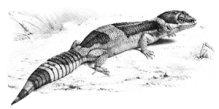
East Indian Leopard Gecko
Eublepharis hardwickii
Unknown author, Public domain, via Wikimedia Commons

Side by side
| Painted Leopard Gecko | East Indian Leopard Gecko | |
|---|---|---|
| Scientific name | Eublepharis pictus Mirza & Gnaneswar, 2022 | Eublepharis hardwickii Gray, 1827 |
| English name | Painted Leopard Gecko | East Indian Leopard Gecko |
| Group | Reptiles | Reptiles |
| Class | Reptilia Reptile | Reptilia Reptile |
| Order | Squamata Snakes | Squamata Snakes |
| Family | Eublepharidae Eublepharid Geckos | Eublepharidae Eublepharid Geckos |
| Genus | Eublepharis Southwest Asian Leopard Geckos | Eublepharis Southwest Asian Leopard Geckos |
| Named in | 2022 | 1827 |
| Red List category | Not recorded | Least Concern |
| Countries on record | 1 country | 2 countries |
| GBIF occurrence records | 30 records | 15 records |
Rows where the two agree are shown in grey.
Where each is found
Both recorded in 1 country
Only East Indian Leopard Gecko (1)
From Catalogue of Life checklists and GBIF occurrence records. A country missing from a list means no record is held, which is not proof of absence.
Checked facts
| Painted Leopard Gecko | East Indian Leopard Gecko | |
|---|---|---|
| Appearance |
|
|
| Size |
|
|
| Habitat |
|
|
| Diet | No checked fact yet |
|
| Behaviour |
|
|
| Reproduction | No checked fact yet |
|
| Distribution |
|
|
| Conservation |
| No checked fact yet |
In brief
Painted Leopard Gecko
The species occurs in Andhra Pradesh and Odisha, India, where it inhabits dry evergreen forests interspersed with scrub and meadows. It is distinguished by 23–26 rows of large, flat, keeled tubercle-like dorsal scales and one pale band between the nuchal loop and the caudal constriction. Full profile
East Indian Leopard Gecko
Eublepharis hardwickii is endemic to India and Bangladesh, with records from eastern India and Bangladesh. It has a stout body, a swollen ringed tail and reddish brown and cream-coloured upper surfaces marked with broad brown bands. Full profile
Compare something else
Page built on 29 November 2026 from the data on the two species pages, where every source is listed.
Cite this page
ScientificNames.org. (2026). Painted Leopard Gecko vs East Indian Leopard Gecko. Retrieved November 29, 2026, from https://scientificnames.org/compare/painted-leopard-gecko-vs-east-indian-leopard-gecko
“Painted Leopard Gecko vs East Indian Leopard Gecko.” ScientificNames.org, 2026, scientificnames.org/compare/painted-leopard-gecko-vs-east-indian-leopard-gecko. Accessed 29 Nov. 2026.
ScientificNames.org. “Painted Leopard Gecko vs East Indian Leopard Gecko.” Accessed November 29, 2026. https://scientificnames.org/compare/painted-leopard-gecko-vs-east-indian-leopard-gecko.
@misc{scientificnames_painted_leopard_gecko_vs_east_indian_leopard_gecko,
  author = {{ScientificNames.org}},
  title = {Painted Leopard Gecko vs East Indian Leopard Gecko},
  year = {2026},
  url = {https://scientificnames.org/compare/painted-leopard-gecko-vs-east-indian-leopard-gecko},
  note = {Accessed 2026-11-29}
}