Comparison

San Marcos Salamander vs Texas Blind Salamander

San Marcos Salamander (Eurycea nana) and Texas Blind Salamander (Eurycea rathbuni) both belong to the genus Eurycea (brook salamander) and part ways below it. Both are recorded in 1 country.

San Marcos Salamander

San Marcos Salamander

Eurycea nana

USFWS, Public domain, via Wikimedia Commons

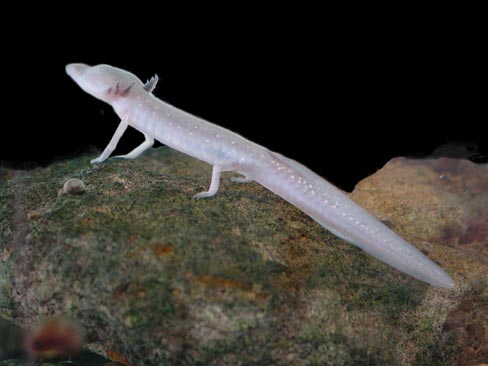
Texas Blind Salamander

Texas Blind Salamander

Eurycea rathbuni

Photograph courtesy of Joe N. Fries, U.S. Fish and Wildlife Service, Public domain, via Wikimedia Commons

Side by side

San Marcos SalamanderTexas Blind Salamander
Scientific nameEurycea nana Bishop, 1941Eurycea rathbuni (Stejneger, 1896)
English nameSan Marcos SalamanderTexas Blind Salamander
GroupAmphibiansAmphibians
ClassAmphibia AmphibiansAmphibia Amphibians
OrderCaudata SalamandersCaudata Salamanders
FamilyPlethodontidae Lungless SalamandersPlethodontidae Lungless Salamanders
GenusEurycea Brook SalamanderEurycea Brook Salamander
Named in19411896
Red List categoryCritically EndangeredCritically Endangered
Countries on record1 country1 country
GBIF occurrence records1,796 records388 records

Rows where the two agree are shown in grey.

Where each is found

Both recorded in 1 country

From Catalogue of Life checklists and GBIF occurrence records. A country missing from a list means no record is held, which is not proof of absence.

Checked facts

San Marcos SalamanderTexas Blind Salamander
Appearance
Size
Habitat
  • It inhabits clear, flowing spring water in the headwaters of the San Marcos River. tpwd.texas.gov
  • It occurs in shallow, alkaline springs with limestone, sand, and gravel substrates. animaldiversity.org
  • Thick moss and algae in shallow spring pools provide habitat and protection from predators. animaldiversity.org
  • The water temperature near the springs is approximately 21.0–21.5 degrees Celsius. animaldiversity.org
  • It is commonly found along river substrates such as rocks and vegetation. English Wikipedia
  • Unvegetated substrates and muddy silt areas are unsuitable habitats for the species. English Wikipedia
  • The species inhabits underground streams and deep pools in caves. English Wikipedia
  • Its underground pools are generally cool, measuring approximately 21–22 °C. English Wikipedia
  • It inhabits underground water-filled caves in the Edwards Aquifer. tpwd.texas.gov
  • The species is usually restricted to caves, although it has also been found in wells. animaldiversity.org
Diet
  • Its diet includes amphipods, fly larvae, and aquatic snails. English Wikipedia
  • It is carnivorous and primarily consumes amphipods, midge fly larvae, and aquatic snails. animaldiversity.org
  • Its diet varies according to the availability of aquatic invertebrates. English Wikipedia
  • Its diet includes blind shrimp, snails, and amphipods. English Wikipedia
  • Tiny snails, shrimp, and other aquatic invertebrates form its diet. tpwd.texas.gov
  • Its diet varies according to the food material flowing into its cave habitat. English Wikipedia
Behaviour
  • It remains aquatic throughout development rather than transforming into a terrestrial adult. English Wikipedia
  • It commonly waits stationary in algal vegetation for prey to pass. animaldiversity.org
  • It catches passing prey by abruptly snapping forward. English Wikipedia
  • It responds to fish predators by freezing. English Wikipedia
  • Both males and females exhibit site tenacity by returning to the same nest or breeding site depending on the season. English Wikipedia
  • It is typically active in surface vegetation but shelters beneath underwater logs and boulders during extreme winter weather. animaldiversity.org
  • The species hunts by moving its head from side to side while searching the bottom for food. tpwd.texas.gov
  • It detects prey by sensing water-pressure waves in underground water. tpwd.texas.gov
  • The species is neotenic and retains external gills throughout its life. animaldiversity.org
Reproduction
Distribution
  • The species is endemic to Spring Lake and the headwaters of the San Marcos River in Hays County, Texas, United States. English Wikipedia
No checked fact yet
Conservation
  • The species has been federally listed as threatened since 1980. English Wikipedia
  • Agricultural and urban development around its spring habitats are considered major threats. animaldiversity.org
  • Groundwater contamination and dependence on the Edwards Aquifer threaten the species. English Wikipedia
  • Introduced species and drying of its spring habitat are additional threats. English Wikipedia
  • A population estimate recorded in 1984 ranged from 17,000 to 21,000 individuals. animaldiversity.org
  • The species was listed as endangered on March 11, 1967. English Wikipedia
  • The species is listed as endangered under the U.S. Endangered Species Act. animaldiversity.org
  • Groundwater pumping for commercial or domestic purposes threatens the species by increasing its vulnerability to predators and potentially causing extinction. English Wikipedia
  • Stormwater runoff and chemical spills are sources of pollution affecting the Edwards Aquifer. English Wikipedia
  • Urban growth, water overuse, and pollution threaten the species' survival. tpwd.texas.gov
  • The species depends on a continuous supply of clean, cool water from the Edwards Aquifer. tpwd.texas.gov
UsesNo checked fact yet
Similar speciesNo checked fact yet
  • The Texas blind salamander resembles the European olm. English Wikipedia
  • Unlike the olm, it has four digits on its front limbs and five on its back limbs. English Wikipedia

In brief

San Marcos Salamander

Eurycea nana is endemic to Spring Lake and the headwaters of the San Marcos River in Hays County, Texas, United States. Full profile

Texas Blind Salamander

Eurycea rathbuni inhabits underground water-filled caves in the Edwards Aquifer. It has vestigial eyes covered by skin, red external gills, and a white body with little skin pigment. Full profile

Compare something else

Page built on 27 November 2026 from the data on the two species pages, where every source is listed.

Cite this page

ScientificNames.org. (2026). San Marcos Salamander vs Texas Blind Salamander. Retrieved November 27, 2026, from https://scientificnames.org/compare/san-marcos-salamander-vs-texas-blind-salamander