Species · Amphibians
San Marcos Salamander Eurycea nana
The scientific name of the San Marcos Salamander is Eurycea nana. It is a species of amphibian in the family Plethodontidae (lungless salamanders), order Caudata. The name dates from 1941.
- Scientific name
- Eurycea nana Bishop, 1941
- Common name
- San Marcos Salamander
- Genus
- Eurycea
- Family
- Plethodontidae (Lungless Salamanders)
- Order
- Caudata
- Class
- Amphibia
- Red List category
- CR Critically Endangered
- Recorded in
- 1 country
- Name status
- accepted in the Catalogue of Life

Overview
Eurycea nana is endemic to Spring Lake and the headwaters of the San Marcos River in Hays County, Texas, United States.
Written 26 November 2026 from the sources listed below. Each statement was checked against the passage it cites; statements that could not be supported were removed.
Appearance
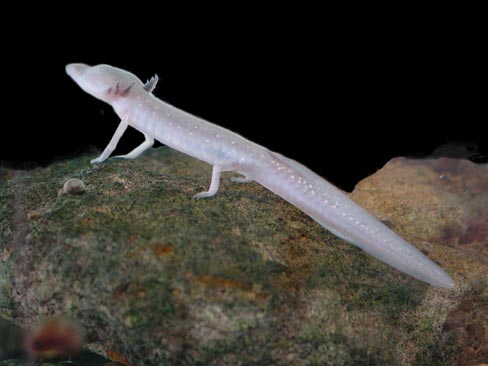
Its slender tail bears a dorsal fin. It has four toes on each forefoot and five on each hind foot.[1][2]
Males have larger vents than females.[3]
A measured specimen had a total length of 56 millimetres. The species averages approximately two inches in length but can reach 3.25 inches.[4][5]
Habitat
The San Marcos Salamander inhabits clear, flowing spring water in the headwaters of the San Marcos River. It occurs in shallow, alkaline springs with limestone, sand, and gravel substrates.[6][7]
Thick moss and algae in shallow spring pools provide habitat and protection from predators. The water temperature near the springs is approximately 21.0–21.5 degrees Celsius.[8][9]
It is commonly found along river substrates such as rocks and vegetation. Unvegetated substrates and muddy silt areas are unsuitable habitats for the species.[10][11]
Diet
The San Marcos Salamander is carnivorous and primarily consumes amphipods, midge fly larvae, and aquatic snails. Its diet varies according to the availability of aquatic invertebrates.[12][13][14]
Behaviour
The San Marcos Salamander remains aquatic throughout development rather than transforming into a terrestrial adult. It typically remains active in surface vegetation but shelters beneath underwater logs and boulders during extreme winter weather.[15][16]
It commonly waits stationary in algal vegetation for prey to pass and catches passing prey by abruptly snapping forward. It responds to fish predators by freezing.[17][18][19]
Both males and females exhibit site tenacity by returning to the same nest or breeding site depending on the season.[20]
Reproduction and life cycle
The species has separate male and female sexes. Males reach sexual maturity at a snout-to-vent length of approximately 19–23.5 millimetres, while females reach sexual maturity when their length exceeds 21 millimetres.[21][22][23]
Eggs are jelly-covered and are usually laid in standing pools with thick vegetation. They hatch after approximately 24 days.[24][25]
Conservation
The San Marcos Salamander has been federally listed as threatened since 1980. Agricultural and urban development around its spring habitats are considered major threats.[26][27]
Groundwater contamination and dependence on the Edwards Aquifer threaten the species. Introduced species and drying of its spring habitat are additional threats.[28][29]
A population estimate recorded in 1984 ranged from 17,000 to 21,000 individuals.[30]
Classification of the San Marcos Salamander
| Kingdom | Animalia |
|---|---|
| Phylum | Chordata |
| Subphylum | Vertebrata |
| Infraphylum | Gnathostomata |
| Parvphylum | Osteichthyes |
| Megaclass | Tetrapoda |
| Class | Amphibia (Amphibians) |
| Order | Caudata (Salamanders) |
| Family | Plethodontidae (Lungless Salamanders) |
| Subfamily | Hemidactyliinae |
| Genus | Eurycea (Brook Salamander) |
| Species | Eurycea nana Bishop, 1941 |
Where the San Marcos Salamander is found
Checklists and occurrence records place Eurycea nana in 1 country across North America. GBIF holds 1,796 georeferenced records of it.
Countries
Regions and cities with the most records
- Texas, United States 1,424
- San Marcos, United States 1,316
- Kyle, United States 1,315
- New Braunfels, United States 108
- Cibolo, United States 107
Range as the checklists state it
North America
A number beside a place is its count of GBIF occurrence records. A place without a number comes from a checklist alone. Records show where a species has been observed or collected, which can include escapes and vagrants.
Common names
English
- San Marcos Salamander
Names in 4 other languages
- Czech
- mločík malý
- French
- Eurycée de San Marcos
- Russian
- Санмаркосская ручьевая саламандра, Хрупкая саламандра
- Spanish
- Salamandra de San Marcos
Synonyms
One other scientific name has been used for this species and is now treated as a synonym of Eurycea nana.
- Eurycea neotenes nana Bishop, 1941
Related species
-
 Texas Blind SalamanderEurycea rathbuni
- Blanco Blind SalamanderEurycea robusta
-
 Northern Two-lined SalamanderEurycea bislineata
-
 Barton Springs SalamanderEurycea sosorum
-
 Long-tailed SalamanderEurycea longicauda
-
 Cave SalamanderEurycea lucifuga
-
 Southern Two-lined SalamanderEurycea cirrigera
-
 Blue Ridge Two-lined SalamanderEurycea wilderae
Compare
Questions and answers
What is the scientific name of the San Marcos Salamander?
The scientific name of the San Marcos Salamander is Eurycea nana. Written with its author, the full name is Eurycea nana Bishop, 1941.
Which family does the San Marcos Salamander belong to?
Eurycea nana belongs to the family Plethodontidae, in the order Caudata and the class Amphibia.
Where is the San Marcos Salamander found?
Checklists and occurrence records place Eurycea nana in 1 country: United States.
What is the conservation status of the San Marcos Salamander?
The IUCN Red List category recorded for Eurycea nana is Critically Endangered (CR).
What is the diet of a salamander?
The San Marcos Salamander is carnivorous. Its diet includes amphipods, midge fly larvae, and aquatic snails, and varies according to the availability of aquatic invertebrates.[12][13][14]
What is the habitat for a salamander?
The San Marcos Salamander inhabits clear, flowing spring water in the headwaters of the San Marcos River. It occurs in shallow, alkaline springs with limestone, sand, and gravel substrates, where thick moss and algae provide habitat and protection from predators.[6][7][8]
Sources
Passages the profile rests on
- Its tail is slender and bears a dorsal fin. Source passage: “The tail is slender and has a dorsal fin.” — English Wikipedia
- It has four toes on each forefoot and five on each hind foot. Source passage: “It has four toes on its forefeet and five on its hind feet.” — English Wikipedia
- Males have larger vents than females. Source passage: “males have larger vents than females do.” — English Wikipedia
- A measured specimen had a total length of 56 millimetres. Source passage: “The size of the species was measured to be 56 millimetres (2.2 in) total in length.” — English Wikipedia
- The species averages approximately two inches in length but can reach 3.25 inches. Source passage: “Eurycea nana averages about 2 inches long, but may reach up to 3.25 inches.” — animaldiversity.org
- It inhabits clear, flowing spring water in the headwaters of the San Marcos River. Source passage: “Clear, flowing spring water coming from the headwaters of the San Marcos River provide habitat for the San Marcos” — tpwd.texas.gov
- It occurs in shallow, alkaline springs with limestone, sand, and gravel substrates. Source passage: “This salamander is characteristically found in shallow, alkaline springs carved out of limestone with sand and gravel substrates.” — animaldiversity.org
- Thick moss and algae in shallow spring pools provide habitat and protection from predators. Source passage: “The thick moss and algae that cover the shallow pools around the springs provide and excellent habitat for Euryca nana to not only find food for itself, but also to keep it safe from predators.” — animaldiversity.org
- The water temperature near the springs is approximately 21.0–21.5 degrees Celsius. Source passage: “Water temperature in the San Marcos and Comal Rivers are remarkably stable with temperatures in close proximity to the springs being between 21.0 to 21.5 degrees Celsius.” — animaldiversity.org
- It is commonly found along river substrates such as rocks and vegetation. Source passage: “E. nana are often found along the river substrates, such as rocks and vegetation.” — English Wikipedia
- Unvegetated substrates and muddy silt areas are unsuitable habitats for the species. Source passage: “Substrates without vegetation and muddy slit areas are unsuitable for E. nana” — English Wikipedia
- Its diet includes amphipods, fly larvae, and aquatic snails. Source passage: “The diet of E. nana includes amphipods, fly larvae, and aquatic snails.” — English Wikipedia
- It is carnivorous and primarily consumes amphipods, midge fly larvae, and aquatic snails. Source passage: “It is carnivorous and has been found to feed mostly on amphipods, midge fly larvae, and some aquatic snails” — animaldiversity.org
- Its diet varies according to the availability of aquatic invertebrates. Source passage: “San Marcos Salamanders typically follow a temporal diet, or a diet that varies with the availability of invertebrates present to them at a given time.” — English Wikipedia
- It remains aquatic throughout development rather than transforming into a terrestrial adult. Source passage: “It does not leave the water to change into a terrestrial form, but rather matures in the water.” — English Wikipedia
- It is typically active in surface vegetation but shelters beneath underwater logs and boulders during extreme winter weather. Source passage: “The San Marcos Salamander is typically active in surface vegetation except in extreme winter weather where it stays beneath underwater logs and boulders.” — animaldiversity.org
- It commonly waits stationary in algal vegetation for prey to pass. Source passage: “It is often found sitting stationary in algal vegetation waiting for prey” — animaldiversity.org
- It catches passing prey by abruptly snapping forward. Source passage: “it waits for prey to pass and will abruptly snap forward to catch its food.” — English Wikipedia
- It responds to fish predators by freezing. Source passage: “Antipredator responses include freezing behavior to its fish predators.” — English Wikipedia
- Both males and females exhibit site tenacity by returning to the same nest or breeding site depending on the season. Source passage: “Site tenacity, the pattern of returning to the same nest or breeding site dependent on the season, was observed in both males and females of E. nana.” — English Wikipedia
- Males reach sexual maturity at a snout-to-vent length of approximately 19–23.5 millimetres. Source passage: “Males are sexually mature at 19 to 23.5 mm” — animaldiversity.org
- Females reach sexual maturity when their length exceeds 21 millimetres. Source passage: “females when they are longer than 21 mm.” — animaldiversity.org
- The species has separate male and female sexes. Source passage: “gonochoric/gonochoristic/dioecious (sexes separate)” — animaldiversity.org
- Eggs are jelly-covered and are usually laid in standing pools with thick vegetation. Source passage: “the jelly-covered eggs are usually laid in standing pools with thick vegetation.” — animaldiversity.org
- Eggs hatch after approximately 24 days. Source passage: “Eggs are jelly-covered and will hatch in about 24 days.” — English Wikipedia
- The species has been federally listed as threatened since 1980. Source passage: “The San Marcos salamander has been federally listed as a threatened species since 1980.” — English Wikipedia
- Agricultural and urban development around its spring habitats are considered major threats. Source passage: “Agricultural and urban development around the springs it inhabits are thought to be the biggest threats.” — animaldiversity.org
- Groundwater contamination and dependence on the Edwards Aquifer threaten the species. Source passage: “it is threatened primarily by the contamination of groundwater sources and heavy dependence of central Texas cities upon the Edwards Aquifer for water.” — English Wikipedia
- Introduced species and drying of its spring habitat are additional threats. Source passage: “Other threats include drying of the spring and introduced species.” — English Wikipedia
- A population estimate recorded in 1984 ranged from 17,000 to 21,000 individuals. Source passage: “the population seemed stable with a count of 17,000-21,000 recorded in 1984.” — animaldiversity.org
Data
- Catalogue of Life, 2026-10-16 XR cc by
- Global Biodiversity Information Facility CC BY 4.0
- Wikidata CC0
- GeoNames CC BY 4.0
- Wikimedia Commons per image; credit shown with each image
- Within the Catalogue of Life, this name comes from The Integrated Taxonomic Information System cc0
References
- Notes on sala-manders with descriptions of several new forms. (1941). Occasional Papers of the Museum of Zoology University of Michigan Ann Arbor, 451, 1–21. https://bionames.org/references/6f8580a92fa0697787c1ebeb8a0ae59d Link where the name was published
- Banks, R. C., R. W. McDiarmid, and A. L. Gardner. (1987). Checklist of Vertebrates of the United States, the U.S. Territories, and Canada. Resource Publication, No. 166.
- Crother, Brian I., Jeff Boundy, Jonathan A. Campbell, et al. / Moriarty, John J., ed. (2000). Scientific and Standard English Names of Amphibians and Reptiles of North America North of Mexico, with Comments Regarding Confidence in Our Understanding. Herpetological Circular, No. 29.
- Crother, Brian I., Jeff Boundy, Frank T. Burbrink, et al. / Moriarty, John J., ed. (2008). Scientific and Standard English Names of Amphibians and Reptiles of North America North of Mexico, With Comments Regarding Confidence in Our Understanding, Sixth Ed. Herpetological Circular No. 37.
This species in other databases
Page built on 27 November 2026. See how the catalog is made and all sources and licences.
Cite this page
ScientificNames.org. (2026). Eurycea nana (San Marcos Salamander). Retrieved November 27, 2026, from https://scientificnames.org/species/eurycea-nana
“Eurycea nana (San Marcos Salamander).” ScientificNames.org, 2026, scientificnames.org/species/eurycea-nana. Accessed 27 Nov. 2026.
ScientificNames.org. “Eurycea nana (San Marcos Salamander).” Accessed November 27, 2026. https://scientificnames.org/species/eurycea-nana.
@misc{scientificnames_eurycea_nana_san_marcos_salamander,
  author = {{ScientificNames.org}},
  title = {Eurycea nana (San Marcos Salamander)},
  year = {2026},
  url = {https://scientificnames.org/species/eurycea-nana},
  note = {Accessed 2026-11-27}
}