Comparison

Oklahoma Salamander vs Texas Blind Salamander

Oklahoma Salamander (Eurycea tynerensis) and Texas Blind Salamander (Eurycea rathbuni) both belong to the genus Eurycea (brook salamander) and part ways below it. Both are recorded in 1 country.

Oklahoma Salamander

Oklahoma Salamander

Eurycea tynerensis

Stanley Trauth, CC BY-SA 2.5, via Wikimedia Commons

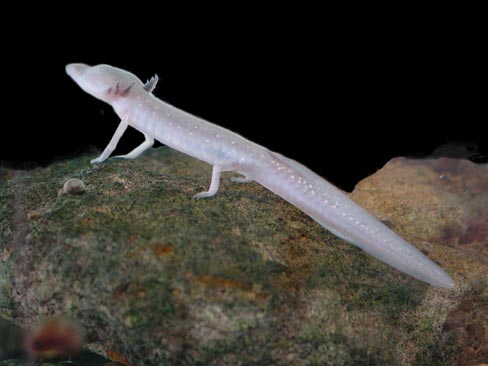
Texas Blind Salamander

Texas Blind Salamander

Eurycea rathbuni

Photograph courtesy of Joe N. Fries, U.S. Fish and Wildlife Service, Public domain, via Wikimedia Commons

Side by side

Oklahoma SalamanderTexas Blind Salamander
Scientific nameEurycea tynerensis Moore & Hughes, 1939Eurycea rathbuni (Stejneger, 1896)
English nameOklahoma SalamanderTexas Blind Salamander
GroupAmphibiansAmphibians
ClassAmphibia AmphibiansAmphibia Amphibians
OrderCaudata SalamandersCaudata Salamanders
FamilyPlethodontidae Lungless SalamandersPlethodontidae Lungless Salamanders
GenusEurycea Brook SalamanderEurycea Brook Salamander
Named in19391896
Red List categoryLeast ConcernCritically Endangered
Environmentfreshwater, terrestrialNot recorded
Countries on record1 country1 country
GBIF occurrence records2,045 records388 records

Rows where the two agree are shown in grey.

Where each is found

Both recorded in 1 country

From Catalogue of Life checklists and GBIF occurrence records. A country missing from a list means no record is held, which is not proof of absence.

Checked facts

Oklahoma SalamanderTexas Blind Salamander
Appearance
  • The salamander has a small, dark, slender body that is generally yellowish tan, dark brown, or gray. mdc.mo.gov
  • Its dorsal stripe ranges from golden or yellowish tan to brown and is bordered by dark brown lines. mdc.mo.gov
  • Some individuals have a row of dark brown V-shaped markings along the back corresponding to their costal grooves. mdc.mo.gov
  • The sides and tail bear small white flecks, while the belly is gray and may have a yellowish tint. mdc.mo.gov
  • Gilled aquatic individuals have cream or light tan backs and sides with extensive gray stippling. mdc.mo.gov
  • Gilled individuals have two lines of small white spots along their sides and a pale belly. mdc.mo.gov
  • Gilled individuals possess poorly developed dorsal and ventral tail fins. mdc.mo.gov
Size
  • Adults typically measure 1¾–3¼ inches in length, with occasional individuals reaching 4 inches. mdc.mo.gov
Habitat
  • Its natural habitats include temperate forests, rivers, and freshwater springs. English Wikipedia
  • Most Missouri populations inhabit small, clear streams and springs with cherty gravel bottoms. mdc.mo.gov
  • When surface water is available, individuals shelter among loose gravel or beneath rocks. mdc.mo.gov
  • During dry periods, individuals move down into creek gravel beds as water levels fall. mdc.mo.gov
  • Transformed individuals shelter beneath rocks and logs in or near cave springs and cold, clear streams. mdc.mo.gov
  • Transformed individuals are particularly associated with dimly lit areas beyond cave entrances and leafy seepage areas of the Ozark Highlands. mdc.mo.gov
  • The species inhabits underground streams and deep pools in caves. English Wikipedia
  • Its underground pools are generally cool, measuring approximately 21–22 °C. English Wikipedia
  • It inhabits underground water-filled caves in the Edwards Aquifer. tpwd.texas.gov
  • The species is usually restricted to caves, although it has also been found in wells. animaldiversity.org
Diet
  • Small arthropods are the primary food of both adults and larvae. mdc.mo.gov
  • Its recorded prey includes ostracods, isopods, dipterans, and ephemeropterans. mdc.mo.gov
  • Its diet includes blind shrimp, snails, and amphipods. English Wikipedia
  • Tiny snails, shrimp, and other aquatic invertebrates form its diet. tpwd.texas.gov
  • Its diet varies according to the food material flowing into its cave habitat. English Wikipedia
Behaviour
  • Both larval and adult life stages are permanently aquatic. mdc.mo.gov
  • Neoteny is common, with adults retaining the external gills characteristic of larvae. mdc.mo.gov
  • Individuals can remain active throughout the year by occupying aquatic habitats within creek gravel beds. mdc.mo.gov
  • Transformed individuals are nocturnal outside caves and may move away from streams on rainy nights. mdc.mo.gov
  • The species hunts by moving its head from side to side while searching the bottom for food. tpwd.texas.gov
  • It detects prey by sensing water-pressure waves in underground water. tpwd.texas.gov
  • The species is neotenic and retains external gills throughout its life. animaldiversity.org
Reproduction
  • Fertilization is internal. mdc.mo.gov
  • Females attach their eggs beneath rocks or within gravel spaces in springs and streams. mdc.mo.gov
  • Females lay between 3 and 21 eggs. mdc.mo.gov
  • Egg incubation lasts approximately 30 days. mdc.mo.gov
  • Larvae reach sexual maturity after 5–8 months. mdc.mo.gov
  • The reproductive season generally extends from September through July, although its duration varies among populations. mdc.mo.gov
  • Some populations lay eggs from autumn through late spring. mdc.mo.gov
  • A documented terrestrial oviposition event involved 30 eggs deposited above water on October 12–13, 2013. academia.edu
  • Most adults retain their gills, while a smaller number transform into gill-less adults. mdc.mo.gov
  • Neotenic adults generally grow larger than individuals that undergo complete metamorphosis. mdc.mo.gov
Distribution
  • The Oklahoma salamander is endemic to the United States. English Wikipedia
  • The species occurs in the eastern edge of Oklahoma, southwestern Missouri, and northern Arkansas. mdc.mo.gov
No checked fact yet
Conservation
  • Habitat loss threatens the species. English Wikipedia
  • Water pollution and habitat loss threaten the species because it requires clean creeks, springs, and abundant clean gravel. mdc.mo.gov
  • Siltation and gravel removal are identified as primary threats to the species. mdc.mo.gov
  • The species appears relatively secure in Missouri despite its restricted distribution. mdc.mo.gov
  • The species was listed as endangered on March 11, 1967. English Wikipedia
  • The species is listed as endangered under the U.S. Endangered Species Act. animaldiversity.org
  • Groundwater pumping for commercial or domestic purposes threatens the species by increasing its vulnerability to predators and potentially causing extinction. English Wikipedia
  • Stormwater runoff and chemical spills are sources of pollution affecting the Edwards Aquifer. English Wikipedia
  • Urban growth, water overuse, and pollution threaten the species' survival. tpwd.texas.gov
  • The species depends on a continuous supply of clean, cool water from the Edwards Aquifer. tpwd.texas.gov
UsesNo checked fact yet
Similar species
  • The Oklahoma salamander is closely related to the many-ribbed salamander (Eurycea multiplicata multiplicata). mdc.mo.gov
  • The Texas blind salamander resembles the European olm. English Wikipedia
  • Unlike the olm, it has four digits on its front limbs and five on its back limbs. English Wikipedia

In brief

Oklahoma Salamander

Eurycea tynerensis occurs in the eastern edge of Oklahoma, southwestern Missouri, and northern Arkansas. Neoteny is common, and most adults retain the external gills characteristic of larvae. Full profile

Texas Blind Salamander

Eurycea rathbuni inhabits underground water-filled caves in the Edwards Aquifer. It has vestigial eyes covered by skin, red external gills, and a white body with little skin pigment. Full profile

Compare something else

Page built on 29 November 2026 from the data on the two species pages, where every source is listed.

Cite this page

ScientificNames.org. (2026). Oklahoma Salamander vs Texas Blind Salamander. Retrieved November 29, 2026, from https://scientificnames.org/compare/oklahoma-salamander-vs-texas-blind-salamander