Species · Amphibians
Oklahoma Salamander Eurycea tynerensis
The scientific name of the Oklahoma Salamander is Eurycea tynerensis. It is a species of amphibian in the family Plethodontidae (lungless salamanders), order Caudata. The name dates from 1939.
- Scientific name
- Eurycea tynerensis Moore & Hughes, 1939
- Common name
- Oklahoma Salamander
- Genus
- Eurycea
- Family
- Plethodontidae (Lungless Salamanders)
- Order
- Caudata
- Class
- Amphibia
- Red List category
- LC Least Concern
- Environment
- freshwater, terrestrial
- Recorded in
- 1 country
- Name status
- accepted in the Catalogue of Life

Overview
Eurycea tynerensis occurs in the eastern edge of Oklahoma, southwestern Missouri, and northern Arkansas. Neoteny is common, and most adults retain the external gills characteristic of larvae.
Written 27 November 2026 from the sources listed below. Each statement was checked against the passage it cites; statements that could not be supported were removed.
Appearance
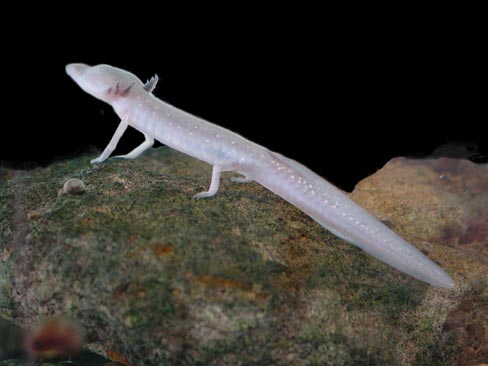
The Oklahoma Salamander has a small, dark, slender body that is generally yellowish tan, dark brown, or gray. Its dorsal stripe ranges from golden or yellowish tan to brown and is bordered by dark brown lines.[1][2]
Some individuals have dark brown V-shaped markings along the back corresponding to their costal grooves. The sides and tail bear small white flecks, while the belly is gray and may have a yellowish tint.[3][4]
Gilled aquatic individuals have cream or light tan backs and sides with extensive gray stippling. They have two lines of small white spots along their sides, a pale belly, and poorly developed dorsal and ventral tail fins.[5][6][7]
Adults typically measure 1¾–3¼ inches in length, with occasional individuals reaching 4 inches.[8]
Habitat
The Oklahoma Salamander inhabits temperate forests, rivers, and freshwater springs. Most Missouri populations inhabit small, clear streams and springs with cherty gravel bottoms.[9][10]
When surface water is available, individuals shelter among loose gravel or beneath rocks. During dry periods, they move down into creek gravel beds as water levels fall.[11][12]
Transformed individuals shelter beneath rocks and logs in or near cave springs and cold, clear streams. They are particularly associated with dimly lit areas beyond cave entrances and leafy seepage areas of the Ozark Highlands.[13][14]
Behaviour
Both larval and adult life stages are permanently aquatic. Neoteny is common, with adults retaining the external gills characteristic of larvae.[15][16]
Individuals can remain active throughout the year by occupying aquatic habitats within creek gravel beds. Transformed individuals are nocturnal outside caves and may move away from streams on rainy nights.[17][18]
Most adults retain their gills, while a smaller number transform into gill-less adults. Neotenic adults generally grow larger than individuals that undergo complete metamorphosis.[19][20]
Diet
Small arthropods are the primary food of both adults and larvae. Recorded prey includes ostracods, isopods, dipterans, and ephemeropterans.[21][22]
Reproduction and life cycle
Fertilization is internal. Females attach their eggs beneath rocks or within gravel spaces in springs and streams.[23][24]
Females lay between 3 and 21 eggs. Egg incubation lasts approximately 30 days, and larvae reach sexual maturity after 5–8 months.[25][26][27]
The reproductive season generally extends from September through July, although its duration varies among populations. Some populations lay eggs from autumn through late spring.[28][29]
A documented terrestrial oviposition event involved 30 eggs deposited above water on October 12–13, 2013.[30]
Conservation
Habitat loss and water pollution threaten the species because it requires clean creeks, springs, and abundant clean gravel. Siltation and gravel removal are identified as primary threats.[31][32][33]
The species appears relatively secure in Missouri despite its restricted distribution.[34]
Similar species
The Oklahoma Salamander is closely related to the many-ribbed salamander (Eurycea multiplicata multiplicata).[35]
Classification of the Oklahoma Salamander
| Kingdom | Animalia |
|---|---|
| Phylum | Chordata |
| Subphylum | Vertebrata |
| Infraphylum | Gnathostomata |
| Parvphylum | Osteichthyes |
| Megaclass | Tetrapoda |
| Class | Amphibia (Amphibians) |
| Order | Caudata (Salamanders) |
| Family | Plethodontidae (Lungless Salamanders) |
| Subfamily | Hemidactyliinae |
| Genus | Eurycea (Brook Salamander) |
| Species | Eurycea tynerensis Moore & Hughes, 1939 |
Where the Oklahoma Salamander is found
Checklists and occurrence records place Eurycea tynerensis in 1 country across North America. GBIF holds 2,045 georeferenced records of it.
Countries
Regions and cities with the most records
- Oklahoma, United States 685
- Arkansas, United States 379
- Tahlequah, United States 149
- Fayetteville, United States 67
- Springdale, United States 61
- Missouri, United States 47
- Siloam Springs, United States 25
- Rogers, United States 21
- Van Buren, United States 21
- Bella Vista, United States 20
- Bentonville, United States 12
- Ozark, United States 10
- Fort Smith, United States 6
- Little Rock, United States 5
- Maumelle, United States 5
- North Little Rock, United States 5
- Sherwood, United States 5
- Russellville, United States 3
- Searcy, United States 3
Range as the checklists state it
North America
A number beside a place is its count of GBIF occurrence records. A place without a number comes from a checklist alone. Records show where a species has been observed or collected, which can include escapes and vagrants.
Common names
English
- Oklahoma Salamander
Names in 4 other languages
- Czech
- mločík oklahomský
- French
- Eurycée de l'Oklahoma
- Russian
- Оклахомская саламандра
- Spanish
- Salamandra de Oklahoma
Synonyms
2 other scientific names have been used for this species and are now treated as synonyms of Eurycea tynerensis.
- Eurycea griseogaster Moore & Hughes, 1941
- Eurycea multiplicata griseogaster Moore & Hughes, 1941
Related species
-
 Texas Blind SalamanderEurycea rathbuni
- Blanco Blind SalamanderEurycea robusta
-
 Northern Two-lined SalamanderEurycea bislineata
-
 Barton Springs SalamanderEurycea sosorum
-
 Long-tailed SalamanderEurycea longicauda
-
 Cave SalamanderEurycea lucifuga
-
 Southern Two-lined SalamanderEurycea cirrigera
-
 Blue Ridge Two-lined SalamanderEurycea wilderae
Compare
Questions and answers
What is the scientific name of the Oklahoma Salamander?
The scientific name of the Oklahoma Salamander is Eurycea tynerensis. Written with its author, the full name is Eurycea tynerensis Moore & Hughes, 1939.
Which family does the Oklahoma Salamander belong to?
Eurycea tynerensis belongs to the family Plethodontidae, in the order Caudata and the class Amphibia.
Where is the Oklahoma Salamander found?
Checklists and occurrence records place Eurycea tynerensis in 1 country: United States.
What is the conservation status of the Oklahoma Salamander?
The IUCN Red List category recorded for Eurycea tynerensis is Least Concern (LC).
What kind of salamanders live in Oklahoma?
The Oklahoma Salamander (Eurycea tynerensis) occurs in the eastern edge of Oklahoma.[36][37]
Sources
Passages the profile rests on
- The salamander has a small, dark, slender body that is generally yellowish tan, dark brown, or gray. Source passage: “The Oklahoma salamander is a small, dark, slender salamander that is generally yellowish tan to dark brown or gray.” — mdc.mo.gov
- Its dorsal stripe ranges from golden or yellowish tan to brown and is bordered by dark brown lines. Source passage: “The stripe running along the back may be golden or yellowish tan to brown and is bordered by dark brown lines.” — mdc.mo.gov
- Some individuals have a row of dark brown V-shaped markings along the back corresponding to their costal grooves. Source passage: “Also along back, there may be a row of dark brown V-shapes corresponding to each of the 19–21 costal grooves” — mdc.mo.gov
- The sides and tail bear small white flecks, while the belly is gray and may have a yellowish tint. Source passage: “The sides and tail have small white flecks. The belly is gray but may be somewhat yellow.” — mdc.mo.gov
- Gilled aquatic individuals have cream or light tan backs and sides with extensive gray stippling. Source passage: “the back and sides are cream or light tan and covered with extensive gray stippling” — mdc.mo.gov
- Gilled individuals have two lines of small white spots along their sides and a pale belly. Source passage: “with two lines of small white spots along the sides, and a pale belly.” — mdc.mo.gov
- Gilled individuals possess poorly developed dorsal and ventral tail fins. Source passage: “Poorly developed dorsal and ventral fins are present on the tail.” — mdc.mo.gov
- Adults typically measure 1¾–3¼ inches in length, with occasional individuals reaching 4 inches. Source passage: “Adult length: 1¾–3¼ inches; occasionally to 4 inches.” — mdc.mo.gov
- Its natural habitats include temperate forests, rivers, and freshwater springs. Source passage: “Its natural habitats are temperate forests, rivers, and freshwater springs.” — English Wikipedia
- Most Missouri populations inhabit small, clear streams and springs with cherty gravel bottoms. Source passage: “most of Missouri's population lives in small, clear, cherty, gravel-bottom creeks, streams, and springs.” — mdc.mo.gov
- When surface water is available, individuals shelter among loose gravel or beneath rocks. Source passage: “When surface water is present, these salamanders live in the spaces among loose gravel or under rocks.” — mdc.mo.gov
- During dry periods, individuals move down into creek gravel beds as water levels fall. Source passage: “During dry periods and presumably during the winter, these salamanders follow the water level down into the creek gravel bed” — mdc.mo.gov
- Transformed individuals shelter beneath rocks and logs in or near cave springs and cold, clear streams. Source passage: “transformed individuals (adults lacking external gills) hide under rocks and logs in or near cave springs or cold, clear streams.” — mdc.mo.gov
- Transformed individuals are particularly associated with dimly lit areas beyond cave entrances and leafy seepage areas of the Ozark Highlands. Source passage: “They are especially associated with the dimly lit areas beyond cave entrances and in leafy seepage areas of the Ozark Highlands.” — mdc.mo.gov
- Both larval and adult life stages are permanently aquatic. Source passage: “Both larval and adult life stages are permanently aquatic” — mdc.mo.gov
- Neoteny is common, with adults retaining the external gills characteristic of larvae. Source passage: “Neoteny is common in this species; this means that adults retain the feathery external gills that generally characterize the larval stage” — mdc.mo.gov
- Individuals can remain active throughout the year by occupying aquatic habitats within creek gravel beds. Source passage: “using this type of aquatic habitat allows them to remain active all year.” — mdc.mo.gov
- Transformed individuals are nocturnal outside caves and may move away from streams on rainy nights. Source passage: “When outside caves, these salamanders are nocturnal and may venture away from streams on rainy nights.” — mdc.mo.gov
- Most adults retain their gills, while a smaller number transform into gill-less adults. Source passage: “Most adults will be neotenic (retaining the gilled, aquatic form), while a few may transform into the gill-less adult form more typical of this family.” — mdc.mo.gov
- Neotenic adults generally grow larger than individuals that undergo complete metamorphosis. Source passage: “Neotenic adults generally attain larger sizes than those that undergo the full metamorphosis.” — mdc.mo.gov
- Small arthropods are the primary food of both adults and larvae. Source passage: “Small arthropods are the primary food of both adults and larvae” — mdc.mo.gov
- Its recorded prey includes ostracods, isopods, dipterans, and ephemeropterans. Source passage: “especially ostracods (seed shrimp), isopods (such as aquatic pillbugs), dipterans (true flies, including their aquatic, wormlike larvae), and ephemeropterans (mayflies, including their aquatic larvae).” — mdc.mo.gov
- Fertilization is internal. Source passage: “Fertilization is internal” — mdc.mo.gov
- Females attach their eggs beneath rocks or within gravel spaces in springs and streams. Source passage: “females attach their eggs to the undersurface of rocks or within spaces in the gravel substrate of springs and streams.” — mdc.mo.gov
- Females lay between 3 and 21 eggs. Source passage: “Females lay 3–21 eggs.” — mdc.mo.gov
- Egg incubation lasts approximately 30 days. Source passage: “Incubation lasts about 30 days.” — mdc.mo.gov
- Larvae reach sexual maturity after 5–8 months. Source passage: “After 5–8 months, the larvae become sexually mature.” — mdc.mo.gov
- The reproductive season generally extends from September through July, although its duration varies among populations. Source passage: “Generally, breeding may last from September into July” — mdc.mo.gov
- Some populations lay eggs from autumn through late spring. Source passage: “with many populations laying eggs during the fall to late spring.” — mdc.mo.gov
- A documented terrestrial oviposition event involved 30 eggs deposited above water on October 12–13, 2013. Source passage: “Eurycea tynerensis exhibits terrestrial oviposition, with 30 eggs deposited above water on October 12-13, 2013.” — academia.edu
- Habitat loss threatens the species. Source passage: “It is threatened by habitat loss.” — English Wikipedia
- Water pollution and habitat loss threaten the species because it requires clean creeks, springs, and abundant clean gravel. Source passage: “its requirements for clean creeks, springs, and an abundance of clean gravel make it vulnerable to water pollution and habitat loss.” — mdc.mo.gov
- Siltation and gravel removal are identified as primary threats to the species. Source passage: “Siltation, gravel removal, and water pollution are its primary threats.” — mdc.mo.gov
- The species appears relatively secure in Missouri despite its restricted distribution. Source passage: “Populations appear to be relatively secure, despite the restricted distribution.” — mdc.mo.gov
- The Oklahoma salamander is closely related to the many-ribbed salamander (Eurycea multiplicata multiplicata). Source passage: “It's closely related to the many-ribbed salamander (Eurycea multiplicata multiplicata)” — mdc.mo.gov
- The Oklahoma salamander is endemic to the United States. Source passage: “The Oklahoma salamander (Eurycea tynerensis) is a salamander in the family Plethodontidae, endemic to the United States.” — English Wikipedia
- The species occurs in the eastern edge of Oklahoma, southwestern Missouri, and northern Arkansas. Source passage: “Overall range is limited to the eastern edge of Oklahoma, southwestern Missouri, and northern Arkansas.” — mdc.mo.gov
Data
- Catalogue of Life, 2026-10-16 XR cc by
- Global Biodiversity Information Facility CC BY 4.0
- Wikidata CC0
- GeoNames CC BY 4.0
- Wikimedia Commons per image; credit shown with each image
- Within the Catalogue of Life, this name comes from The Integrated Taxonomic Information System cc0
References
- Moore, G.A.; Hughes, R.C. (1939). A new plethodontid from eastern Oklahoma. Amer. Midland Nat. 22: 696-699. Link where the name was published
- Crother, Brian I., Jeff Boundy, Jonathan A. Campbell, et al. / Moriarty, John J., ed. (2000). Scientific and Standard English Names of Amphibians and Reptiles of North America North of Mexico, with Comments Regarding Confidence in Our Understanding. Herpetological Circular, No. 29.
- Crother, Brian I., Jeff Boundy, Frank T. Burbrink, et al. / Moriarty, John J., ed. (2008). Scientific and Standard English Names of Amphibians and Reptiles of North America North of Mexico, With Comments Regarding Confidence in Our Understanding, Sixth Ed. Herpetological Circular No. 37.
This species in other databases
- Catalogue of Life 3D3HW
- Wikidata Q1594251
- iNaturalist 27099
- WoRMS urn:lsid:marinespecies.org:taxname:1820146
Page built on 29 November 2026. See how the catalog is made and all sources and licences.
Cite this page
ScientificNames.org. (2026). Eurycea tynerensis (Oklahoma Salamander). Retrieved November 29, 2026, from https://scientificnames.org/species/eurycea-tynerensis
“Eurycea tynerensis (Oklahoma Salamander).” ScientificNames.org, 2026, scientificnames.org/species/eurycea-tynerensis. Accessed 29 Nov. 2026.
ScientificNames.org. “Eurycea tynerensis (Oklahoma Salamander).” Accessed November 29, 2026. https://scientificnames.org/species/eurycea-tynerensis.
@misc{scientificnames_eurycea_tynerensis_oklahoma_salamander,
  author = {{ScientificNames.org}},
  title = {Eurycea tynerensis (Oklahoma Salamander)},
  year = {2026},
  url = {https://scientificnames.org/species/eurycea-tynerensis},
  note = {Accessed 2026-11-29}
}