Comparison

Graceful Small-headed Sea Snake vs Common Krait

Graceful Small-headed Sea Snake (Microcephalophis gracilis) and Common Krait (Bungarus caeruleus) both belong to the family Elapidae (cobras) and part ways below it. Both are recorded in 6 countries.

Graceful Small-headed Sea Snake

Microcephalophis gracilis
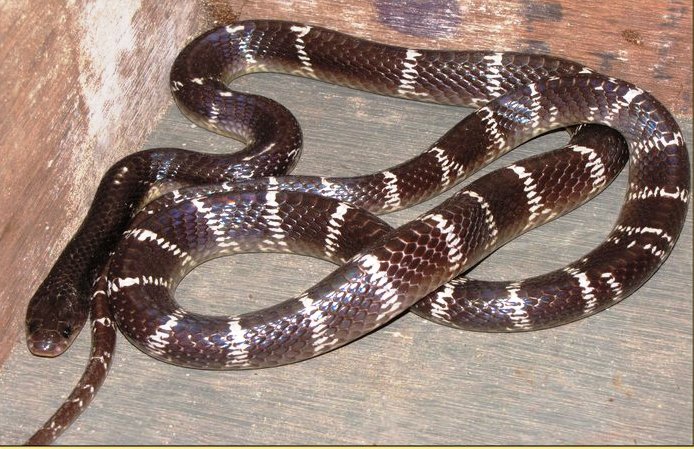
Common Krait

Common Krait

Bungarus caeruleus

Jayendra Chiplunkar, CC BY-SA 3.0, via Wikimedia Commons

Side by side

Graceful Small-headed Sea SnakeCommon Krait
Scientific nameMicrocephalophis gracilis (Shaw, 1802)Bungarus caeruleus (Schneider, 1801)
English nameGraceful Small-headed Sea SnakeCommon Krait
GroupReptilesReptiles
ClassReptilia ReptileReptilia Reptile
OrderSquamata SnakesSquamata Snakes
FamilyElapidae CobrasElapidae Cobras
GenusMicrocephalophisBungarus Deathpickers
Named in18021801
Red List categoryNot recordedLeast Concern
Countries on record12 countries8 countries
GBIF occurrence records110 records1,003 records

Rows where the two agree are shown in grey.

Where each is found

Both recorded in 6 countries

Only Graceful Small-headed Sea Snake (6)

Only Common Krait (2)

From Catalogue of Life checklists and GBIF occurrence records. A country missing from a list means no record is held, which is not proof of absence.

Checked facts

Graceful Small-headed Sea SnakeCommon Krait
Appearance
  • The common krait generally has a black or bluish-black body with narrow white crossbands. English Wikipedia
  • The common krait has a cylindrical body that tapers towards a short, rounded tail. English Wikipedia
  • The common krait has a flat head and relatively small eyes with rounded pupils. English Wikipedia
  • The common krait has highly polished scales arranged in 15–17 rows, with an enlarged hexagonal vertebral row. English Wikipedia
  • The common krait typically has approximately 40 thin white crossbars, which may be indistinct or absent near the front of the body. English Wikipedia
  • Young common kraits have conspicuous white crossbars across the anterior part of their bodies. English Wikipedia
  • The upper lips and belly of the common krait are white. English Wikipedia
  • Albino individuals of the common krait occur but are extremely rare. English Wikipedia
Size
  • The average body length of the common krait is approximately 0.9 m. English Wikipedia
  • The common krait can reach a maximum recorded length of 1.75 m. English Wikipedia
  • Male common kraits are longer than females and have proportionately longer tails. English Wikipedia
Habitat
  • The species occurs along the coasts of the Indian Ocean and western Pacific. English Wikipedia
  • The common krait inhabits scrub jungles, grasslands, agricultural fields, semi-desert environments and rocky terrain. English Wikipedia
  • The common krait occurs in suburban gardens and human-modified landscapes such as plantations and cultivated lands. English Wikipedia
  • The common krait takes refuge in termite mounds, rat burrows and locations beneath debris. English Wikipedia
  • The common krait is particularly associated with habitats near streams, canals and ponds. English Wikipedia
  • During the monsoon season, the common krait may enter houses in search of shelter or prey. English Wikipedia
DietNo checked fact yet
  • The common krait feeds primarily on other snakes, including venomous kraits and vipers. English Wikipedia
  • The common krait also consumes small rodents, lizards, birds and frogs. English Wikipedia
Behaviour
  • The common krait is nocturnal and is most active during the night. English Wikipedia
  • During daylight hours, the common krait remains inactive and hides in concealed locations. English Wikipedia
  • The common krait generally avoids confrontation and is non-aggressive. English Wikipedia
  • When threatened, the common krait may coil tightly with its head tucked underneath. English Wikipedia
  • The common krait rarely bites unless provoked. English Wikipedia
  • Common krait bites have been frequently recorded among people sleeping on the ground. English Wikipedia
  • Common krait bites investigated in Anuradhapura occurred at night while victims were asleep on the floor. pmc.ncbi.nlm.nih.gov
ReproductionNo checked fact yet
Distribution
  • Its documented distribution includes Pakistan, India, Sri Lanka, Bangladesh, Myanmar, Thailand and Indonesia. English Wikipedia
  • Its western Pacific distribution includes Malaysia, Singapore, Cambodia, Vietnam, the Philippines, southern China, Hong Kong and Taiwan. English Wikipedia
  • The species is also recorded in Queensland, Australia, and Papua New Guinea. English Wikipedia
  • The common krait occurs in India, Pakistan, Bangladesh, Sri Lanka and Nepal. English Wikipedia
  • The reported western extent of the common krait's range includes Afghanistan and potentially parts of Iran. English Wikipedia
ConservationNo checked fact yet
  • The common krait is reported to have a stable population despite localized habitat fragmentation and persecution. English Wikipedia
OtherNo checked fact yet
  • The common krait is highly venomous. English Wikipedia
  • The common krait's venom is predominantly neurotoxic. English Wikipedia
  • Phospholipases A2 account for approximately 64.5% of the common krait's venom proteome. English Wikipedia
  • The common krait is identified as the deadliest snake commonly found in Sri Lanka's dry zone. pmc.ncbi.nlm.nih.gov
  • In a prospective Anuradhapura study, 210 farmers bitten by common kraits were investigated over three years. pmc.ncbi.nlm.nih.gov
  • In the Anuradhapura study, 16 patients, representing 7.6% of the investigated cases, died. pmc.ncbi.nlm.nih.gov

In brief

Graceful Small-headed Sea Snake

Microcephalophis gracilis has a small head, a long and slender anterior body, and juxtaposed scales on the thickest part of its body. Full profile

Common Krait

The Common Krait (Bungarus caeruleus) is a highly venomous snake in the family Elapidae, order Squamata and class Reptilia. It occurs in India, Pakistan, Bangladesh, Sri Lanka and Nepal, with a reported western extent including Afghanistan and potentially parts of Iran. It is predominantly nocturnal and feeds primarily on other snakes, including venomous kraits and vipers. Full profile

Compare something else

Page built on 28 November 2026 from the data on the two species pages, where every source is listed.

Cite this page

ScientificNames.org. (2026). Graceful Small-headed Sea Snake vs Common Krait. Retrieved November 28, 2026, from https://scientificnames.org/compare/graceful-small-headed-sea-snake-vs-common-krait