Species · Reptiles
Graceful Small-headed Sea Snake Microcephalophis gracilis
The scientific name of the Graceful Small-headed Sea Snake is Microcephalophis gracilis. It is a species of reptile in the family Elapidae (cobras), order Squamata. The name dates from 1802.
- Scientific name
- Microcephalophis gracilis (Shaw, 1802)
- Common name
- Graceful Small-headed Sea Snake
- Genus
- Microcephalophis
- Family
- Elapidae (Cobras)
- Order
- Squamata
- Class
- Reptilia
- Recorded in
- 12 countries
- Name status
- accepted in the Catalogue of Life
Overview
Microcephalophis gracilis has a small head, a long and slender anterior body, and juxtaposed scales on the thickest part of its body.
Written 26 November 2026 from the sources listed below. Each statement was checked against the passage it cites; statements that could not be supported were removed.
Habitat
The species occurs along the coasts of the Indian Ocean and western Pacific.[1]
Its documented distribution includes Pakistan, India, Sri Lanka, Bangladesh, Myanmar, Thailand and Indonesia. Its western Pacific distribution includes Malaysia, Singapore, Cambodia, Vietnam, the Philippines, southern China, Hong Kong and Taiwan. It is also recorded in Queensland, Australia, and Papua New Guinea.[2][3][4]
Appearance
The species has a small head and a long, slender body in its anterior region. The scales on the thickest part of the body are juxtaposed.[5][6]
It has 5–6 maxillary teeth behind its fangs. The prefrontal scale contacts the third upper labial scale.[7][8]
There are 17–21 scale rows around the neck and 30–36 around the thickest part of the body. The number of scale rows increases by 18–24 between the neck and midbody.[9][10][11]
The ventral scales are divided by a longitudinal fissure.[12]
Male specimens have a reported total length of 950 mm and a reported tail length of 80 mm.[13][14]
Behaviour
The species' venom can be dangerous and potentially fatal to humans. Its bites typically do not cause pain, and symptoms of envenomation generally begin within 30 minutes of a bite.[15][16][17]
Envenomation can cause muscle paralysis. Bite victims may also experience headache, thirst and sweating.[18][19]
Classification of the Graceful Small-headed Sea Snake
| Kingdom | Animalia |
|---|---|
| Phylum | Chordata |
| Subphylum | Vertebrata |
| Infraphylum | Gnathostomata |
| Parvphylum | Osteichthyes |
| Megaclass | Tetrapoda |
| Class | Reptilia (Reptile) |
| Order | Squamata (Snakes) |
| Suborder | Serpentes (Snakes) |
| Infraorder | Alethinophidia |
| Family | Elapidae (Cobras) |
| Subfamily | Hydrophiinae |
| Genus | Microcephalophis |
| Species | Microcephalophis gracilis (Shaw, 1802) |
Where the Graceful Small-headed Sea Snake is found
Checklists and occurrence records place Microcephalophis gracilis in 12 countries across Asia. GBIF holds 110 georeferenced records of it.
Countries
- Bangladesh 1
- China 4
- India 28
- Indonesia 7
- Iran 21
- Malaysia 13
- Myanmar
- Pakistan 4
- Philippines 2
- Sri Lanka 10
- Thailand 17
- Vietnam 3
Regions and cities with the most records
- Dambulla, Sri Lanka 3
- Kertih, Malaysia 3
- Paka, Malaysia 3
- Point Pedro, Sri Lanka 3
- Valvedditturai, Sri Lanka 3
Range as the checklists state it
Indian Ocean: Pakistan, India (Gujarat etc.), Sri Lanka, Bangladesh, Myanmar (= Burma), Thailand, Philippines,
A number beside a place is its count of GBIF occurrence records. A place without a number comes from a checklist alone. Records show where a species has been observed or collected, which can include escapes and vagrants.
Common names
English
- Graceful Small-headed Sea Snake
- Graceful Small-headed
- Narrow-headed Sea Snake
- Common Small-headed Sea Snake
- Slender Seasnake
Names in 7 other languages
- Arabic
- الافعى البحرية صغيرة الرأس, ثعبان البحر الرشيق, ثعبان البحر صغير الرأس الرشيق, ثعبان البحر صغير الرأس الشائع
- Chinese
- 小头海蛇, 小頭海蛇
- French
- Hydrophide mince
- Italian
- Idrofide gracile, Idrofide testa piccola, Serpente di mare gracile, Serpente di mare testa piccola
- Russian
- Стройный микроцефал
- Spanish
- serpiente marina de cabeza pequeña
- Thai
- งูคออ่อนหัวเข็ม
Synonyms
10 other scientific names have been used for this species and are now treated as synonyms of Microcephalophis gracilis.
- Disteira gracilis (Shaw, 1802)
- Hydophis guntheri Murray, 1884
- Hydrophis gracilis (Shaw, 1802)
- Hydrophis gracilis gracilis
- Hydrophis gracilis Leviton, Brown, and Siler, 2014
- Hydrophis leprogaster Duméril & Bibron ex Fischer, 1856
- Hydrophis rostralis Smith, 1917
- Hydrus gracilis Shaw, 1802
- Hydrus kadellnagam Boie, 1827
- Thalassophis microcephala Schmidt, 1852
Related species
- Cantor’s Narrow –headed Sea SnakeMicrocephalophis cantoris
-
 King CobraOphiophagus hannah
-
 Inland TaipanOxyuranus microlepidotus
-
 Black MambaDendroaspis polylepis
-
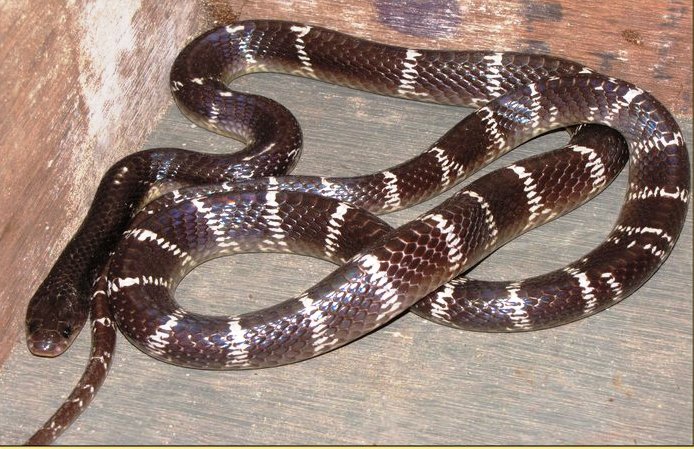 Common KraitBungarus caeruleus
-
 Eastern Brown SnakePseudonaja textilis
-
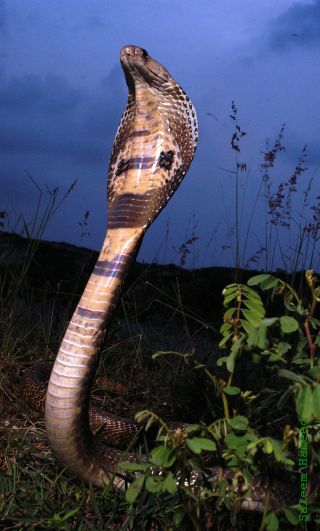 Indian CobraNaja naja
-
 Tiger SnakeNotechis scutatus
Compare
Questions and answers
What is the scientific name of the Graceful Small-headed Sea Snake?
The scientific name of the Graceful Small-headed Sea Snake is Microcephalophis gracilis. Written with its author, the full name is Microcephalophis gracilis (Shaw, 1802).
Which family does the Graceful Small-headed Sea Snake belong to?
Microcephalophis gracilis belongs to the family Elapidae, in the order Squamata and the class Reptilia.
Where is the Graceful Small-headed Sea Snake found?
Checklists and occurrence records place Microcephalophis gracilis in 12 countries, including India, Iran, Thailand, Malaysia, Sri Lanka and Indonesia.
What other names does the Graceful Small-headed Sea Snake have?
Microcephalophis gracilis is also known in English as Graceful Small-headed, Narrow-headed Sea Snake, Common Small-headed Sea Snake and Slender Seasnake.
Sources
Passages the profile rests on
- The species occurs along the coasts of the Indian Ocean and western Pacific. Source passage: “found on the coasts of the Indian Ocean and West Pacific” — English Wikipedia
- Its documented distribution includes Pakistan, India, Sri Lanka, Bangladesh, Myanmar, Thailand and Indonesia. Source passage: “Pakistan, India, Sri Lanka, Bangladesh, Myanmar, Thailand, and Indonesia” — English Wikipedia
- Its western Pacific distribution includes Malaysia, Singapore, Cambodia, Vietnam, the Philippines, southern China, Hong Kong and Taiwan. Source passage: “Malaysia, Singapore, Cambodia, Vietnam, the Philippines, southern China, Hong Kong, and Taiwan” — English Wikipedia
- The species is also recorded in Queensland, Australia, and Papua New Guinea. Source passage: “as well as in Australia (Queensland) and Papua New Guinea.” — English Wikipedia
- The species has a small head and a long, slender body in its anterior region. Source passage: “Head small, body long and slender anteriorly” — English Wikipedia
- The scales on the thickest part of the body are juxtaposed. Source passage: “scales on thickest part of body juxtaposed” — English Wikipedia
- The species has 5–6 maxillary teeth behind its fangs. Source passage: “5–6 maxillary teeth behind fangs” — English Wikipedia
- The prefrontal scale contacts the third upper labial scale. Source passage: “prefrontal in contact with third upper labial” — English Wikipedia
- The species has 17–21 scale rows around its neck. Source passage: “17–21 scale rows around neck” — English Wikipedia
- The species has 30–36 scale rows around the thickest part of its body. Source passage: “30–36 around thickest part of body” — English Wikipedia
- The number of scale rows increases by 18–24 between the neck and midbody. Source passage: “increase from neck to midbody 18–24” — English Wikipedia
- The ventral scales are divided by a longitudinal fissure. Source passage: “ventrals divided by a longitudinal fissure” — English Wikipedia
- Male specimens have a reported total length of 950 mm. Source passage: “Total length males 950 mm” — English Wikipedia
- Male specimens have a reported tail length of 80 mm. Source passage: “tail length males 80 mm” — English Wikipedia
- The species' venom can be dangerous and potentially fatal to humans. Source passage: “The venom of this species is dangerous and can be fatal.” — English Wikipedia
- Symptoms of envenomation generally begin within 30 minutes of a bite. Source passage: “The symptoms generally began to appear within 30 minutes after being bitten.” — English Wikipedia
- Its bites typically do not cause pain. Source passage: “The bite typically does not cause any pain.” — English Wikipedia
- Envenomation can cause muscle paralysis. Source passage: “Muscles get affected once the venom starts to act causing paralysis” — English Wikipedia
- Bite victims may experience headache, thirst and sweating. Source passage: “Victim may also experience headache, thirst and sweating after the bite.” — English Wikipedia
Data
- Catalogue of Life, 2026-10-16 XR cc by
- Global Biodiversity Information Facility CC BY 4.0
- Wikidata CC0
- GeoNames CC BY 4.0
- Within the Catalogue of Life, this name comes from The Reptile Database cc by
References
- Russell, P. (1801). A continuation of an account of Indian serpents: containing descriptions and figures from specimens and drawings, transmitted from various parts of India to the hon. Court of Directors of the East Indian Company. Volume 2. London, W. Bulmer and Co for G. And W. Nicol., Pp. I–V + 1–12, Pls. 1–10, [See Adler 2015 for Details].
- Shaw, G. (1802). General Zoology, or Systematic Natural History. Vol.3, part 2. G. Kearsley, Thomas Davison, London: 313-615.
- Fitzinger, L. (1826). Neue Classification der Reptilien nach ihren natürlichen Verwandtschaften nebst einer Verwandschafts-Tafel und einem Verzeichnisse der Reptilien-Sammlung des K. K. Zoologischen Museums zu Wien. J. G. Heubner, Wien, 66 Pp.
- Boie, F. (1827). Bemerkungen über Merrem’s Versuch eines Systems der Amphibien, 1. Lieferung: Ophidier. Isis von Oken 20: 508-566.
- Lesson, R. P. (1831). Reptiles. pp. 291-336, pls. 1-7. In: I.G.S. Bélanger (ed.), Voyage aux Indes-Orientales, par le Nord de l’Europe, les Provinces du Caucase, la Géorgie, l’Armenie, et la Perse, . . . pendant les années 1825-29. Zoologie. A. Bertrand, Paris. Xxxix + 535 P. [Published in Sections from 1831-1834].
- Schmidt, & Philipp. (1852). Beiträge zur ferneren Kenntniss der Meerschlangen. Abh. Nat. Ver. Hamburg 2 (2): 69-86.
- Duméril, A. M. C., Bibron, G. & DUMÉRIL, A. H. A.,. (1854). Erpétologie générale ou histoire naturelle complète des reptiles. Tome septième. Deuxième partie, comprenant l’histoire des serpents venimeux. Paris, Librairie Encyclopédique de Roret: I-Xii + 781-1536.
- Fischer, J. G. (1856). Die Familie der Seeschlangen. Abhandl. Nat. Ver. Hamburg 3: 1-78.
- Günther, A. (1864). The Reptiles of British India. London (Taylor & Francis), Xxvii + 452 Pp.
- Anderson, J. (1872). On some Persian, Himalayan, and other Reptiles. Proc. Zool. Soc. London 1872: 371-404.
- Boulenger, G. A. (1896). Catalogue of the snakes in the British Museum, Vol. 3. London (Taylor & Francis), Xiv + 727 Pp.
- Smith, M. A. (1917). Preliminary diagnoses of four new sea snakes. J. Nat. Hist. Soc. Siam 2: 340.
- Wall, F. (1918). Notes on a Collection of Sea Snakes from Madras. J. Bombay Nat. Hist. Soc. 25: 599-607.
- Smith, M. A. (1920). On sea snakes from the coasts of the Malay peninsula, Siam and Cochin-China. J. Fed. Malay St. Mus. Singapore 10 (1): 1-63.
- Wall, & FRANK. (1921). Ophidia Taprobanica or the Snakes of Ceylon. Colombo Mus. (H. R. Cottle, Govt. Printer), Colombo. Xxii, 581 Pages.
- Volsøe, H. (1939). The sea-snakes of the Iranian Gulf and the Gulf of Oman. Danish Scientific Investigation in Iran 1: 9-45.
- Smith, M. A. (1943). The Fauna of British India, Ceylon and Burma, Including the Whole of the Indo-Chinese Sub-Region. Reptilia and Amphibia. 3 (Serpentes). Taylor and Francis, London. 583 Pp.
- Taylor, E. H. (1965). The serpents of Thailand and adjacent waters. Univ. Kansas Sci. Bull. 45 (9): 609-1096.
- Corkill, N. L. and Cochrane, J. A. (1966). The snakes of the Arabian Peninsula and Socotra. J. Bombay Nat. Hist. Soc. 62 (3): 475-506 (1965).
- Voris, H.K., Voris, H.H.,. (1983). Feeding strategies in marine snakes: an analysis of evolutionary, morphological, behavioural and ecological relationships. American Zoologist 23: 411–425.
- Dowling, H.G., & Jenner, J.V. (1988). Snakes of Burma: checklist of reported species and bibliography. Smithsonian Herp. Inf. Serv. (76): 19 Pp.
- Bauer, Aaron M.;Vindum, Jens V. (1990). A checklist and key to the herpetofauna of New Caledonia, with remarks on biogeography. Proc. Cal. Acad. Sci. 47 (2): 17-45.
- Leviton, A. E., Anderson, S. C., Adler, K., & Minton, S. A. (1992). Handbook to Middle East Amphibians and Reptiles. SSAR, Oxford, Ohio (Contr. To Herpetol. No. 8), 1-252.
- O’Shea,M. (1996). A Guide to the Snakes of Papua New Guinea. Independent Publishing, Port Moresby, Xii + 239 Pp.
- Stuebing, R. B., & INGER, R. F. (1999). A field guide to the snakes of Borneo. Natural History Publications (Borneo), Kota Kinabalu, 254 Pp. [Corrections in HR 31: 124].
This species in other databases
- Catalogue of Life C7PMG
- Wikidata Q61885198
- iNaturalist 1474128
- WoRMS urn:lsid:marinespecies.org:taxname:344091
Page built on 27 November 2026. See how the catalog is made and all sources and licences.
Cite this page
ScientificNames.org. (2026). Microcephalophis gracilis (Graceful Small-headed Sea Snake). Retrieved November 27, 2026, from https://scientificnames.org/species/microcephalophis-gracilis
“Microcephalophis gracilis (Graceful Small-headed Sea Snake).” ScientificNames.org, 2026, scientificnames.org/species/microcephalophis-gracilis. Accessed 27 Nov. 2026.
ScientificNames.org. “Microcephalophis gracilis (Graceful Small-headed Sea Snake).” Accessed November 27, 2026. https://scientificnames.org/species/microcephalophis-gracilis.
@misc{scientificnames_microcephalophis_gracilis_graceful_small_headed_sea_snake,
  author = {{ScientificNames.org}},
  title = {Microcephalophis gracilis (Graceful Small-headed Sea Snake)},
  year = {2026},
  url = {https://scientificnames.org/species/microcephalophis-gracilis},
  note = {Accessed 2026-11-27}
}