Comparison

Four-toed Salamander vs Texas Blind Salamander

Four-toed Salamander (Hemidactylium scutatum) and Texas Blind Salamander (Eurycea rathbuni) both belong to the subfamily Hemidactyliinae and part ways below it. Both are recorded in 1 country.

Four-toed Salamander

Four-toed Salamander

Hemidactylium scutatum

Brian Gratwicke, CC BY 4.0, via Wikimedia Commons

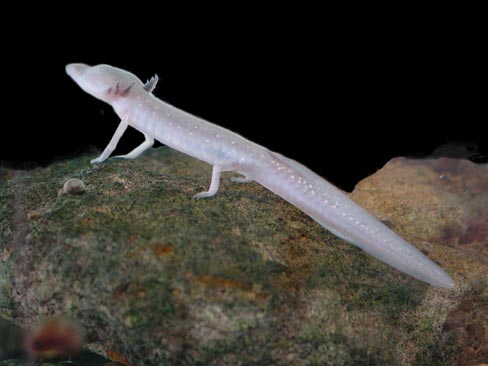
Texas Blind Salamander

Texas Blind Salamander

Eurycea rathbuni

Photograph courtesy of Joe N. Fries, U.S. Fish and Wildlife Service, Public domain, via Wikimedia Commons

Side by side

Four-toed SalamanderTexas Blind Salamander
Scientific nameHemidactylium scutatum (Temminck in Temminck & Schlegel, 1838)Eurycea rathbuni (Stejneger, 1896)
English nameFour-toed SalamanderTexas Blind Salamander
GroupAmphibiansAmphibians
ClassAmphibia AmphibiansAmphibia Amphibians
OrderCaudata SalamandersCaudata Salamanders
FamilyPlethodontidae Lungless SalamandersPlethodontidae Lungless Salamanders
GenusHemidactylium Four-toed SalamandersEurycea Brook Salamander
Named in18381896
Red List categoryLeast ConcernCritically Endangered
Countries on record2 countries1 country
GBIF occurrence records8,846 records388 records

Rows where the two agree are shown in grey.

Where each is found

Both recorded in 1 country

Only Four-toed Salamander (1)

From Catalogue of Life checklists and GBIF occurrence records. A country missing from a list means no record is held, which is not proof of absence.

Checked facts

Four-toed SalamanderTexas Blind Salamander
Appearance
  • Sexually active males have squared snouts and enlarged premaxillary teeth, whereas females have rounded snouts. animaldiversity.org
  • Female snout-to-vent length is approximately 15 percent greater than male snout-to-vent length. animaldiversity.org
  • Newly hatched individuals measure approximately 11 to 15 mm in total body length. animaldiversity.org
  • The aquatic larvae are yellowish brown and have a dorsal fin extending from the tail toward the back of the head. animaldiversity.org
Size
Habitat
  • The species favors mature, moist forests with dense canopy cover, abundant downed woody debris, and nearby breeding wetlands. animaldiversity.org
  • Suitable breeding habitats include vernal pools, ponds, bogs, shallow marshes, and other fishless water bodies. animaldiversity.org
  • Females commonly nest in moss mats overhanging pools of water. animaldiversity.org
  • The species overwinters underground in old burrows or cavities formed by decaying roots. English Wikipedia
  • The species inhabits underground streams and deep pools in caves. English Wikipedia
  • Its underground pools are generally cool, measuring approximately 21–22 °C. English Wikipedia
  • It inhabits underground water-filled caves in the Edwards Aquifer. tpwd.texas.gov
  • The species is usually restricted to caves, although it has also been found in wells. animaldiversity.org
Diet
  • Adults feed primarily on small invertebrates, including spiders, worms, ticks, springtails, ground beetles, and other insects. English Wikipedia
  • Larvae primarily consume zooplankton and other aquatic invertebrates. biokids.umich.edu
  • The reported adult diet includes beetles, flies, ants, bristletails, spiders, mites, worms, and snails. biokids.umich.edu
  • Its diet includes blind shrimp, snails, and amphipods. English Wikipedia
  • Tiny snails, shrimp, and other aquatic invertebrates form its diet. tpwd.texas.gov
  • Its diet varies according to the food material flowing into its cave habitat. English Wikipedia
Behaviour
  • When threatened, individuals may curl up, conceal their heads beneath their tails, and remain motionless. biokids.umich.edu
  • The species can voluntarily detach its tail, which continues moving and may distract predators. biokids.umich.edu
  • When threatened, individuals may raise their heads and sway their tails while secreting a mildly distasteful skin toxin. animaldiversity.org
  • The species hunts by moving its head from side to side while searching the bottom for food. tpwd.texas.gov
  • It detects prey by sensing water-pressure waves in underground water. tpwd.texas.gov
  • The species is neotenic and retains external gills throughout its life. animaldiversity.org
Reproduction
  • Mating occurs during late summer and autumn and may continue into early winter in some locations. animaldiversity.org
  • During courtship, males rub their noses against females' noses before circling them with their tails bent at a sharp angle. animaldiversity.org
  • A female generally lays between 15 and 80 eggs per clutch. animaldiversity.org
  • Individual eggs measure approximately 2.5 to 3.0 mm in diameter. animaldiversity.org
  • Females frequently share nesting sites, and individual nests have contained as many as 1,110 eggs. animaldiversity.org
  • Egg incubation lasts approximately 38 to 62 days, depending on geographic region and local conditions. animaldiversity.org
  • The aquatic larval stage lasts approximately 23 to 39 days. biokids.umich.edu
  • Individuals generally reach sexual maturity between two and three years of age. animaldiversity.org
Distribution
  • The species occurs from Nova Scotia to northern Minnesota and extends south to the Gulf of Mexico. animaldiversity.org
  • Its distribution is more continuous along the Appalachian Mountain Range, throughout New England, and west to northeastern Minnesota. animaldiversity.org
  • Southern and Midwestern populations occur in small, isolated groups. animaldiversity.org
  • The species occurs throughout Michigan except in the eastern thumb region. biokids.umich.edu
No checked fact yet
Conservation
  • The species is classified as Least Concern by the International Union for Conservation of Nature. English Wikipedia
  • The species is classified as threatened in Illinois. English Wikipedia
  • The species is classified as being of special concern in Wisconsin, Ohio, and Missouri. English Wikipedia
  • The species was listed as endangered on March 11, 1967. English Wikipedia
  • The species is listed as endangered under the U.S. Endangered Species Act. animaldiversity.org
  • Groundwater pumping for commercial or domestic purposes threatens the species by increasing its vulnerability to predators and potentially causing extinction. English Wikipedia
  • Stormwater runoff and chemical spills are sources of pollution affecting the Edwards Aquifer. English Wikipedia
  • Urban growth, water overuse, and pollution threaten the species' survival. tpwd.texas.gov
  • The species depends on a continuous supply of clean, cool water from the Edwards Aquifer. tpwd.texas.gov
UsesNo checked fact yet
Similar speciesNo checked fact yet
  • The Texas blind salamander resembles the European olm. English Wikipedia
  • Unlike the olm, it has four digits on its front limbs and five on its back limbs. English Wikipedia
Other
  • Hemidactylium scutatum belongs to the Plethodontidae family. fs.usda.gov
No checked fact yet

In brief

Four-toed Salamander

The Four-toed Salamander is an amphibian in the Plethodontidae family, Caudata order, and Amphibia class. It occurs from Nova Scotia to northern Minnesota and extends south to the Gulf of Mexico. Full profile

Texas Blind Salamander

Eurycea rathbuni inhabits underground water-filled caves in the Edwards Aquifer. It has vestigial eyes covered by skin, red external gills, and a white body with little skin pigment. Full profile

Compare something else

Page built on 29 November 2026 from the data on the two species pages, where every source is listed.

Cite this page

ScientificNames.org. (2026). Four-toed Salamander vs Texas Blind Salamander. Retrieved November 29, 2026, from https://scientificnames.org/compare/four-toed-salamander-vs-texas-blind-salamander