Species · Amphibians
Four-toed Salamander Hemidactylium scutatum
The scientific name of the Four-toed Salamander is Hemidactylium scutatum. It is a species of amphibian in the family Plethodontidae (lungless salamanders), order Caudata. The name dates from 1838.
- Scientific name
- Hemidactylium scutatum (Temminck in Temminck & Schlegel, 1838)
- Common name
- Four-toed Salamander
- Genus
- Hemidactylium
- Family
- Plethodontidae (Lungless Salamanders)
- Order
- Caudata
- Class
- Amphibia
- Red List category
- LC Least Concern
- Recorded in
- 2 countries
- Name status
- accepted in the Catalogue of Life

Overview
The Four-toed Salamander is an amphibian in the Plethodontidae family, Caudata order, and Amphibia class. It occurs from Nova Scotia to northern Minnesota and extends south to the Gulf of Mexico.
Written 26 November 2026 from the sources listed below. Each statement was checked against the passage it cites; statements that could not be supported were removed.
Appearance
Adults generally measure between 5 and 10.2 cm in total body length. Newly hatched individuals measure approximately 11 to 15 mm.[1][2]
Sexually active males have squared snouts and enlarged premaxillary teeth, whereas females have rounded snouts. Female snout-to-vent length is approximately 15 percent greater than male snout-to-vent length.[3][4]
Aquatic larvae are yellowish brown and have a dorsal fin extending from the tail toward the back of the head.[5]
Habitat
Suitable breeding habitats include vernal pools, ponds, bogs, shallow marshes, and other fishless water bodies. Females commonly nest in moss mats overhanging pools of water.[6][7]
The species overwinters underground in old burrows or cavities formed by decaying roots.[8]
Diet
Adults feed primarily on small invertebrates, including spiders, worms, ticks, springtails, ground beetles, and other insects. The reported adult diet also includes flies, ants, bristletails, mites, and snails.[9][10]
Larvae primarily consume zooplankton and other aquatic invertebrates.[11]
Behaviour
When threatened, individuals may curl up, conceal their heads beneath their tails, and remain motionless. They may also raise their heads and sway their tails while secreting a mildly distasteful skin toxin.[12][13]
The species can voluntarily detach its tail, which continues moving and may distract predators.[14]
Reproduction and life cycle
Mating occurs during late summer and autumn and may continue into early winter in some locations. During courtship, males rub their noses against females' noses before circling them with their tails bent at a sharp angle.[15][16]
A female generally lays between 15 and 80 eggs per clutch. Individual eggs measure approximately 2.5 to 3.0 mm in diameter.[17][18]
Females frequently share nesting sites, and individual nests have contained as many as 1,110 eggs. Egg incubation lasts approximately 38 to 62 days, depending on geographic region and local conditions.[19][20]
The aquatic larval stage lasts approximately 23 to 39 days. Individuals generally reach sexual maturity between two and three years of age.[21][22]
Conservation
The Four-toed Salamander is classified as Least Concern by the International Union for Conservation of Nature.[23]
The species is classified as threatened in Illinois and as being of special concern in Wisconsin, Ohio, and Missouri.[24][25]
Classification of the Four-toed Salamander
| Kingdom | Animalia |
|---|---|
| Phylum | Chordata |
| Subphylum | Vertebrata |
| Infraphylum | Gnathostomata |
| Parvphylum | Osteichthyes |
| Megaclass | Tetrapoda |
| Class | Amphibia (Amphibians) |
| Order | Caudata (Salamanders) |
| Family | Plethodontidae (Lungless Salamanders) |
| Subfamily | Hemidactyliinae |
| Genus | Hemidactylium (Four-toed Salamanders) |
| Species | Hemidactylium scutatum (Temminck in Temminck & Schlegel, 1838) |
Where the Four-toed Salamander is found
Checklists and occurrence records place Hemidactylium scutatum in 2 countries across North America. GBIF holds 8,846 georeferenced records of it.
Countries
Regions and cities with the most records
- New York, United States 623
- Virginia, United States 585
- Ontario, Canada 576
- Pennsylvania, United States 497
- Michigan, United States 472
- Massachusetts, United States 397
- Maine, United States 333
- Maryland, United States 229
- Ohio, United States 226
- Connecticut, United States 214
- Illinois, United States 196
- Bangor, United States 191
- West Virginia, United States 189
- Vermont, United States 185
- New Jersey, United States 182
- Quebec, Canada 150
- Cambridge, Canada 146
- New Hampshire, United States 134
- Tennessee, United States 124
- North Carolina, United States 121
- Kitchener, Canada 115
- East Hampton, United States 112
- Hampton, United States 112
- Newport News, United States 112
- Brant, Canada 110
- Alabama, United States 108
- Williamsburg, United States 105
- Wisconsin, United States 98
- Nova Scotia, Canada 91
- Danville, United States 88
- New Brunswick, Canada 82
- Dieppe, Canada 80
- Lutes Mountain, Canada 80
- Moncton, Canada 80
- Riverview, Canada 80
- Kentucky, United States 70
Range as the checklists state it
North America
A number beside a place is its count of GBIF occurrence records. A place without a number comes from a checklist alone. Records show where a species has been observed or collected, which can include escapes and vagrants.
Common names
English
- Four-toed Salamander
- 4-Toed Salamander
Names in 8 other languages
- Dutch
- Vierteensalamander
- French
- Desmodactyle, salamandre à quatre doigts, salamandre à quatre orteils
- German
- Vierzehensalamander
- Polish
- Przewężnik czteropalcy
- Portuguese
- Salamandra-de-quatro-dedos
- Russian
- Четырёхпалая саламандра
- Spanish
- Salamandra de Cuatro Dedos
- oji
- Neewi kinakwaisideh Dawgomeg
Synonyms
9 other scientific names have been used for this species and are now treated as synonyms of Hemidactylium scutatum.
- Ambystoma frontale (Gray, 1831)
- Batrachoseps scutatus (Temminck in Temminck & Schlegel, 1838)
- Cotobotes scutatum (Temminck in Temminck & Schlegel, 1838)
- Desmodactylus melanostictus (Gibbes, 1845)
- Desmodactylus scutatus (Temminck in Temminck & Schlegel, 1838)
- Salamandra frontalis Gray, 1831
- Salamandra melanosticta Gibbes, 1845
- Salamandra scutata Temminck in Temminck & Schlegel, 1838
- Salamandra sinciputalbida Green, 1818
Related species
-
 Red-backed SalamanderPlethodon cinereus
-
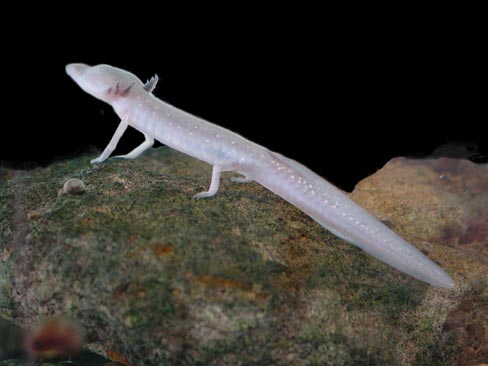 Texas Blind SalamanderEurycea rathbuni
-
 Red SalamanderPseudotriton ruber
- Blanco Blind SalamanderEurycea robusta
-
 Northern Two-lined SalamanderEurycea bislineata
-
 EnsatinaEnsatina eschscholtzii
-
 Northern Slimy SalamanderPlethodon glutinosus
-
 Arboreal SalamanderAneides lugubris
Compare
Questions and answers
What is the scientific name of the Four-toed Salamander?
The scientific name of the Four-toed Salamander is Hemidactylium scutatum. Written with its author, the full name is Hemidactylium scutatum (Temminck in Temminck & Schlegel, 1838).
Which family does the Four-toed Salamander belong to?
Hemidactylium scutatum belongs to the family Plethodontidae, in the order Caudata and the class Amphibia.
Where is the Four-toed Salamander found?
Checklists and occurrence records place Hemidactylium scutatum in 2 countries: United States and Canada.
What is the conservation status of the Four-toed Salamander?
The IUCN Red List category recorded for Hemidactylium scutatum is Least Concern (LC).
What other names does the Four-toed Salamander have?
Hemidactylium scutatum is also known in English as 4-Toed Salamander.
What two names make up the scientific name of a salamander?
The scientific name of this species is Hemidactylium scutatum.[26]
What does a four-toed salamander eat?
Adults primarily eat small invertebrates, including spiders, worms, ticks, springtails, ground beetles, and other insects. Larvae primarily consume zooplankton and other aquatic invertebrates.[9][11]
What kind of habitat do salamanders need?
The Four-toed Salamander favors mature, moist forests with dense canopy cover, abundant downed woody debris, and nearby breeding wetlands. Suitable breeding habitats include vernal pools, ponds, bogs, shallow marshes, and other fishless water bodies.[27][6]
What is the diet of a salamander?
Adult Four-toed Salamanders eat invertebrates such as beetles, flies, ants, spiders, mites, worms, and snails. Their larvae primarily consume zooplankton and other aquatic invertebrates.[11][10]
Where do four toed salamanders live?
The species occurs from Nova Scotia to northern Minnesota and extends south to the Gulf of Mexico. Its distribution is more continuous along the Appalachian Mountain Range, throughout New England, and west to northeastern Minnesota, while southern and Midwestern populations occur in small, isolated groups. It occurs throughout Michigan except in the eastern thumb region.[28][29][30][31]
Sources
Passages the profile rests on
- Adults generally measure between 5 and 10.2 cm in total body length. Source passage: “The four-toed salamander is a small plethodontid (lungless) salamander only 5 to 10.2 cm (2 to 4 in) in length.” — animaldiversity.org
- Newly hatched individuals measure approximately 11 to 15 mm in total body length. Source passage: “Hatchlings are only 11 to 15 mm total body length.” — animaldiversity.org
- Sexually active males have squared snouts and enlarged premaxillary teeth, whereas females have rounded snouts. Source passage: “Female four-toed salamanders have rounded snouts, while sexually active males have more squared (truncated) snouts. Enlarged premaxillary teeth are also evident in sexually active males” — animaldiversity.org
- Female snout-to-vent length is approximately 15 percent greater than male snout-to-vent length. Source passage: “The snout-to-vent length (SVL) is approximately 15 percent longer in females than males” — animaldiversity.org
- The aquatic larvae are yellowish brown and have a dorsal fin extending from the tail toward the back of the head. Source passage: “The larvae are aquatic and a yellowish brown color. A dorsal fin runs from the length of the tail to near the back of the head.” — animaldiversity.org
- Suitable breeding habitats include vernal pools, ponds, bogs, shallow marshes, and other fishless water bodies. Source passage: “vernal pools, ponds, bogs, shallow marshes, or other fishless bodies of water for nesting and larval success.” — animaldiversity.org
- Females commonly nest in moss mats overhanging pools of water. Source passage: “females are most often found during the breeding season nesting in moss mats which overhang pools of water.” — animaldiversity.org
- The species overwinters underground in old burrows or cavities formed by decaying roots. Source passage: “It overwinters in terrestrial habitat, using old burrows or cavities created by rotting roots, below the freezing depth.” — English Wikipedia
- Adults feed primarily on small invertebrates, including spiders, worms, ticks, springtails, ground beetles, and other insects. Source passage: “Four-toed salamanders feed mostly on small invertebrates, such as spiders, worms, ticks, springtails (collembola), ground beetles (Carabidae), and other insects.” — English Wikipedia
- The reported adult diet includes beetles, flies, ants, bristletails, spiders, mites, worms, and snails. Source passage: “Few studies have been conducted on the feeding habits of the four-toed salamander, but it is believed their diet consists mainly of insects and their larvae (beetles, flies, ants, bristletails), spiders, mites, worms, and snails” — biokids.umich.edu
- Larvae primarily consume zooplankton and other aquatic invertebrates. Source passage: “During this larval stage they feed primarily on tiny zooplankton and other invertebrates.” — biokids.umich.edu
- When threatened, individuals may curl up, conceal their heads beneath their tails, and remain motionless. Source passage: “If bothered by humans or predators, a four-toed salamander will curl up, hide its head under its tail and become still.” — biokids.umich.edu
- When threatened, individuals may raise their heads and sway their tails while secreting a mildly distasteful skin toxin. Source passage: “At times they may aggressively posture themselves by lifting their head high and swaying the tail while secreting a mild but distasteful skin toxin.” — animaldiversity.org
- The species can voluntarily detach its tail, which continues moving and may distract predators. Source passage: “They can also detach their tails, which continue to wiggle, possibly distracting predators.” — biokids.umich.edu
- Mating occurs during late summer and autumn and may continue into early winter in some locations. Source passage: “Mating occurs in the late summer, fall, and possibly into early winter in some places.” — animaldiversity.org
- During courtship, males rub their noses against females' noses before circling them with their tails bent at a sharp angle. Source passage: “The male courts the female first by rubbing his nose on the female's nose, then he will circle around her with his tail bend at a sharp right angle.” — animaldiversity.org
- A female generally lays between 15 and 80 eggs per clutch. Source passage: “Fifteen to 80 eggs, each between 2.5 and 3.0 mm in diameter, are laid.” — animaldiversity.org
- Individual eggs measure approximately 2.5 to 3.0 mm in diameter. Source passage: “Fifteen to 80 eggs, each between 2.5 and 3.0 mm in diameter, are laid.” — animaldiversity.org
- Females frequently share nesting sites, and individual nests have contained as many as 1,110 eggs. Source passage: “Females often share nests and as many as 1110 eggs have been found in a single nest” — animaldiversity.org
- Egg incubation lasts approximately 38 to 62 days, depending on geographic region and local conditions. Source passage: “The incubation period varies from 38 to 62 days depending upon the region and local site conditions.” — animaldiversity.org
- The aquatic larval stage lasts approximately 23 to 39 days. Source passage: “Their larval period lasts between 23-39 days, which is brief compared to other amphibians.” — biokids.umich.edu
- Individuals generally reach sexual maturity between two and three years of age. Source passage: “It takes between two and three years for H. scutatum to reach sexual maturity.” — animaldiversity.org
- The species is classified as Least Concern by the International Union for Conservation of Nature. Source passage: “It is also listed as a species of least concern by the International Union for Conversation of Nature (IUCN)” — English Wikipedia
- The species is classified as threatened in Illinois. Source passage: “Its status in the United States ranges from threatened (Illinois)” — English Wikipedia
- The species is classified as being of special concern in Wisconsin, Ohio, and Missouri. Source passage: “special concern (Wisconsin, Ohio, and Missouri).” — English Wikipedia
- Hemidactylium scutatum belongs to the Plethodontidae family. Source passage: “Hemidactylium scutatum (Schlegel) is the scientific name of the four-toed salamander, a member of the Plethodontidae family” — fs.usda.gov
- The species favors mature, moist forests with dense canopy cover, abundant downed woody debris, and nearby breeding wetlands. Source passage: “They prefer mature, mesic forests with dense canopy cover to preserve body moisture, an abundance of downed woody debris for cover and foraging opportunities” — animaldiversity.org
- The species occurs from Nova Scotia to northern Minnesota and extends south to the Gulf of Mexico. Source passage: “Hemidactylium scutatum , the four-toed salamander, occurs from Nova Scotia to northern Minnesota, and south to the Gulf of Mexico.” — animaldiversity.org
- Its distribution is more continuous along the Appalachian Mountain Range, throughout New England, and west to northeastern Minnesota. Source passage: “Its range is more continuous in states along the Appalachian Mountain Range, New England and west to northeastern Minnesota.” — animaldiversity.org
- Southern and Midwestern populations occur in small, isolated groups. Source passage: “It has a discontinuous range and occurs only in small isolated populations in the southern and midwestern states.” — animaldiversity.org
- The species occurs throughout Michigan except in the eastern thumb region. Source passage: “It can be found all over Michigan except in the eastern thumb area.” — biokids.umich.edu
Data
- Catalogue of Life, 2026-10-16 XR cc by
- Global Biodiversity Information Facility CC BY 4.0
- Wikidata CC0
- GeoNames CC BY 4.0
- Wikimedia Commons per image; credit shown with each image
- Within the Catalogue of Life, this name comes from The Integrated Taxonomic Information System cc0
References
- Temminck and Schlegel, 1838 where the name was published
- Crother, Brian I., Jeff Boundy, Jonathan A. Campbell, Kevin de Quieroz, Darrel Frost, et al. (2003). Scientific and Standard English Names of Amphibians and Reptiles of North America North of Mexico: Update. Herpetological Review, Vol. 34, No. 3.
- Crother, Brian I., Jeff Boundy, Frank T. Burbrink, et al. / Moriarty, John J., ed. (2008). Scientific and Standard English Names of Amphibians and Reptiles of North America North of Mexico, With Comments Regarding Confidence in Our Understanding, Sixth Ed. Herpetological Circular No. 37.
- Crother, Brian I., Ronald M. Bonett, Jeff Boundy, Frank T. Burbrink, et al. / Moriarty, John J., ed. (2017). Scientific and Standard English Names of Amphibians and Reptiles of North America North of Mexico, with Comments Regarding Confidence in Our Understanding, Eighth Ed. Herpetological Circular, No. 43.
This species in other databases
Page built on 29 November 2026. See how the catalog is made and all sources and licences.
Cite this page
ScientificNames.org. (2026). Hemidactylium scutatum (Four-toed Salamander). Retrieved November 29, 2026, from https://scientificnames.org/species/hemidactylium-scutatum
“Hemidactylium scutatum (Four-toed Salamander).” ScientificNames.org, 2026, scientificnames.org/species/hemidactylium-scutatum. Accessed 29 Nov. 2026.
ScientificNames.org. “Hemidactylium scutatum (Four-toed Salamander).” Accessed November 29, 2026. https://scientificnames.org/species/hemidactylium-scutatum.
@misc{scientificnames_hemidactylium_scutatum_four_toed_salamander,
  author = {{ScientificNames.org}},
  title = {Hemidactylium scutatum (Four-toed Salamander)},
  year = {2026},
  url = {https://scientificnames.org/species/hemidactylium-scutatum},
  note = {Accessed 2026-11-29}
}