Comparison
Island Molly vs Guppy
Island Molly (Poecilia vandepolli) and Guppy (Poecilia reticulata) both belong to the genus Poecilia (mollies) and part ways below it. Both are recorded in 3 countries.
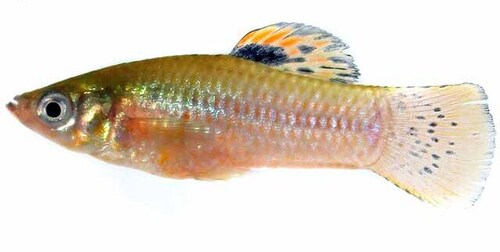
Island Molly
Poecilia vandepolli
(c) Adeljean Ho, some rights reserved (CC BY-SA), CC BY-SA 4.0, via iNaturalist

How they differ
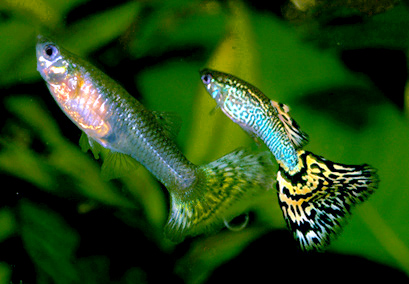
Vandepoll's Molly (Poecilia vandepolli) has a rounded caudal fin without an elongated sword, whereas male Guppies (Poecilia reticulata) have ornamental caudal and dorsal fins. Vandepoll's Molly displays coloration ranging from grayish-brown to yellow or orange, whereas wild-type female Guppies have grey bodies and males display spots, splashes, or stripes in various colours. Vandepoll's Molly inhabits freshwater, brackish, seawater, and hypersaline coastal environments, whereas Guppies inhabit freshwater bodies, some brackish-water environments, and can acclimate to full-strength saltwater.
| Island Molly | Guppy | |
|---|---|---|
| Appearance | Vandepoll's Molly frequently has 10–12 gray vertical stripes on its body and tail. | Male Guppies display spots, splashes, or stripes in a variety of colours. |
| Fin structure | Vandepoll's Molly has a rounded caudal fin without an elongated sword. | Male Guppies have ornamental caudal and dorsal fins. |
| Grouping | Vandepoll's Molly forms relatively small shoals near the water surface, typically containing several dozen fish. | Guppies frequently forage in groups and often school together to reduce their vulnerability to predation. |
| Diet | Vandepoll's Molly is omnivorous, feeds mainly on organisms growing on submerged surfaces, and preferentially consumes the planktonic crustacean Artemia salina. | Wild Guppies consume algal remains, diatoms, invertebrates, zooplankton, detritus, plant fragments, mineral particles, and aquatic insect larvae, with algal remains constituting the largest proportion in most cases. |
| Offspring consumption | Adult Vandepoll's Mollies consume their own fry when food becomes scarce. | Guppies can consume their own offspring under laboratory conditions. |
| Habitat | Vandepoll's Molly occurs in streams, ponds, bays, salt pans, and lagoons. | Guppies are generally more abundant in small streams and pools than in large, deep, or fast-flowing rivers. |
| Distribution | Vandepoll's Molly is native to Aruba, Bonaire, and Curaçao and also occurs in freshwater habitats on Saint Martin. | Guppies inhabit freshwater bodies, particularly streams near the coastal fringes of mainland South America. |
Written from the checked facts listed further down. Statements that the sources did not support were removed.
Side by side
| Island Molly | Guppy | |
|---|---|---|
| Scientific name | Poecilia vandepolli Van Lidth de Jeude, 1887 | Poecilia reticulata Peters, 1859 |
| English name | Island Molly | Guppy |
| Group | Fishes | Fishes |
| Class | Teleostei Teleost | Teleostei Teleost |
| Order | Cyprinodontiformes | Cyprinodontiformes |
| Family | Poeciliidae Topminnows | Poeciliidae Topminnows |
| Genus | Poecilia Mollies | Poecilia Mollies |
| Named in | 1887 | 1859 |
| Red List category | Least Concern | Least Concern |
| Environment | freshwater | brackish, freshwater |
| Countries on record | 5 countries | 69 countries |
| GBIF occurrence records | 76 records | 12,634 records |
Rows where the two agree are shown in grey.
Where each is found
Both recorded in 3 countries
Only Island Molly (2)
Only Guppy (66)
- Algeria
- Antigua and Barbuda
- Argentina
- Australia
- Bangladesh
- Barbados
- Brazil
- Cabo Verde
- Cambodia
- Canada
- Chile
- China
- Comoros
- Costa Rica
- Cuba
- Democratic Republic of the Congo
- Dominican Republic
- Ecuador
- French Guiana
- Guadeloupe
- Guyana
- Haiti
- Hong Kong
- India
- Indonesia
- Israel
- Jamaica
- Japan
- Kenya
- Madagascar
- Malawi
- Malaysia
- Martinique
- Mauritius
- Mayotte
- Mexico
- Mozambique
- Myanmar
- Namibia
- Nigeria
- Panama
- Paraguay
- Peru
- Philippines
- Puerto Rico
- Republic of the Congo
- Reunion
- Rwanda
- Saint Barthelemy
- Saint Lucia
- Saint Vincent and the Grenadines
- Senegal
- Seychelles
- Singapore
- South Africa
- South Korea
- Sri Lanka
- Suriname
- Taiwan
- Tanzania
- Thailand
- Trinidad and Tobago
- U.S. Virgin Islands
- Uganda
- United States
- Vietnam
From Catalogue of Life checklists and GBIF occurrence records. A country missing from a list means no record is held, which is not proof of absence.
Checked facts
| Island Molly | Guppy | |
|---|---|---|
| Appearance |
|
|
| Size |
| No checked fact yet |
| Habitat |
|
|
| Diet |
|
|
| Behaviour |
|
|
| Reproduction |
|
|
| Lifespan | No checked fact yet |
|
| Distribution |
| No checked fact yet |
| Conservation |
| No checked fact yet |
| Uses | No checked fact yet |
|
| Other |
|
|
In brief
Island Molly
The Island Molly (Poecilia vandepolli Van Lidth de Jeude, 1887) is a fish in the family Poeciliidae, order Cyprinodontiformes, and class Teleostei. It is native to Aruba, Bonaire, and Curaçao and also occurs in freshwater habitats on Saint Martin, where it was probably introduced by Dutch settlers. It is distinguished by its ability to inhabit freshwater, seawater, and hypersaline environments, with recorded salinity tolerance reaching approximately 80‰ and occasionally 135‰. Full profile
Guppy
Guppies inhabit freshwater bodies, particularly streams near the coastal fringes of mainland South America, as well as some brackish-water environments. Male guppies have colourful markings and ornamental caudal and dorsal fins, while wild-type females have grey bodies. Full profile
Compare something else
Page built on 24 November 2026 from the data on the two species pages, where every source is listed.
Cite this page
ScientificNames.org. (2026). Island Molly vs Guppy. Retrieved November 24, 2026, from https://scientificnames.org/compare/island-molly-vs-guppy
“Island Molly vs Guppy.” ScientificNames.org, 2026, scientificnames.org/compare/island-molly-vs-guppy. Accessed 24 Nov. 2026.
ScientificNames.org. “Island Molly vs Guppy.” Accessed November 24, 2026. https://scientificnames.org/compare/island-molly-vs-guppy.
@misc{scientificnames_island_molly_vs_guppy,
  author = {{ScientificNames.org}},
  title = {Island Molly vs Guppy},
  year = {2026},
  url = {https://scientificnames.org/compare/island-molly-vs-guppy},
  note = {Accessed 2026-11-24}
}