Species · Fishes
Island Molly Poecilia vandepolli
The scientific name of the Island Molly is Poecilia vandepolli. It is a species of fish in the family Poeciliidae (topminnows), order Cyprinodontiformes. The name dates from 1887.
- Scientific name
- Poecilia vandepolli Van Lidth de Jeude, 1887
- Common name
- Island Molly
- Genus
- Poecilia
- Family
- Poeciliidae (Topminnows)
- Order
- Cyprinodontiformes
- Class
- Teleostei
- Red List category
- LC Least Concern
- Environment
- freshwater
- Recorded in
- 5 countries
- Name status
- accepted in the Catalogue of Life
Overview
The Island Molly (Poecilia vandepolli Van Lidth de Jeude, 1887) is a fish in the family Poeciliidae, order Cyprinodontiformes, and class Teleostei. It is native to Aruba, Bonaire, and Curaçao and also occurs in freshwater habitats on Saint Martin, where it was probably introduced by Dutch settlers. It is distinguished by its ability to inhabit freshwater, seawater, and hypersaline environments, with recorded salinity tolerance reaching approximately 80‰ and occasionally 135‰.
Written 24 November 2026 from the sources listed below. Each statement was checked against the passage it cites; statements that could not be supported were removed.
Conservation
The Island Molly occurs in at least one protected area. Conservation sites have been identified across part of its range, and an area-based regional management plan exists for the species.[1][2][3]
The species is exposed to habitat pressures associated with tourism-related shoreline development and altered water flow. Its estimated extent of occurrence is 5,832 km².[4][5]
Appearance
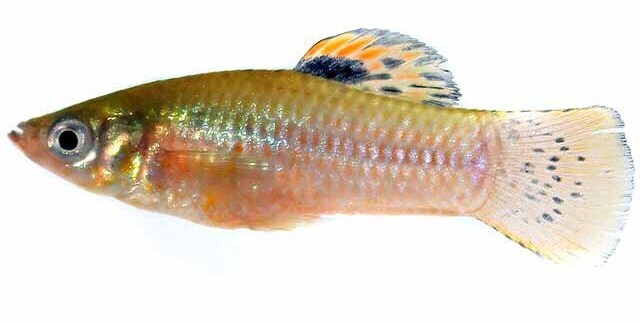
The Island Molly exhibits coloration ranging from grayish-brown to yellow or orange. Females are generally grayish-brown, sometimes with faint green or blue coloration on their backs.[6][7]
Some males have yellow flanks with blue tinges, while others display orange-red dorsal fins edged in black and orange throats. The body and tail frequently display 10–12 gray vertical stripes.[8][9]
The species has a rounded caudal fin without an elongated sword. It typically has 26–28 lateral scales, 16 scales around the tail base, and a dorsal fin with 8–9 rays.[10][11][12]
The mouth is small and slightly oblique, with a projecting lower jaw. The outer row of jaw teeth consists of large backward-curved teeth with expanded tips, accompanied by several inner rows of small pointed teeth.[13][14]
The male anal fin is modified into an elongated reproductive organ. Male specimens range from 2.6 to 5.3 cm in total length, while females range from 3.2 to 9.6 cm.[15][16][17]
Habitat
The Island Molly inhabits freshwater, brackish, seawater, and hypersaline coastal environments. It occurs in streams, ponds, bays, salt pans, and lagoons.[18][19]
The species inhabits waters approximately 10–200 cm deep and is particularly abundant in calm lagoons and sheltered bay areas containing mangroves. It prefers waters containing green filamentous algae.[20][21][22]
Its habitats include soft-bottom environments such as mud, sand, gravel, beaches, estuaries, mangroves, and seagrass habitats. It also inhabits freshwater and brackish shoreline environments.[23][24]
Diet
The Island Molly is omnivorous and feeds mainly on organisms growing on submerged surfaces. Recorded stomach contents include detritus, algae, protozoans, fish eggs, and fly larvae.[25][26]
The species preferentially consumes the planktonic crustacean Artemia salina. It also captures copepods, mysids, and small fish.[27][28]
Adults consume their own fry when food becomes scarce.[29]
Behaviour
Individuals form relatively small shoals near the water surface, typically containing several dozen fish. The species migrates from marine habitats into freshwater systems when rainfall causes flooding.[30][31]
The species can survive in waters with salinity reaching approximately 80‰ and occasionally 135‰. It tolerates water temperatures between 16 and 36 °C.[32][33]
Marine specimens generally have larger bodies, greater robustness, and more vivid coloration than freshwater specimens.[34]
Reproduction and life cycle
Females reproduce by giving birth to live young rather than laying eggs. The species has no pelagic larval stage.[35][36]
Female specimens reach sexual maturity at total lengths of 2.3–5.5 cm, while males reach sexual maturity at total lengths of 2.1–3.2 cm.[37][38]
Successful reproduction depends on the availability of shelter for young fish because most fry are vulnerable to predation by adults.[39]
Similar species
The closest identified relative geographically is Poecilia gillii cuneata from Panama.[40]
Classification of the Island Molly
| Kingdom | Animalia |
|---|---|
| Phylum | Chordata |
| Subphylum | Vertebrata |
| Infraphylum | Gnathostomata |
| Parvphylum | Osteichthyes |
| Gigaclass | Actinopterygii |
| Superclass | Actinopteri |
| Class | Teleostei (Teleost) |
| Order | Cyprinodontiformes |
| Family | Poeciliidae (Topminnows) |
| Subfamily | Poeciliinae |
| Genus | Poecilia (Mollies) |
| Species | Poecilia vandepolli Van Lidth de Jeude, 1887 |
Where the Island Molly is found
Checklists and occurrence records place Poecilia vandepolli in 5 countries. GBIF holds 76 georeferenced records of it.
Countries
Regions and cities with the most records
- Willemstad, Curacao 20
- Zulia, Venezuela 7
- Falcón, Venezuela 4
- Carabobo, Venezuela 3
- Puerto Cabello, Venezuela 3
A number beside a place is its count of GBIF occurrence records. A place without a number comes from a checklist alone. Records show where a species has been observed or collected, which can include escapes and vagrants.
Common names
English
- Island Molly
- Vandepoll's Molly
Names in 1 other language
- Czech
- živorodka Vandepollova
Synonyms
3 other scientific names have been used for this species and are now treated as synonyms of Poecilia vandepolli.
- Mollienesia vandepolli (Van Lidt de Jeude)
- Mollienisia sphenops vandepolli (van Lidth de Jeude)
- Mollinesia vandepolli Van Lindth de Jeude, 1887
Related species
-
 GuppyPoecilia reticulata
-
 Common MollyPoecilia sphenops
-
 Endler's LivebearerPoecilia wingei
-
 Amazon MollyPoecilia formosa
-
 Sailfin MollyPoecilia latipinna
-
 Yucatán MollyPoecilia velifera
-
 Shortfin MollyPoecilia mexicana
-
 Sulphur MollyPoecilia sulphuraria
Compare
Questions and answers
What is the scientific name of the Island Molly?
The scientific name of the Island Molly is Poecilia vandepolli. Written with its author, the full name is Poecilia vandepolli Van Lidth de Jeude, 1887.
Which family does the Island Molly belong to?
Poecilia vandepolli belongs to the family Poeciliidae, in the order Cyprinodontiformes and the class Teleostei.
Where is the Island Molly found?
Checklists and occurrence records place Poecilia vandepolli in 5 countries: Curacao, Venezuela, Aruba, Saint Martin and Colombia.
What is the conservation status of the Island Molly?
The IUCN Red List category recorded for Poecilia vandepolli is Least Concern (LC).
What other names does the Island Molly have?
Poecilia vandepolli is also known in English as Vandepoll's Molly.
What is the scientific name of Molly?
The scientific name of the Island Molly is Poecilia vandepolli Van Lidth de Jeude, 1887.[41]
What food do molly fish eat?
The Island Molly is omnivorous and feeds on detritus, algae, protozoans, fish eggs, and fly larvae. It preferentially consumes Artemia salina and also eats copepods, mysids, and small fish.[25][26][27][28]
Sources
Passages the profile rests on
- The species occurs in at least one protected area. Source passage: “Occurs in at least one protected area: Yes” — iucnredlist.org
- Conservation sites have been identified across part of the species' range. Source passage: “Conservation sites identified: Yes, over part of range” — iucnredlist.org
- An area-based regional management plan exists for the species. Source passage: “Area based regional management plan: Yes” — iucnredlist.org
- The species is exposed to habitat pressures associated with tourism-related shoreline development and altered water flow. Source passage: “Habitat pressures across the islands—including invasive species, altered water flow, and tourism-related shoreline development” — English Wikipedia
- The IUCN assessment identifies an estimated extent of occurrence of 5,832 km². Source passage: “Estimated extent of occurrence (EOO) (km²): 5832” — iucnredlist.org
- The species exhibits coloration ranging from grayish-brown to yellow or orange. Source passage: “coloration varying from grayish-brown to yellow or orange in any given population.” — English Wikipedia
- Females are generally grayish-brown, sometimes with faint green or blue coloration on their backs. Source passage: “While females are generally grayish-brown, their backs may carry a faint wash of green or blue.” — English Wikipedia
- Some males have yellow flanks with blue tinges, while others display orange-red dorsal fins edged in black and orange throats. Source passage: “display yellow flanks tinged with blue, or have an orange-red dorsal fin bordered in black and an orange throat.” — English Wikipedia
- The body and tail frequently display 10–12 gray vertical stripes. Source passage: “Often, 10–12 grey vertical stripes can be seen on the trunk and tail.” — English Wikipedia
- The species has a rounded caudal fin without an elongated sword. Source passage: “tail fin rounded, without elongate sword;” — biogeodb.stri.si.edu
- The species typically has 26–28 lateral scales and 16 scales around the tail base. Source passage: “26-28 lateral scales, 16 scales around tail base.” — biogeodb.stri.si.edu
- The dorsal fin typically has 8–9 rays. Source passage: “its origin behind pelvic origin, 8-9 rays;” — biogeodb.stri.si.edu
- The species has a small, slightly oblique mouth with a projecting lower jaw. Source passage: “mouth small, at front, slightly oblique, lower jaw slightly projecting” — biogeodb.stri.si.edu
- The species has an outer row of large backward-curved jaw teeth with expanded tips and several inner rows of small pointed teeth. Source passage: “jaw teeth consist of an outer row of large backward curved teeth with expanded tips, and several rows of small pointed teeth, inner row 1-pointed;” — biogeodb.stri.si.edu
- Male specimens range from 2.6 to 5.3 cm in total length. Source passage: “males ranging in total length from 2.6 to 5.3 cm (1.0 to 2.1 in)” — English Wikipedia
- Female specimens range from 3.2 to 9.6 cm in total length. Source passage: “females from 3.2 to 9.6 cm (1.3 to 3.8 in)” — English Wikipedia
- The male anal fin is modified into an elongated reproductive organ. Source passage: “anal fin modified in male to form an elongate sex organ” — biogeodb.stri.si.edu
- The species inhabits freshwater, brackish, seawater, and hypersaline coastal environments. Source passage: “It inhabits freshwater, brackish, saltwater (c. 35‰), and hypersaline coastal habitats.” — English Wikipedia
- The species occurs in streams, ponds, bays, salt pans, and lagoons. Source passage: “inhabiting fresh, brackish, salt, and hypersaline waters such as streams, ponds, bays, salt pans, and lagoons.” — English Wikipedia
- The species inhabits waters approximately 10–200 cm deep. Source passage: “Habitats are between 10 and 200 cm deep;” — English Wikipedia
- The species is particularly abundant in calm lagoons and sheltered bay areas containing mangroves. Source passage: “Calm lagoons and secluded parts of bays harbor abundant populations of mollies; their numbers are particularly high in areas where mangroves grow.” — English Wikipedia
- The species prefers waters containing green filamentous algae. Source passage: “Waters containing green filamentous algae are preferred regardless of depth.” — English Wikipedia
- The species occurs in soft-bottom environments including mud, sand, gravel, beaches, estuaries, mangroves, and seagrass habitats. Source passage: “Soft bottom (mud/sand/gravel/beach/estuary/mangrove/seagrass)” — biogeodb.stri.si.edu
- The species inhabits freshwater and brackish shoreline environments. Source passage: “Lives in fresh to brackish shoreline waters.” — biogeodb.stri.si.edu
- The species is omnivorous and feeds mainly on organisms growing on submerged surfaces. Source passage: “Poecilia vandepolli is omnivorous. Its diet is largely composed of organisms growing on submerged surfaces” — English Wikipedia
- Its recorded stomach contents include detritus, algae, protozoans, fish eggs, and fly larvae. Source passage: “stomach contents have been found to include detritus, algae (Cyanophyceae and Chlorophyceae), protozoans, fish eggs, fly larvae (Ephydra)” — English Wikipedia
- The species preferentially consumes the planktonic crustacean Artemia salina. Source passage: “Their preferred planktonic prey is Artemia salina” — English Wikipedia
- The species also captures copepods, mysids, and small fish. Source passage: “but they also capture copepods, mysids, and small fish.” — English Wikipedia
- Adults consume their own fry when food becomes scarce. Source passage: “When food becomes scarce, adults cannibalize fry.” — English Wikipedia
- Individuals form relatively small shoals near the water surface, typically containing several dozen fish. Source passage: “In deeper water, the fish remain near the surface, forming relatively small shoals, typically of a few dozen individuals.” — English Wikipedia
- The species migrates from marine habitats into freshwater systems when rainfall causes flooding. Source passage: “surface runoff laden with terrestrial organic compounds spurs mollies from the sea to swim frantically against the current to colonize the reemergent freshwater systems” — English Wikipedia
- The species can survive in waters with salinity reaching approximately 80‰ and occasionally 135‰. Source passage: “P. vandepolli inhabits waters with salinities up to about 80‰, and occasionally as high as 135‰” — English Wikipedia
- The species tolerates water temperatures between 16 and 36 °C. Source passage: “It withstands a thermal range of 16–36 °C (61–97 °F)” — English Wikipedia
- Marine specimens generally have larger bodies, greater robustness, and more vivid coloration than freshwater specimens. Source passage: “Marine fish are generally larger, stronger, and more colorful than freshwater specimens.” — English Wikipedia
- Females reproduce by giving birth to live young rather than laying eggs. Source passage: “An advantage Poecilia vandepolli has over its competitors is its ovoviparity–the bearing of live fry as opposed to laying eggs.” — English Wikipedia
- The species has no pelagic larval stage. Source passage: “No pelagic phase No pelagic larva” — biogeodb.stri.si.edu
- Female specimens reach sexual maturity at total lengths of 2.3–5.5 cm. Source passage: “Females, which reach maturity at total lengths of 2.3–5.5 cm” — English Wikipedia
- Male specimens reach sexual maturity at total lengths of 2.1–3.2 cm. Source passage: “males, which mature at 2.1–3.2 cm.” — English Wikipedia
- Successful reproduction depends on the availability of shelter for young fish because most fry are vulnerable to predation by adults. Source passage: “Successful reproduction depends on the availability of shelter for fry, most of which fall prey to adults.” — English Wikipedia
- The species' closest identified relative geographically is Poecilia gillii cuneata from Panama. Source passage: “Geographically, the closest relative of P. vandepolli is the Panamian P. gillii cuneata” — English Wikipedia
- The species was originally described in 1887 from specimens collected in a freshwater rivulet on Curaçao. Source passage: “In 1887, Van Lidth de Jeude described a new Poecilia species, P. vandepolli, from specimens collected in a freshwater rivulet on Curaçao.” — English Wikipedia
- The species is native to the Caribbean islands of Aruba, Bonaire, and Curaçao. Source passage: “Poecilia vandepolli is native to three islands of the Leeward Antilles: Aruba, Bonaire, and Curaçao.” — English Wikipedia
- The species is native to the ABC islands of the Lesser Antilles. Source passage: “Poecilia vandepolli, or Van de Poll's molly, is a poeciliid fish native to the ABC islands of the Lesser Antilles, namely Aruba, Bonaire, and Curaçao.” — inaturalist.org
Data
- Catalogue of Life, 2026-10-16 XR cc by
- Global Biodiversity Information Facility CC BY 4.0
- Wikidata CC0
- GeoNames CC BY 4.0
- iNaturalist per image; credit shown with each image
- Within the Catalogue of Life, this name comes from World Register of Marine Species cc by
References
- Van Lidth de Jeude, T. W. (1887). On a collection of reptiles and fishes from the West Indies. Notes from the Leyden Museum, v. 9 (no. 1, art. 8): 129–139, Pl. 2. [Pisces on p. 135–139, Pl. 2 (figs. 4–10)]. where the name was published
This species in other databases
- Catalogue of Life 4KSFY
- Wikidata Q2008505
- iNaturalist 619543
- WoRMS urn:lsid:marinespecies.org:taxname:298226
- ITIS 647539
Page built on 24 November 2026. See how the catalog is made and all sources and licences.
Cite this page
ScientificNames.org. (2026). Poecilia vandepolli (Island Molly). Retrieved November 24, 2026, from https://scientificnames.org/species/poecilia-vandepolli
“Poecilia vandepolli (Island Molly).” ScientificNames.org, 2026, scientificnames.org/species/poecilia-vandepolli. Accessed 24 Nov. 2026.
ScientificNames.org. “Poecilia vandepolli (Island Molly).” Accessed November 24, 2026. https://scientificnames.org/species/poecilia-vandepolli.
@misc{scientificnames_poecilia_vandepolli_island_molly,
  author = {{ScientificNames.org}},
  title = {Poecilia vandepolli (Island Molly)},
  year = {2026},
  url = {https://scientificnames.org/species/poecilia-vandepolli},
  note = {Accessed 2026-11-24}
}