Species · Fishes
Guppy Poecilia reticulata
The scientific name of the Guppy is Poecilia reticulata. It is a species of fish in the family Poeciliidae (topminnows), order Cyprinodontiformes. The name dates from 1859.
- Scientific name
- Poecilia reticulata Peters, 1859
- Common name
- Guppy
- Genus
- Poecilia
- Family
- Poeciliidae (Topminnows)
- Order
- Cyprinodontiformes
- Class
- Teleostei
- Red List category
- LC Least Concern
- Environment
- brackish, freshwater
- Recorded in
- 69 countries
- Name status
- accepted in the Catalogue of Life
Overview
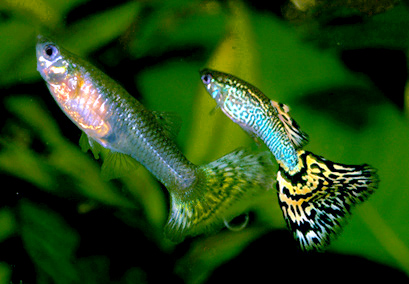
Guppies inhabit freshwater bodies, particularly streams near the coastal fringes of mainland South America, as well as some brackish-water environments. Male guppies have colourful markings and ornamental caudal and dorsal fins, while wild-type females have grey bodies.
Written 24 November 2026 from the sources listed below. Each statement was checked against the passage it cites; statements that could not be supported were removed.
Appearance
Wild-type female guppies have grey bodies, while males display spots, splashes, or stripes in a variety of colours. Male guppies have ornamental caudal and dorsal fins.[1][2]
Male guppies typically have body lengths between 1.5 and 4 cm, while females typically measure between 3 and 7 cm.[3][4]
Habitat
Guppies inhabit freshwater bodies, particularly streams near the coastal fringes of mainland South America. They also inhabit some brackish-water environments.[5][6]
Guppies are generally more abundant in small streams and pools than in large, deep, or fast-flowing rivers. They can acclimate to full-strength saltwater.[7][8]
Diet
Wild guppies consume algal remains, diatoms, invertebrates, zooplankton, detritus, plant fragments, mineral particles, and aquatic insect larvae. Algal remains constitute the largest proportion of their diet in most cases.[9][10]
Guppies sometimes consume native fishes' eggs. Under laboratory conditions, they can also consume their own offspring.[11][12]
Behaviour
Guppies frequently forage in groups to improve their ability to find food. They also often school together to reduce their vulnerability to predation.[13][14]
Some guppies approach potential predators to assess the danger they pose. When they detect a predator, they rapidly darken their irises.[15][16]
Shoaling guppies spend less time and energy on antipredator behaviour than solitary individuals.[17]
Reproduction and life cycle
Female guppies first produce offspring at approximately 10–20 weeks of age. Males reach sexual maturity in seven weeks or less.[18][19]
Guppies are polyandrous, with females mating with multiple males. Female guppies are attracted to brightly coloured males, particularly those with orange flank spots.[20][21]
Guppy gestation lasts approximately 20–60 days at temperatures between 25 and 27.8 °C. Females can store sperm for up to eight months after insemination.[22][23]
The typical lifespan of wild guppies is approximately two years.[24]
Uses
Guppies have been introduced to some environments as a means of controlling mosquito populations.[25]
Guppies are used as model organisms in ecology, evolution, and behavioural studies. They are also among the most popular freshwater aquarium fish species.[26][27]
Classification of the Guppy
| Kingdom | Animalia |
|---|---|
| Phylum | Chordata |
| Subphylum | Vertebrata |
| Infraphylum | Gnathostomata |
| Parvphylum | Osteichthyes |
| Gigaclass | Actinopterygii |
| Superclass | Actinopteri |
| Class | Teleostei (Teleost) |
| Order | Cyprinodontiformes |
| Family | Poeciliidae (Topminnows) |
| Subfamily | Poeciliinae |
| Genus | Poecilia (Mollies) |
| Species | Poecilia reticulata Peters, 1859 |
Where the Guppy is found
Checklists and occurrence records place Poecilia reticulata in 69 countries. GBIF holds 12,634 georeferenced records of it.
Countries
- Algeria 10
- Antigua and Barbuda 7
- Argentina 14
- Australia 438
- Bangladesh 8
- Barbados 13
- Brazil 2,789
- Cabo Verde 3
- Cambodia 3
- Canada 19
- Chile 10
- China 20
- Colombia 1,448
- Comoros 4
- Costa Rica 30
- Cuba 26
- Democratic Republic of the Congo 5
- Dominican Republic 64
- Ecuador 31
- French Guiana 9
- Guadeloupe 95
- Guyana 58
- Haiti 11
- Hong Kong 53
- India 82
- Indonesia 177
- Israel 4
- Jamaica 10
- Japan 2,004
- Kenya 254
- Madagascar 19
- Malawi 4
- Malaysia 89
- Martinique 30
- Mauritius 23
- Mayotte 44
- Mexico 420
- Mozambique 3
- Myanmar 39
- Namibia 4
- Nigeria 3
- Panama 14
- Paraguay 14
- Peru 111
- Philippines 51
- Puerto Rico 188
- Republic of the Congo 3
- Reunion 312
- Rwanda 12
- Saint Barthelemy 5
- Saint Lucia 7
- Saint Martin 3
- Saint Vincent and the Grenadines 4
- Senegal 5
- Seychelles 5
- Singapore 134
- South Africa 139
- South Korea 17
- Sri Lanka 22
- Suriname 35
- Taiwan 1,235
- Tanzania 31
- Thailand 194
- Trinidad and Tobago 312
- U.S. Virgin Islands 15
- Uganda 44
- United States 478
- Venezuela 836
- Vietnam 31
Regions and cities with the most records
- Kagoshima, Japan 1,568
- Taiwan, Taiwan 829
- Chiayi City, Taiwan 634
- Tolima Department, Colombia 611
- Espinal, Colombia 520
- Girardot City, Colombia 517
- Espírito Santo, Brazil 465
- São Paulo, Brazil 432
- Paraná, Brazil 414
- Queensland, Australia 391
- Antioquia, Colombia 339
- Minas Gerais, Brazil 289
- Envigado, Colombia 284
- Itagüí, Colombia 284
- Medellín, Colombia 284
- Caldas, Colombia 282
- La Estrella, Colombia 282
- Valle del Cauca Department, Colombia 247
- Rio de Janeiro, Brazil 236
- Bahia, Brazil 233
- Xinying, Taiwan 216
- Tunapuna/Piarco, Trinidad and Tobago 188
- Portuguesa, Venezuela 156
- Bukit Timah, Singapore 141
- Ang Mo Kio New Town, Singapore 140
- Cambé, Brazil 140
- Sembawang Estate, Singapore 140
- Yishun New Town, Singapore 140
- Bukit Panjang New Town, Singapore 139
- Woodlands, Singapore 139
- Choa Chu Kang New Town, Singapore 138
- Sengkang New Town, Singapore 138
- Matilda Estate, Singapore 137
- Punggol, Singapore 137
- Rolândia, Brazil 134
- Saint-Denis, Reunion 133
21 more countries have a few records outside this range
These countries hold a few records of Poecilia reticulata but lie outside the range the checklists give for it. Such records are often zoo or garden specimens, museum material or vagrants, so the species is not counted as occurring there.
A number beside a place is its count of GBIF occurrence records. A place without a number comes from a checklist alone. Records show where a species has been observed or collected, which can include escapes and vagrants.
Common names
English
- Guppy
- Barbados Millions
- Drainfish
- Fancy Guppy
- Million Fish
- Sevenscolours
- Millions Fish
- Rainbowfish
Names in 30 other languages
- Afrikaans
- Guppie, Miljoenvis
- Albanian
- Lareza tripikaloshe, barkuleci i ylbertë, larëza këlyshlindëse, larëza tripikaloshe
- Arabic
- جوبي
- Chinese
- 孔雀花鱂, 孔雀魚, 胎鱂, 虹鱂(孔雀魚)
- Czech
- živorodka duhová
- Dutch
- gup
- Finnish
- Miljoonakala
- French
- Poisson million, Queue de voile
- German
- Millionenfisch, Wilder Riesenguppy
- Hebrew
- גופי
- Indonesian
- Renting
- Japanese
- Guppii, グッピー
- Korean
- 구피
- Lithuanian
- Paprastasis gupis
- Malay
- Ikan seribu
- Mandarin Chinese
- 虹鮰
- Polish
- Cytrynówka, Gupik pawie, Gupik pawie oczko, Gúpi
- Portuguese
- Barrigudinho-mexicano, Lebiste, Mexicano, Sarapintado
- Russian
- Гуппи
- Sinhala
- ගප්පි
- Slovak
- Živorodka dúhová
- Spanish
- Bandera, Barrigudinho, Guaru, Gupi africano, Guppy salvaje, Sardinita, gupi
- Thai
- ปลาหางนกยูง
- Turkish
- Lepistes
- Ukrainian
- Гупі
- Vietnamese
- Cá bay màu, cá bảy màu
- bbc
- Bunting, Burting, Sibolon perut, Siburting
- jav
- Bahenol
- pau
- Kingyo
- yue
- Hung dzoek ue
Synonyms
16 other scientific names have been used for this species and are now treated as synonyms of Poecilia reticulata.
- Acanthophacelus guppii (Günther, 1866)
- Acanthophacelus reticulatus (Peters, 1859)
- Girardinus guppii Günther, 1866
- Girardinus reticulatus (Peters, 1859)
- Haridichthys reticulatus (Peters, 1859)
- Heterandria guppyi (Günther, 1866)
- Lebistes poecilioides De Filippi, 1861
- Lebistes poeciloides De Filippi, 1861
- Lebistes reticulatus var. fredlini Stoye, 1935
- Pocilia reticulata Peters, 1859
- Poecilia kempkesi Poeser, 2013
- Poecilia reticulate Peters, 1859
- Poecilia reticulatus Peters, 1859
- Poeciliodes reticulatus (Peters, 1859)
- Poecilioides reticulatus (Peters, 1859)
- Lebistes reticulatus (Peters, 1859) ambiguous synonym
Subspecies and varieties
- Lebistes reticulatus aurata subspecies
Related species
-
 Island MollyPoecilia vandepolli
-
 Common MollyPoecilia sphenops
-
 Endler's LivebearerPoecilia wingei
-
 Amazon MollyPoecilia formosa
-
 Sailfin MollyPoecilia latipinna
-
 Yucatán MollyPoecilia velifera
-
 Shortfin MollyPoecilia mexicana
-
 Sulphur MollyPoecilia sulphuraria
Compare
Questions and answers
What is the scientific name of the Guppy?
The scientific name of the Guppy is Poecilia reticulata. Written with its author, the full name is Poecilia reticulata Peters, 1859.
Which family does the Guppy belong to?
Poecilia reticulata belongs to the family Poeciliidae, in the order Cyprinodontiformes and the class Teleostei.
Where is the Guppy found?
Checklists and occurrence records place Poecilia reticulata in 69 countries, including Brazil, Japan, Colombia, Taiwan, Venezuela and United States.
What is the conservation status of the Guppy?
The IUCN Red List category recorded for Poecilia reticulata is Least Concern (LC).
What other names does the Guppy have?
Poecilia reticulata is also known in English as Barbados Millions, Drainfish, Fancy Guppy, Million Fish, Sevenscolours and Millions Fish.
What are guppies named after?
The name Girardinus guppii commemorates Robert John Lechmere Guppy.[28]
Sources
Passages the profile rests on
- Wild-type female guppies have grey bodies, while males display spots, splashes, or stripes in a variety of colours. Source passage: “While wild-type females are grey in body colour, males have splashes, spots, or stripes that can be any of a wide variety of colours.” — English Wikipedia
- Male guppies have ornamental caudal and dorsal fins. Source passage: “Male guppies, which are smaller than females, have ornamental caudal and dorsal fins.” — English Wikipedia
- Male guppies typically have body lengths between 1.5 and 4 cm. Source passage: “males are typically 1.5–4 cm (0.6–1.6 in) long” — English Wikipedia
- Female guppies typically have body lengths between 3 and 7 cm. Source passage: “females are 3–7 cm (1.2–2.8 in) long.” — English Wikipedia
- Guppies inhabit freshwater bodies, particularly streams near the coastal fringes of mainland South America. Source passage: “guppies have colonised almost every freshwater body accessible to them in their natural ranges, especially in the streams located near the coastal fringes of mainland South America.” — English Wikipedia
- Guppies also inhabit some brackish-water environments. Source passage: “Although not typically found there, guppies also have tolerance to brackish water and have colonised some brackish environments.” — English Wikipedia
- Guppies are generally more abundant in small streams and pools than in large, deep, or fast-flowing rivers. Source passage: “They tend to be more abundant in smaller streams and pools than in large, deep, or fast-flowing rivers.” — English Wikipedia
- Guppies can acclimate to full-strength saltwater. Source passage: “They also are capable of being acclimated to full saltwater like their molly cousins.” — English Wikipedia
- Wild guppies consume algal remains, diatoms, invertebrates, zooplankton, detritus, plant fragments, mineral particles, and aquatic insect larvae. Source passage: “Wild guppies feed on algal remains, diatoms, invertebrates, zooplankton, detritus, plant fragments, mineral particles, aquatic insect larvae, and other sources.” — English Wikipedia
- Algal remains constitute the largest proportion of the wild guppy's diet in most cases. Source passage: “Algal remains constitute the biggest proportion of wild guppy diet in most cases” — English Wikipedia
- Guppies sometimes consume native fishes' eggs. Source passage: “Guppies have also been observed eating native fishes' eggs” — English Wikipedia
- Guppies can consume their own offspring under laboratory conditions. Source passage: “occasionally expressing cannibalism, also eating its own young, when kept in laboratory conditions.” — English Wikipedia
- Guppies frequently forage in groups to improve their ability to find food. Source passage: “Guppies often forage in groups because they can find food more easily.” — English Wikipedia
- Guppies often school together to reduce their vulnerability to predation. Source passage: “like many fish, they often school together to avoid predation.” — English Wikipedia
- Some guppies approach potential predators to assess the danger they pose. Source passage: “When guppies encounter a potential predator, some of them approach the predator to assess danger.” — English Wikipedia
- Guppies rapidly darken their irises when they detect a predator. Source passage: “their irises rapidly darken from silver to jet black” — English Wikipedia
- Shoaling guppies spend less time and energy on antipredator behaviour than solitary individuals. Source passage: “Shoaling guppies spend less time and energy on antipredatory behaviour than solitary ones” — English Wikipedia
- Female guppies first produce offspring at approximately 10–20 weeks of age. Source passage: “Female guppies first produce offspring at 10–20 weeks of age” — English Wikipedia
- Male guppies reach sexual maturity in seven weeks or less. Source passage: “Male guppies mature in 7 weeks or less.” — English Wikipedia
- Guppies are polyandrous, with females mating with multiple males. Source passage: “Guppies are polyandrous, where females mate with multiple males.” — English Wikipedia
- Female guppies are attracted to brightly coloured males, particularly those with orange flank spots. Source passage: “Female guppies are attracted to brightly coloured males, especially ones with orange spots on the flank.” — English Wikipedia
- Guppy gestation lasts approximately 20–60 days at temperatures between 25 and 27.8 °C. Source passage: “The gestation period of guppies varies considerably, ranging from 20 to 60 days at 25 to 27.8 °C (77 to 82 °F)” — English Wikipedia
- Female guppies can store sperm for up to eight months after insemination. Source passage: “which can continue to fertilise ova up to eight months.” — English Wikipedia
- The typical lifespan of wild guppies is approximately two years. Source passage: “Total lifespan of guppies in the wild varies greatly, but it is typically around 2 years.” — English Wikipedia
- Guppies have been introduced to some environments as a means of controlling mosquito populations. Source passage: “most often as a means of mosquito control.” — English Wikipedia
- Guppies are used as model organisms in ecology, evolution, and behavioural studies. Source passage: “Guppies are used as a model organism in the fields of ecology, evolution, and behavioural studies.” — English Wikipedia
- Guppies are among the most popular freshwater aquarium fish species. Source passage: “one of the most popular freshwater aquarium fish species.” — English Wikipedia
- The name Girardinus guppii commemorates Robert John Lechmere Guppy. Source passage: “It was named Girardinus guppii by Albert Günther in honour of Robert John Lechmere Guppy” — English Wikipedia
Data
- Catalogue of Life, 2026-10-16 XR cc by
- Global Biodiversity Information Facility CC BY 4.0
- Wikidata CC0
- GeoNames CC BY 4.0
- Wikimedia Commons per image; credit shown with each image
- Within the Catalogue of Life, this name comes from World Register of Marine Species cc by
References
- Peters, W.(C.H.). (1859). Eine neue vom Herrn Jagor im atlantischen Meere gefangene Art der Gattung Leptocephalus, und über einige andere neue Fische des Zoologischen Museums. Monatsb. Akad. Wiss. Berlin, 411–413. where the name was published
This species in other databases
- Catalogue of Life 4KSF6
- Wikidata Q178202
- iNaturalist 173412
- WoRMS urn:lsid:marinespecies.org:taxname:154400
- ITIS 165903
Page built on 24 November 2026. See how the catalog is made and all sources and licences.
Cite this page
ScientificNames.org. (2026). Poecilia reticulata (Guppy). Retrieved November 24, 2026, from https://scientificnames.org/species/poecilia-reticulata
“Poecilia reticulata (Guppy).” ScientificNames.org, 2026, scientificnames.org/species/poecilia-reticulata. Accessed 24 Nov. 2026.
ScientificNames.org. “Poecilia reticulata (Guppy).” Accessed November 24, 2026. https://scientificnames.org/species/poecilia-reticulata.
@misc{scientificnames_poecilia_reticulata_guppy,
  author = {{ScientificNames.org}},
  title = {Poecilia reticulata (Guppy)},
  year = {2026},
  url = {https://scientificnames.org/species/poecilia-reticulata},
  note = {Accessed 2026-11-24}
}