Comparison

Desert Kingsnake vs Scarlet Kingsnake

Desert Kingsnake (Lampropeltis splendida) and Scarlet Kingsnake (Lampropeltis elapsoides) both belong to the genus Lampropeltis (kingsnakes) and part ways below it. Both are recorded in 2 countries.
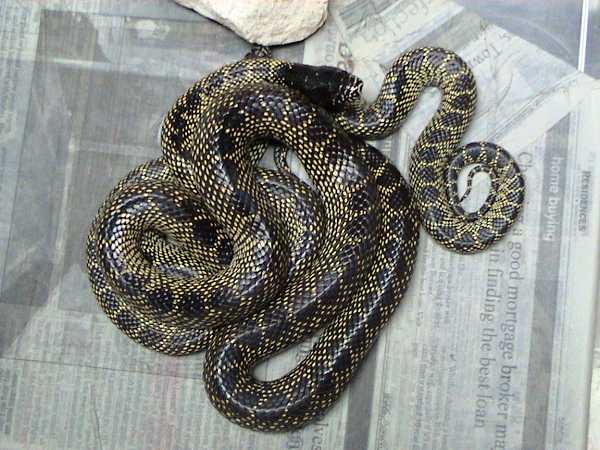
Desert Kingsnake

Desert Kingsnake

Lampropeltis splendida

The original uploader was Dawson at English Wikipedia., CC BY-SA 2.5, via Wikimedia Commons

Scarlet Kingsnake

Scarlet Kingsnake

Lampropeltis elapsoides

Glenn Bartolotti, CC BY-SA 3.0, via Wikimedia Commons

Side by side

Desert KingsnakeScarlet Kingsnake
Scientific nameLampropeltis splendida (Baird & Girard, 1853)Lampropeltis elapsoides (Holbrook, 1838)
English nameDesert KingsnakeScarlet Kingsnake
GroupReptilesReptiles
ClassReptilia ReptileReptilia Reptile
OrderSquamata SnakesSquamata Snakes
FamilyColubridae ColubridColubridae Colubrid
GenusLampropeltis KingsnakesLampropeltis Kingsnakes
Named in18531838
Red List categoryLeast ConcernLeast Concern
Countries on record2 countries4 countries
GBIF occurrence records1,996 records2,049 records

Rows where the two agree are shown in grey.

Where each is found

Both recorded in 2 countries

Only Scarlet Kingsnake (2)

From Catalogue of Life checklists and GBIF occurrence records. A country missing from a list means no record is held, which is not proof of absence.

Checked facts

Desert KingsnakeScarlet Kingsnake
Appearance
  • The dorsal surface is black or very dark brown with fine off-white or yellow speckling. English Wikipedia
  • The pale dorsal flecks form narrow, poorly defined crossbands along the vertebral region. English Wikipedia
  • The rectangular areas between the pale dorsal crossbands are black. English Wikipedia
  • Pale yellow scales may be concentrated along the lower sides of the body. English Wikipedia
  • The abdomen is mostly black in both adult and juvenile individuals, with white or pale yellow markings at the outer ends of the ventral plates. English Wikipedia
  • The dorsal scales are smooth. English Wikipedia
  • The anal plate is undivided. English Wikipedia
  • The species has alternating bands of red, black, and yellow or white that typically encircle its body. srelherp.uga.edu
  • The species has smooth scales and a small head. srelherp.uga.edu
  • Its snout is shorter and blunter than that of the scarlet snake. srelherp.uga.edu
  • Its red bands are generally narrower than those of the scarlet snake. srelherp.uga.edu
  • Hatchlings have white, black, and red bands. English Wikipedia
  • Yellow pigmentation in the bands can range from lemon yellow to apricot. English Wikipedia
  • Yellow coloration begins appearing as early as three months of age and continues developing through the first three years. English Wikipedia
Size
Habitat
  • The species may occur in any rural habitat within its geographic range. English Wikipedia
  • Despite its common name, the species is most likely to occur in mesic habitats. English Wikipedia
  • The species is particularly likely to occur near water tanks and in riparian corridors. English Wikipedia
  • The species inhabits pine flatwoods, hydric hammocks, and pine savannas. English Wikipedia
  • The species also occupies mesic pine-oak forests, prairies, cultivated fields, and suburban habitats. English Wikipedia
  • The species is commonly associated with sandy soils and pine or mixed hardwood forests in the Atlantic and Gulf Coastal Plains. srelherp.uga.edu
  • Individuals are frequently found beneath logs, bark, and debris in well-drained sandy woodlands. srelherp.uga.edu
  • The species frequently uses rotting pine stumps and loose bark on trees as refuges. srelherp.uga.edu
  • The species can inhabit barns and other human structures. srelherp.uga.edu
Diet
  • The species consumes rodents, lizards, and smaller snakes, including rattlesnakes. English Wikipedia
  • Captive or domestic individuals primarily eat mice. English Wikipedia
  • Wild individuals primarily consume other rodents. English Wikipedia
  • The species can consume reptile eggs that it detects beneath the surface using its sense of smell. English Wikipedia
  • The species can consume young diamondback rattlesnakes. English Wikipedia
  • The species primarily consumes small reptiles, particularly lizards and other snakes. srelherp.uga.edu
  • Young individuals particularly favor skinks as prey. srelherp.uga.edu
  • Adults may consume small colubrid snakes, including ringneck and pinewoods snakes. srelherp.uga.edu
  • The species can also consume mice. ncwildlife.gov
Behaviour
  • The species is a powerful constrictor. English Wikipedia
  • Individuals are docile when confronted by humans. English Wikipedia
  • Individuals that do not attempt to escape may respond to confrontation by turning onto their backs and remaining motionless. English Wikipedia
Reproduction
Distribution
  • The species is native to Texas, Arizona, and New Mexico in the United States. English Wikipedia
No checked fact yet
ConservationNo checked fact yet
  • The species remains widespread and locally common. srelherp.uga.edu
  • Urbanization and fire suppression have reduced suitable pine and scrub habitats in parts of its range. srelherp.uga.edu
  • Road mortality and persecution resulting from misidentification as a coral snake may reduce populations. srelherp.uga.edu
  • The species has a globally secure conservation status. srelherp.uga.edu
Uses
  • Some ranchers domesticate kingsnakes in the hope that they will prey on other snakes that may pose a greater threat. English Wikipedia
No checked fact yet
Similar species
  • The desert kingsnake was previously classified as a subspecies of the common kingsnake. English Wikipedia
  • The species is frequently mistaken for the scarlet snake because of their similar tricolored patterns. srelherp.uga.edu
Name originNo checked fact yet
  • The genus name Lampropeltis derives from Ancient Greek words meaning shiny and shield. English Wikipedia

In brief

Desert Kingsnake

Lampropeltis splendida is native to Texas, Arizona, and New Mexico in the United States. It is marked by a black or very dark brown dorsal surface with fine pale speckling that forms narrow, poorly defined crossbands. Full profile

Scarlet Kingsnake

Lampropeltis elapsoides inhabits pine flatwoods, hydric hammocks, pine savannas, mesic pine-oak forests, prairies, cultivated fields, and suburban habitats. It is marked by alternating bands of red, black, and yellow or white that typically encircle its body. Full profile

Compare something else

Page built on 29 November 2026 from the data on the two species pages, where every source is listed.

Cite this page

ScientificNames.org. (2026). Desert Kingsnake vs Scarlet Kingsnake. Retrieved November 29, 2026, from https://scientificnames.org/compare/desert-kingsnake-vs-scarlet-kingsnake