Species · Reptiles
Scarlet Kingsnake Lampropeltis elapsoides
The scientific name of the Scarlet Kingsnake is Lampropeltis elapsoides. It is a species of reptile in the family Colubridae (colubrid), order Squamata. The name dates from 1838.
- Scientific name
- Lampropeltis elapsoides (Holbrook, 1838)
- Common name
- Scarlet Kingsnake
- Genus
- Lampropeltis
- Family
- Colubridae (Colubrid)
- Order
- Squamata
- Class
- Reptilia
- Red List category
- LC Least Concern
- Recorded in
- 4 countries
- Name status
- accepted in the Catalogue of Life

Overview
Lampropeltis elapsoides inhabits pine flatwoods, hydric hammocks, pine savannas, mesic pine-oak forests, prairies, cultivated fields, and suburban habitats. It is marked by alternating bands of red, black, and yellow or white that typically encircle its body.
Written 26 November 2026 from the sources listed below. Each statement was checked against the passage it cites; statements that could not be supported were removed.
Conservation
The Scarlet Kingsnake remains widespread and locally common and has a globally secure conservation status.[1][2]
Urbanization and fire suppression have reduced suitable pine and scrub habitats in parts of its range. Road mortality and persecution resulting from misidentification as a coral snake may reduce populations.[3][4]
Similar species
The Scarlet Kingsnake is frequently mistaken for the scarlet snake because of their similar tricolored patterns. Its snout is shorter and blunter, and its red bands are generally narrower than those of the scarlet snake.[5][6][7]
Appearance
The Scarlet Kingsnake has alternating bands of red, black, and yellow or white that typically encircle its body. It has smooth scales and a small head.[8][9]
Hatchlings have white, black, and red bands. Yellow pigmentation can range from lemon yellow to apricot.[10][11]
Yellow coloration begins appearing as early as three months of age and continues developing through the first three years.[12]
Adults typically measure 40–50 cm in length, with a maximum recorded length of 76.2 cm. Hatchlings measure approximately 8–18 cm in length.[13][14][15]
Habitat
The Scarlet Kingsnake inhabits pine flatwoods, hydric hammocks, and pine savannas. It also occupies mesic pine-oak forests, prairies, cultivated fields, and suburban habitats.[16][17]
The species is commonly associated with sandy soils and pine or mixed hardwood forests in the Atlantic and Gulf Coastal Plains. Individuals are frequently found beneath logs, bark, and debris in well-drained sandy woodlands.[18][19]
The species frequently uses rotting pine stumps and loose bark on trees as refuges. It can also inhabit barns and other human structures.[20][21]
Diet
The Scarlet Kingsnake primarily consumes small reptiles, particularly lizards and other snakes. Young individuals particularly favor skinks as prey.[22][23]
Adults may consume small colubrid snakes, including ringneck and pinewoods snakes. The species can also consume mice.[24][25]
Behaviour
The Scarlet Kingsnake is primarily fossorial, secretive, and largely nocturnal. Individuals may emerge on warm, humid nights during spring and early summer.[26][27][28]
The species may cross roads after rainfall when the soil becomes oversaturated. Individuals are capable of climbing trees and shrubs and are excellent climbers.[29][30][31]
The species is nonvenomous and captures prey by constriction.[32][33]
Reproduction and life cycle
The Scarlet Kingsnake is oviparous. Mating occurs from late May to early June.[34][35]
Females lay eggs during June and July, producing clutches containing four to twelve eggs. Eggs are commonly deposited beneath rotting wood and between rocks and logs.[36][37][38]
Egg incubation typically lasts 40–65 days, and hatchlings emerge in late summer.[39][40]
Classification of the Scarlet Kingsnake
| Kingdom | Animalia |
|---|---|
| Phylum | Chordata |
| Subphylum | Vertebrata |
| Infraphylum | Gnathostomata |
| Parvphylum | Osteichthyes |
| Megaclass | Tetrapoda |
| Class | Reptilia (Reptile) |
| Order | Squamata (Snakes) |
| Suborder | Serpentes (Snakes) |
| Infraorder | Alethinophidia |
| Family | Colubridae (Colubrid) |
| Subfamily | Colubrinae |
| Genus | Lampropeltis (Kingsnakes) |
| Species | Lampropeltis elapsoides (Holbrook, 1838) |
Where the Scarlet Kingsnake is found
Checklists and occurrence records place Lampropeltis elapsoides in 4 countries across North America. GBIF holds 2,049 georeferenced records of it.
Countries
Regions and cities with the most records
- Florida, United States 887
- Sanford, United States 117
- Winter Springs, United States 111
- Lake Mary, United States 110
- Oviedo, United States 99
- Casselberry, United States 96
- South Carolina, United States 84
- Alafaya, United States 83
- North Carolina, United States 80
- Altamonte Springs, United States 79
- Maitland, United States 71
- Winter Park, United States 71
- Georgia, United States 70
- Gainesville, United States 60
- DeBary, United States 50
- Deltona, United States 48
- Alabama, United States 45
- Wekiwa Springs, United States 33
- DeLand, United States 29
- Fruit Cove, United States 26
- Tallahassee, United States 26
- Fleming Island, United States 25
- Ponte Vedra Beach, United States 25
- Lakeside, United States 24
- Titusville, United States 24
- Palm Valley, United States 23
- Jacksonville, United States 21
- Jacksonville Beach, United States 21
- Oakleaf Plantation, United States 19
- Ocala, United States 16
- Ormond Beach, United States 16
- Bradenton, United States 14
- Kissimmee, United States 14
- Lake Magdalene, United States 14
- Land O' Lakes, United States 14
- Lutz, United States 14
Range as the checklists state it
USA (N Virginia, North Carolina, South Carolina, S Florida (incl. St. George Island, Apalachicola Island [HR 31: 114]), Mississippi, Alabama, Tennessee, S Kentucky)
A number beside a place is its count of GBIF occurrence records. A place without a number comes from a checklist alone. Records show where a species has been observed or collected, which can include escapes and vagrants.
Common names
English
- Scarlet Kingsnake
- Scarlet Milksnake
Names in 6 other languages
- German
- Rote Königsnatter, Scarlet-Königsnatter, Scharlachrote Milchschlange
- Italian
- Falso corallo scarlatto, Serpente del latte scarlatto
- Russian
- Молочная змея
- Spanish
- Falsa coralillo escarlata, Falsa coralillo real escarlata
- Ukrainian
- Королівська змія червона
- nav
- Haʼaʼaahdę́ę́ʼ tłʼiish łichííʼ dóó łigaaígíí
Synonyms
9 other scientific names have been used for this species and are now treated as synonyms of Lampropeltis elapsoides.
- Coluber doliatus Linnaeus
- Coluber elapsoides Holbrook, 1838
- Coronella doliata Holbrook, 1842
- Lampropeltis doliata (Linnaeus, 1766)
- Lampropeltis doliata temporalis Cope, 1893
- Lampropeltis triangulum elapsoides (Holbrook, 1838)
- Lampropeltis triangulum temporalis Cope, 1893
- Lampropeltis triangulum virginiana Blanchard, 1920
- Ophibolus doliatus temporalis Cope, 1893
Related species
-
 Milk SnakeLampropeltis triangulum
-
 California KingsnakeLampropeltis californiae
-
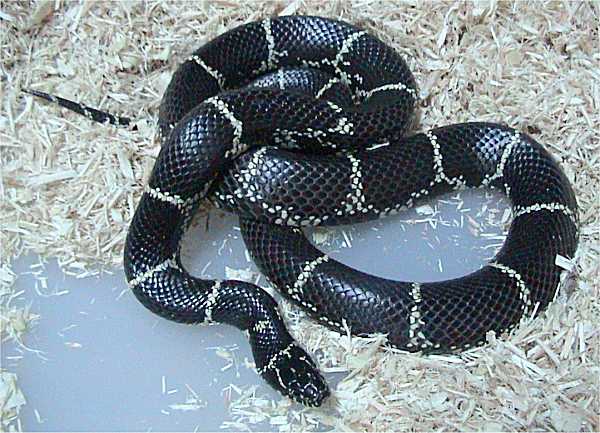 Common KingsnakeLampropeltis getula
-
 Speckled KingsnakeLampropeltis holbrooki
-
 California Mountain KingsnakeLampropeltis zonata
-
 Black KingsnakeLampropeltis nigra
-
 Prairie KingsnakeLampropeltis calligaster
-
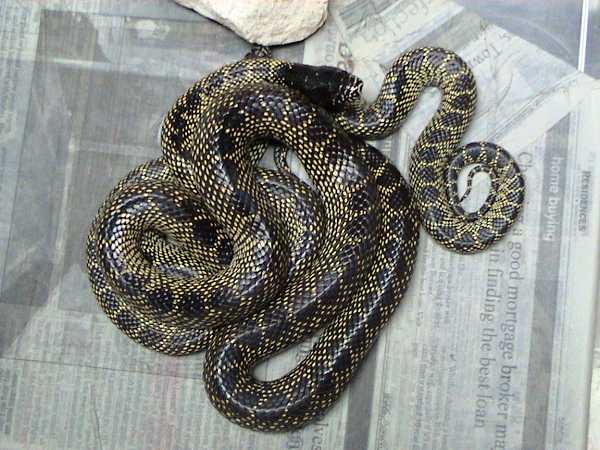 Desert KingsnakeLampropeltis splendida
Compare
Questions and answers
What is the scientific name of the Scarlet Kingsnake?
The scientific name of the Scarlet Kingsnake is Lampropeltis elapsoides. Written with its author, the full name is Lampropeltis elapsoides (Holbrook, 1838).
Which family does the Scarlet Kingsnake belong to?
Lampropeltis elapsoides belongs to the family Colubridae, in the order Squamata and the class Reptilia.
Where is the Scarlet Kingsnake found?
Checklists and occurrence records place Lampropeltis elapsoides in 4 countries: United States, Mexico, Guatemala and Canada.
What is the conservation status of the Scarlet Kingsnake?
The IUCN Red List category recorded for Lampropeltis elapsoides is Least Concern (LC).
What other names does the Scarlet Kingsnake have?
Lampropeltis elapsoides is also known in English as Scarlet Milksnake.
Are scarlet kingsnakes rare?
The Scarlet Kingsnake remains widespread and locally common and has a globally secure conservation status.[1][2]
Is there a difference between a scarlet snake and a scarlet king snake?
The Scarlet Kingsnake and the scarlet snake have similar tricolored patterns and are frequently mistaken for each other. The Scarlet Kingsnake has a shorter, blunter snout and generally narrower red bands.[5][6][7]
Are scarlet kingsnakes poisonous?
The Scarlet Kingsnake is nonvenomous.[32]
Why are king snakes called kingsnakes?
The genus name Lampropeltis derives from Ancient Greek words meaning shiny and shield.[41]
What does the scarlet king snake eat?
The Scarlet Kingsnake primarily consumes small reptiles, particularly lizards and other snakes. Young individuals particularly favor skinks, while adults may consume small colubrid snakes, including ringneck and pinewoods snakes. It can also consume mice.[22][23][24][25]
Sources
Passages the profile rests on
- The species remains widespread and locally common. Source passage: “This species remains widespread and locally common” — srelherp.uga.edu
- The species has a globally secure conservation status. Source passage: “scarlet kingsnakes have global statuses of globally secure” — srelherp.uga.edu
- Urbanization and fire suppression have reduced suitable pine and scrub habitats in parts of its range. Source passage: “Habitat loss through urbanization and fire suppression has reduced suitable pine and scrub habitats in parts of its range.” — srelherp.uga.edu
- Road mortality and persecution resulting from misidentification as a coral snake may reduce populations. Source passage: “Populations may also decline because of road mortality and human persecution when misidentified as a coral snake.” — srelherp.uga.edu
- Its snout is shorter and blunter than that of the scarlet snake. Source passage: “scarlet kingsnakes have shorter, more blunt snouts” — srelherp.uga.edu
- Its red bands are generally narrower than those of the scarlet snake. Source passage: “the red bands of scarlet kingsnakes are generally narrower compared to the broader red bands of a scarlet snake” — srelherp.uga.edu
- The species is frequently mistaken for the scarlet snake because of their similar tricolored patterns. Source passage: “This tri-colored pattern closely resembles that of the scarlet snake (Cemophora coccinea), leading to frequent misidentifications.” — srelherp.uga.edu
- The species has alternating bands of red, black, and yellow or white that typically encircle its body. Source passage: “Its body is typically encircled by alternating bands of red, black, and yellow/white.” — srelherp.uga.edu
- The species has smooth scales and a small head. Source passage: “with smooth scales and small heads.” — srelherp.uga.edu
- Hatchlings have white, black, and red bands. Source passage: “Scarlet kingsnakes are born with white, black, and red banding.” — English Wikipedia
- Yellow pigmentation in the bands can range from lemon yellow to apricot. Source passage: “The yellow pigmentation varies from lemon, to school-bus yellow, to tangerine, to apricot.” — English Wikipedia
- Yellow coloration begins appearing as early as three months of age and continues developing through the first three years. Source passage: “Early expression of yellowing appears as early as 3 months and continues through the first 3 years.” — English Wikipedia
- Adults typically measure 40–50 cm in length. Source passage: “usually ranging from 40 to 50 cm (16 to 20 in) at maturity.” — English Wikipedia
- The maximum recorded length is 76.2 cm. Source passage: “The maximum recorded length is in Jonesboro, AR 76.2 cm (30.0 in).” — English Wikipedia
- Hatchlings measure approximately 8–18 cm in length. Source passage: “Hatchlings range in size from 8 to 18 cm (3.1 to 7.1 in).” — English Wikipedia
- The species inhabits pine flatwoods, hydric hammocks, and pine savannas. Source passage: “They are found in pine flatwoods, hydric hammocks, pine savannas” — English Wikipedia
- The species also occupies mesic pine-oak forests, prairies, cultivated fields, and suburban habitats. Source passage: “mesic pine-oak forests, prairies, cultivated fields, and a variety of suburban habitats” — English Wikipedia
- The species is commonly associated with sandy soils and pine or mixed hardwood forests in the Atlantic and Gulf Coastal Plains. Source passage: “where sandy soils and pine or mixed hardwood forests dominate.” — srelherp.uga.edu
- Individuals are frequently found beneath logs, bark, and debris in well-drained sandy woodlands. Source passage: “Most individuals are encountered beneath logs, bark, or debris in well-drained, sandy woodlands” — srelherp.uga.edu
- The species frequently uses rotting pine stumps and loose bark on trees as refuges. Source passage: “Individuals are frequently observed climbing into rotting pine stumps, scaling shrubs, and climbing several feet up trees underneath loose bark.” — srelherp.uga.edu
- The species can inhabit barns and other human structures. Source passage: “they can be encountered in barns and human structures where they are attracted by suitable cover, and diverse prey items.” — srelherp.uga.edu
- The species primarily consumes small reptiles, particularly lizards and other snakes. Source passage: “Scarlet kingsnakes feed primarily on small reptiles, especially lizards and other snakes.” — srelherp.uga.edu
- Young individuals particularly favor skinks as prey. Source passage: “Young individuals are avid lizard eaters, particularly favoring skinks.” — srelherp.uga.edu
- Adults may consume small colubrid snakes, including ringneck and pinewoods snakes. Source passage: “Adults may also take small snakes, including other colubrid (e.g. ringneck, pinewoods snakes).” — srelherp.uga.edu
- The species can also consume mice. Source passage: “They are constrictors and eat small snakes, lizards, and mice.” — ncwildlife.gov
- The species is primarily fossorial. Source passage: “These largely fossorial snakes” — English Wikipedia
- The species is secretive and largely nocturnal. Source passage: “Scarlet kingsnakes are secretive and largely nocturnal” — srelherp.uga.edu
- Individuals may emerge on warm, humid nights during spring and early summer. Source passage: “often surfacing on warm, humid nights in spring and early summer.” — srelherp.uga.edu
- The species may cross roads after rainfall when the soil becomes oversaturated. Source passage: “They may also be seen crossing roads after rain when soil becomes oversaturated.” — srelherp.uga.edu
- Individuals are capable of climbing trees and shrubs. Source passage: “scaling shrubs, and climbing several feet up trees underneath loose bark.” — srelherp.uga.edu
- Individuals are excellent climbers. Source passage: “They are excellent climbers.” — English Wikipedia
- The species is nonvenomous. Source passage: “Like all kingsnakes, they are nonvenomous.” — English Wikipedia
- The species captures prey by constriction. Source passage: “They are constrictors” — ncwildlife.gov
- The species mates from late May to early June. Source passage: “They mate from late May to early June” — English Wikipedia
- The species is oviparous. Source passage: “Lampropeltis elapsoides is an oviparous species of snake” — English Wikipedia
- Females lay eggs during June and July. Source passage: “females lay eggs in June and July.” — English Wikipedia
- Females produce clutches containing four to twelve eggs. Source passage: “lays eggs in clutches of 4-12” — English Wikipedia
- Eggs are commonly deposited beneath rotting wood and between rocks and logs. Source passage: “usually under rotting wood and between rocks and logs.” — English Wikipedia
- Egg incubation typically lasts 40–65 days. Source passage: “Females have multiple egg clutches that incubate for 40–65 days.” — English Wikipedia
- Hatchlings emerge in late summer. Source passage: “Hatchlings emerge in late summer” — srelherp.uga.edu
- The genus name Lampropeltis derives from Ancient Greek words meaning shiny and shield. Source passage: “The generic name, Lampropeltis, is derived from the Ancient Greek lamprós (λαμπρος) meaning "shiny" and peltas (πελτας) meaning "shield"” — English Wikipedia
Data
- Catalogue of Life, 2026-10-16 XR cc by
- Global Biodiversity Information Facility CC BY 4.0
- Wikidata CC0
- GeoNames CC BY 4.0
- Wikimedia Commons per image; credit shown with each image
- Within the Catalogue of Life, this name comes from The Reptile Database cc by
References
- Holbrook, John E. (1838). North American Herpetology, Vol. 2 (1st ed.). J. Dobson, Philadelphia, 130 Pp.
- Holbrook, John E. (1842). North American Herpetology; or, A description of the reptiles inhabiting the United States. Vol II (2nd ed.). J. Dobson, Philadelphia, 142 Pp.
- Holbrook, John E. (1842). North American Herpetology; or, A description of the reptiles inhabiting the United States. Vol I (2nd ed.). J. Dobson, Philadelphia, 152 Pp.
- Baird, S. F. and C. Girard. (1853). Catalogue of North American Reptiles in the Museum of the Smithsonian Institution. Part 1.-Serpents. Smithsonian Inst., Washington, Xvi + 172 Pp.
- Duméril, A.M.C., G. BIBRON & A.H.A. DUMÉRIL. (1854). Erpétologie générale ou Histoire Naturelle complète des Reptiles. Vol. 7 (partie 1). Paris, Xvi + 780 S.
- Cope, E. D. (1860). Catalogue of the Colubridae in the Museum of the Academy of Natural Sciences of Philadelphia, with notes and descriptions of new species. Part II. Proc. Acad. Nat. Sci. Philadelphia 12: 241-266.
- Jan, G. (1865). Iconographie générale des ophidiens. 14. Livraison. [Elapomorphus d’Orbignyi, Coronella getulus var. Sayi]. J.B. Bailière et Fils, Paris.
- Yarrow, H. C. (1882). Check List of North American Reptilia and Batrachia, with Catalogue of Specimens in U. S. National Museum. Bull. US Natl. Mus. 24: 249.
- Cope, E. D. (1893). The Color Variations of the Milk Snake. American Naturalist 27 (324): 1066-1071.
- Cope, E. D. (1900). The crocodilians, lizards and snakes of North America. Ann. Rep. U.S. Natl. Mus. 1898: 153-1270.
- Largelamb, H. A. (1907). Notes on the remarkable habits of certain turtles and lizards. National Geographic 18(6):413-419.
- Blanchard, Frank N. (1920). Three new snakes of the genus Lampropeltis. Occasional Papers of the Museum of Zoology, University of Michigan (81): 1-10.
- Blanchard, Frank N. (1920). A synopsis of the king snakes: Genus Lampropeltis Fitzinger. Occasional Papers of the Museum of Zoology, University of Michigan (87): 1-7.
- Brimley, C. S. (1920). Notes on Lampropeltis elapsoides virginiana Blanchard. Copeia 89: 106-109.
- Blanchard, Frank N. (1921). A revision of the king snakes: genus Lampropeltis. Bull. US Natl. Mus. (114): 1-260.
- Allen, Morrow J. (1932). A survey of the Amphibians and reptiles of Harrison County, Mississippi. American Museum Novitates (542): 1-20.
- Cochran, Doris M. (1961). Type specimens of reptiles and amphibians in the United States National Museum. [type catalogue]. Bull. US Natl. Mus. (220): Xvi + 291 Pp.
- Denzer, W. (1986). Die Herpetofauna Südfloridas, Teil 2: Die natürlichen Amphibien - und Reptilienpopulationen nearktischen Ursprungs. Sauria 8 (3): 23-26.
- Mehrtens, J. M. (1987). Living snakes of the world in color. Sterling Publ. Co., Hic., New York, NY: 480 Pp.
- Williams, K. L. (1988). Systematics and natural history of the American milk snake Lampropeltis triangulum. 2nd ed. Milwaukee Publ. Mus. Contrib. Biol. Geol.
- Conant, R., & Collins, J. T. (1991). A Field Guide to Reptiles and Amphibians of Eastern/Central North America, 3rd ed. Houghton Mifflin (Boston/New York), Xx + 450 P.
- Williams K L. (1994). Lampropeltis triangulum (Lacepede), milk snake. Catalogue of American Amphibians and Reptiles 594: 1-10.
- Tennant, A., & Bartlett, R. D. (2000). Snakes of North America - Eastern and Central Regions. Gulf Publishing, Houston, TX, 588 Pp.
- Mattison, & Chris. (2007). The New Encyclopedia of Snakes. Princeton University Press.
- Jensen, John B.; Carlos D. Camp, Whit Gibbons, & Matt J. Elliott. (2008). Amphibians and reptiles of Georgia. University of Georgia Press, 575 Pp.
This species in other databases
Page built on 27 November 2026. See how the catalog is made and all sources and licences.
Cite this page
ScientificNames.org. (2026). Lampropeltis elapsoides (Scarlet Kingsnake). Retrieved November 27, 2026, from https://scientificnames.org/species/lampropeltis-elapsoides
“Lampropeltis elapsoides (Scarlet Kingsnake).” ScientificNames.org, 2026, scientificnames.org/species/lampropeltis-elapsoides. Accessed 27 Nov. 2026.
ScientificNames.org. “Lampropeltis elapsoides (Scarlet Kingsnake).” Accessed November 27, 2026. https://scientificnames.org/species/lampropeltis-elapsoides.
@misc{scientificnames_lampropeltis_elapsoides_scarlet_kingsnake,
  author = {{ScientificNames.org}},
  title = {Lampropeltis elapsoides (Scarlet Kingsnake)},
  year = {2026},
  url = {https://scientificnames.org/species/lampropeltis-elapsoides},
  note = {Accessed 2026-11-27}
}