Species · Reptiles
Desert Kingsnake Lampropeltis splendida
The scientific name of the Desert Kingsnake is Lampropeltis splendida. It is a species of reptile in the family Colubridae (colubrid), order Squamata. The name dates from 1853.
- Scientific name
- Lampropeltis splendida (Baird & Girard, 1853)
- Common name
- Desert Kingsnake
- Genus
- Lampropeltis
- Family
- Colubridae (Colubrid)
- Order
- Squamata
- Class
- Reptilia
- Red List category
- LC Least Concern
- Recorded in
- 2 countries
- Name status
- accepted in the Catalogue of Life
Overview
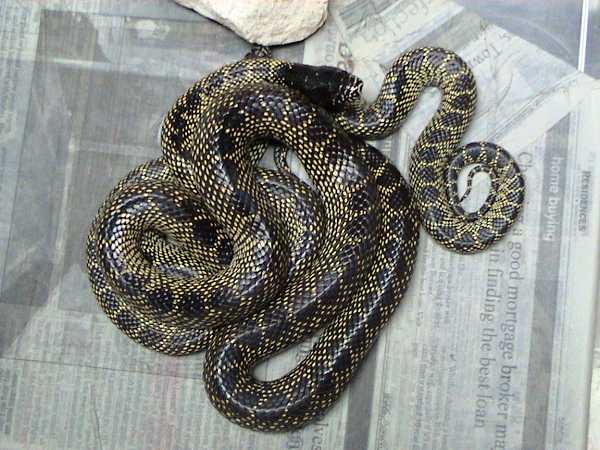
The desert kingsnake (Lampropeltis splendida) is a species of kingsnake native to Texas, Arizona, and New Mexico, United States. It is not venomous, colored yellow and black. The desert kingsnake's diet consists of rodents, lizards, and smaller snakes, including rattlesnakes. They normally grow 3–4 ft long, but have been known to grow up to 6.8 ft. They are docile creatures when confronted by humans.
Classification of the Desert Kingsnake
| Kingdom | Animalia |
|---|---|
| Phylum | Chordata |
| Subphylum | Vertebrata |
| Infraphylum | Gnathostomata |
| Parvphylum | Osteichthyes |
| Megaclass | Tetrapoda |
| Class | Reptilia (Reptile) |
| Order | Squamata (Snakes) |
| Suborder | Serpentes (Snakes) |
| Infraorder | Alethinophidia |
| Family | Colubridae (Colubrid) |
| Subfamily | Colubrinae |
| Genus | Lampropeltis (Kingsnakes) |
| Species | Lampropeltis splendida (Baird & Girard, 1853) |
Where the Desert Kingsnake is found
Checklists and occurrence records place Lampropeltis splendida in 2 countries across North America. GBIF holds 1,996 georeferenced records of it.
Countries
Regions and cities with the most records
- Arizona, United States 602
- New Mexico, United States 497
- Texas, United States 481
- Casas Adobes, United States 154
- Catalina Foothills, United States 152
- Tucson, United States 141
- Oro Valley, United States 131
- Sonora, Mexico 47
- Chihuahua, Mexico 38
- Las Cruces, United States 22
- Coahuila, Mexico 17
- Midland, United States 13
- Nuevo León, Mexico 13
- San Angelo, United States 13
- San Antonio, United States 13
- Nogales, Mexico 12
- Albuquerque, United States 11
- Durango, Mexico 9
- Lubbock, United States 9
- Agua Prieta, Mexico 7
- Hermosillo, Mexico 7
- Roswell, United States 7
- Wichita Falls, United States 7
- Zacatecas, Mexico 7
- Chihuahua, Mexico 5
- Ciudad Juárez, Mexico 5
- Corpus Christi, United States 5
- El Paso, United States 5
- New Braunfels, United States 5
- San Luis Potosí, Mexico 4
- Sinaloa, Mexico 4
- Victoria de Durango, Mexico 4
- Rio Rancho, United States 3
- San Pedro, Mexico 3
Range as the checklists state it
USA (C Texas to SE Arizona; isolated records from N New Mexico and S Colorado), NC Mexico (incl. San Luis Potosi, Durango, Tamaulipas, Chihuahua, Nuevo León, Coahuila, Zacatecas); .
A number beside a place is its count of GBIF occurrence records. A place without a number comes from a checklist alone. Records show where a species has been observed or collected, which can include escapes and vagrants.
Common names
English
- Desert Kingsnake
Names in 4 other languages
- Czech
- korálovka pruhovaná pouštní
- Dutch
- Mexicaanse zwarte koningsslang
- German
- Wüsten-Königsnatter, Wüstenkettennatter
- Spanish
- Barila de Desierto, Culebra real del desierto, Falsa coralillo real del desierto
Synonyms
2 other scientific names have been used for this species and are now treated as synonyms of Lampropeltis splendida.
- Lampropeltis getula splendida (Baird & Girard, 1853)
- Ophibolus splendidus Baird & Girard, 1853
Related species
-
 Milk SnakeLampropeltis triangulum
-
 California KingsnakeLampropeltis californiae
-
 Scarlet KingsnakeLampropeltis elapsoides
-
 Common KingsnakeLampropeltis getula
-
 Speckled KingsnakeLampropeltis holbrooki
-
 California Mountain KingsnakeLampropeltis zonata
-
 Black KingsnakeLampropeltis nigra
-
 Prairie KingsnakeLampropeltis calligaster
Compare
Questions and answers
What is the scientific name of the Desert Kingsnake?
The scientific name of the Desert Kingsnake is Lampropeltis splendida. Written with its author, the full name is Lampropeltis splendida (Baird & Girard, 1853).
Which family does the Desert Kingsnake belong to?
Lampropeltis splendida belongs to the family Colubridae, in the order Squamata and the class Reptilia.
Where is the Desert Kingsnake found?
Checklists and occurrence records place Lampropeltis splendida in 2 countries: United States and Mexico.
What is the conservation status of the Desert Kingsnake?
The IUCN Red List category recorded for Lampropeltis splendida is Least Concern (LC).
Sources
Data
- Catalogue of Life, 2026-10-16 XR cc by
- Global Biodiversity Information Facility CC BY 4.0
- Wikidata CC0
- English Wikipedia CC BY-SA 4.0
- GeoNames CC BY 4.0
- Wikimedia Commons per image; credit shown with each image
- Within the Catalogue of Life, this name comes from The Reptile Database cc by
References
- Baird, S. F. and C. Girard. (1853). Catalogue of North American Reptiles in the Museum of the Smithsonian Institution. Part 1.-Serpents. Smithsonian Inst., Washington, Xvi + 172 Pp.
- Jan, G. (1865). Iconographie générale des ophidiens. 12. Livraison. J.B. Bailière et Fils, Paris.
- Jan, G. (1865). Iconographie générale des ophidiens. 14. Livraison. [Elapomorphus d’Orbignyi, Coronella getulus var. Sayi]. J.B. Bailière et Fils, Paris.
- Cope, E. D. (1900). The crocodilians, lizards and snakes of North America. Ann. Rep. U.S. Natl. Mus. 1898: 153-1270.
- Van Denburgh, John and Joseph R. Slevin. (1913). A list of the amphibians and reptiles of Arizona, with notes on the species in the collection of the Academy. Proc. Cal. Acad. Sci. 3 (13): 391-454.
- Blanchard, Frank N. (1920). A synopsis of the king snakes: Genus Lampropeltis Fitzinger. Occasional Papers of the Museum of Zoology, University of Michigan (87): 1-7.
- Blanchard, Frank N. (1921). A revision of the king snakes: genus Lampropeltis. Bull. US Natl. Mus. (114): 1-260.
- Jameson, David H.;Flury, Alvin G. (1949). The reptiles and amphibians of the Sierra Vieja Range of southwestern Texas. Texas Journal of Science 1 (2): 54-77.
- Taylor, Edward H. (1952). Third contribution of the herpetology of the Mexican state of San Luis Potosí. Univ. Kansas Sci. Bull. 34 (13): 793-815.
- Blaney, Richard M. (1977). Systematics of the common kingsnake, Lampropeltis getulus (Linnaeus). Tulane Studies in Zoology and Botany 19 (3-4): 47-103.
- Webb, R. G. (1984). Herpetogeography in the Mazatlán-Durango Region of the Sierra Madre Occidental, Mexico. Vetrebrate Ecology and Systematics - A Ribute to Henry S. Fitch; Museum of Natural History, University of Kansas, Lawrence, Pp. 217-241.
- Tanner, Wilmer W. (1985). Snakes of Western Chihuahua. Great Basin Naturalist 45 (4): 615-676.
- Dixon, James R. (2000). Amphibians and reptiles of Texas, second edition. Texas A&M University Press, 421 Pp.
- Werler, John E. & James R. Dixon. (2000). Texas Snakes. University of Texas Press, 544 Pages.
- Tennant, A., & Bartlett, R. D. (2000). Snakes of North America - Eastern and Central Regions. Gulf Publishing, Houston, TX, 588 Pp.
- Pyron, R. Alexander; Frank T. Burbrink. (2009). LINEAGE DIVERSIFICATION IN A WIDESPREAD SPECIES: ROLES FOR NICHE DIVERGENCE AND CONSERVATISM IN THE COMMON KINGSNAKE, LAMPROPELTIS GETULA. Molecular Ecology 18: 3443–3457.
- Pyron, R. Alexander; Frank T. Burbrink. (2009). Systematics of the Common Kingsnake (Lampropeltis getula; Serpentes: Colubridae) and the burden of heritage in taxonomy. Zootaxa 2241: 22-32.
- Crother, B. I. (ed.). (2012). Standard Common and Current Scientific Names for North American Amphibians, Turtles, Reptiles, and Crocodilians, Seventh Edition. Herpetological Circular 39: 1-92.
- Lemos-Espinal, Julio A. and James R. Dixon. (2013). Amphibians and Reptiles of San Luis Potosí. Eagle Mountain Publishing, Xii + 300 Pp.
- Laita, & Mark. (2013). Serpentine. Abrams and PQ Blackwell, Auckland, New Zealand, 200 Unnumbered Pages.
- Carbajal-Márquez, Rubén A., Zaira Y. González-Saucedo, Gustavo Quintero-Diaz and Martín Lara. (2013). Lampropeltis splendida (desert kingsnake) diet. Herpetological Review 44 (4): 692.
- Root, Shaun T. and Darrell Ahlers. (2013). Lampropeltis splendida (desert kingsnake) diet. Herpetological Review 44 (3): 523-524.
- Wallach, Van; Kenneth L. Williams, Jeff Boundy. (2014). Snakes of the World: A Catalogue of Living and Extinct Species. [type catalogue]. Taylor and Francis, CRC Press, 1237 Pp.
- Kasper, Stephen. (2014). Geographical Distribution: Lampropeltis splendida (desert kingsnake). Herpetological Review 45 (4): 664.
- Terán-Juárez, Sergio A., Elí García Padilla, Vicente Mata-Silva, Jerry D. Johnson and Larry David Wilson. (2016). The herpetofauna of Tamaulipas, Mexico: composition, distribution, and conservation status. Mesoamerican Herpetology 3 (1): 43–113.
This species in other databases
Page built on 25 November 2026. See how the catalog is made and all sources and licences.
Cite this page
ScientificNames.org. (2026). Lampropeltis splendida (Desert Kingsnake). Retrieved November 25, 2026, from https://scientificnames.org/species/lampropeltis-splendida
“Lampropeltis splendida (Desert Kingsnake).” ScientificNames.org, 2026, scientificnames.org/species/lampropeltis-splendida. Accessed 25 Nov. 2026.
ScientificNames.org. “Lampropeltis splendida (Desert Kingsnake).” Accessed November 25, 2026. https://scientificnames.org/species/lampropeltis-splendida.
@misc{scientificnames_lampropeltis_splendida_desert_kingsnake,
  author = {{ScientificNames.org}},
  title = {Lampropeltis splendida (Desert Kingsnake)},
  year = {2026},
  url = {https://scientificnames.org/species/lampropeltis-splendida},
  note = {Accessed 2026-11-25}
}